Chicken Breasts Per Pound Calculator
Estimate breasts per pound, total raw weight, edible cooked yield, chopped or shredded cups, serving count, and extra breasts needed from count, size, bone state, trim, serving style, cup target, and yield.
🍗Chicken Breast Presets
Choose a real kitchen scenario, then adjust the count, breast size, bone state, raw or cooked entry, trim, serving style, cup target, and yield.
⚖Chicken Breast Inputs
Chicken breast estimate
Your chicken breast estimate appears here.
Count And Weight
Yield And Servings
Target Check
📌Quick Breast Count Grid
🔍Breast Size Comparison Grid
Thin pieces for fast skillet meals and light portions.
The most common grocery math for everyday dinners.
Good for slicing, stuffing, or splitting into two meals.
Big breasts often need portioning before cooking.
Small cut pieces cook quickly and shrink a little faster.
Useful when breast strips are sold in smaller pieces.
Best handled by weight because piece sizes vary.
Bone-in packs look heavy but yield fewer cooked cups.
📊Breasts Per Pound Table
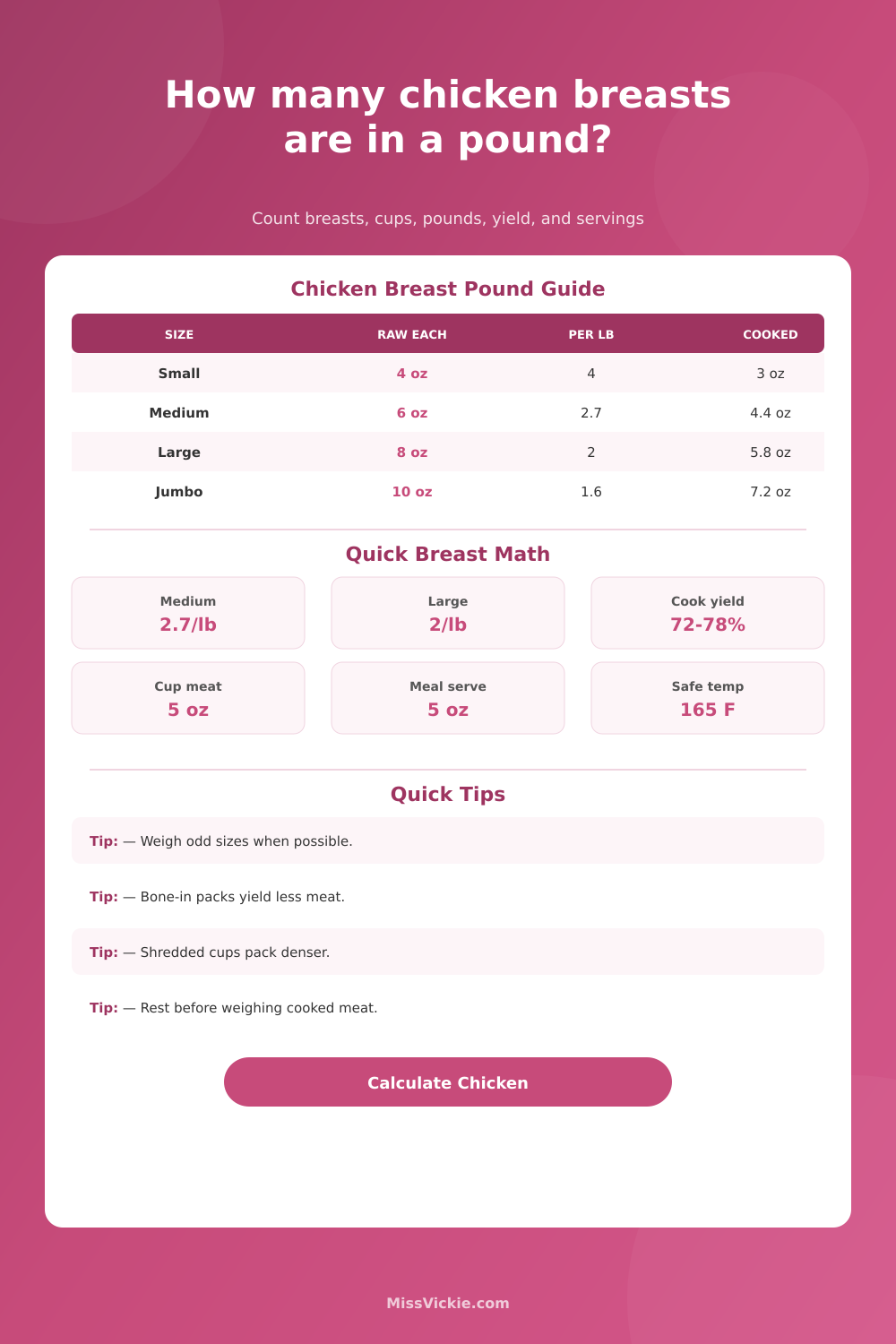
| Breast size | Typical raw weight | Breasts per pound | Cooked edible per piece | Best use |
|---|---|---|---|---|
| Small thin breast | 3.5 to 4.5 oz / 100 to 128 g | 3.6 to 4.6 | 2.5 to 3.2 oz | Fast meals, salads, light plates |
| Medium grocery breast | 5.5 to 6.5 oz / 156 to 184 g | 2.5 to 2.9 | 4.0 to 4.8 oz | Dinner portions and meal prep |
| Large breast | 7 to 9 oz / 198 to 255 g | 1.8 to 2.3 | 5.0 to 6.7 oz | Slicing, bowls, casseroles |
| Jumbo breast | 9.5 to 11.5 oz / 269 to 326 g | 1.4 to 1.7 | 6.8 to 8.5 oz | Splitting for hearty portions |
| Bone-in split breast | 12 to 16 oz / 340 to 454 g | 1.0 to 1.3 | 5.5 to 8 oz edible | Roasting, soup meat, carving |
🍛Cooked Cup Yield Table
| Serving style | Cooked weight per cup | Typical serving | Best estimate | Planning note |
|---|---|---|---|---|
| Whole breast portions | Not cup based | 5 oz cooked | 1 medium breast each | Use weight and count for plate service. |
| Sliced dinner meat | 4.8 oz per cup | 5 oz cooked | About 1 cup per serving | Loose slices leave more air in the cup. |
| Diced bowl meat | 5.2 oz per cup | 5 oz cooked | About 1 cup per serving | Best for rice bowls and pasta. |
| Shredded taco meat | 4.5 oz per cup | 3.5 to 4.5 oz | 1 cup fills 2 to 3 tacos | Fluffy shreds measure lighter. |
| Chopped salad meat | 5.4 oz per cup | 3 to 4 oz cooked | Use for cold salads | Chopping packs denser than slices. |
| Soup or casserole meat | 5.0 oz per cup | 4 to 5 oz cooked | Good recipe cup baseline | Drain before measuring if broth is separate. |
🧪Raw To Cooked Yield Table
| Setup | Edible raw basis | Cooked yield | Breast count effect | Kitchen note |
|---|---|---|---|---|
| Boneless skinless breast | Nearly all edible after trim | 70 to 78% | Count closely matches servings | Lean meat loses water quickly if overcooked. |
| Boneless with skin | Skin may be served or removed | 66 to 74% | Slightly lower edible cups | Remove skin after cooking if not served. |
| Bone-in skin-on split breast | Bone and skin reduce edible share | 42 to 55% | Fewer cups per pound | Useful for roasting flavor or soup meat. |
| Cooked deboned meat | Already edible | 100% | Back-solves raw amount | Use this for leftovers and rotisserie breast meat. |
| Held buffet breast | Edible but loses moisture | 62 to 68% | Plan extra pieces | Covered holding keeps the estimate higher. |
🍽Common Planning Table
| Kitchen job | People or cups | Raw boneless breast | Medium breasts | Planning note |
|---|---|---|---|---|
| Dinner for 4 | 4 normal servings | 1.7 to 2 lb | 5 to 6 breasts | Includes trim and standard baking shrink. |
| Meal prep bowls | 8 servings | 3.4 to 4 lb | 9 to 11 breasts | Use diced style for cup estimates. |
| Chicken salad | 6 cooked cups | 2.5 to 3 lb | 7 to 8 breasts | Chopped meat packs denser than shreds. |
| Taco night | 5 cooked cups | 2 to 2.5 lb | 6 to 7 breasts | Shredded meat stretches farther in tacos. |
| Casserole pan | 4 cooked cups | 1.7 to 2 lb | 5 to 6 breasts | Drain before measuring for a dry cup target. |
| Buffet tray | 24 servings | 10 to 12 lb | 27 to 32 breasts | Use extra yield loss for hot holding. |
💡Chicken Breast Measuring Tips
Chicken yield shifts with trimming, brining, pan juices, cooking temperature, resting time, bone removal, skin removal, and how tightly cooked meat is packed into cups.
How many servings are in that pack of chicken breasts staring at you? One pound it claims on the box, but the dish you’re making calls for four or six cups of cooked meat. How much will it weigh, and shrink by, and be when it’s done? It’s enough to stump even most seasoned cook.
Raw chicken looks like it weighs more then it does (and then there’s shrinkage). This calculator, above, takes care of those factors for you. Input how much you want to make and which cuts you prefer; it spit out amounts.
How to Calculate Cooked Chicken Weight
Specifics are important, like how it will be served and what gets trimmed off in prep. “People think that one pound of raw chicken becomes one pound of cooked chicken. No. When it cooks, water evaporates from meat, and if there are bones in there, fat melts out with the skin still on. This means we should of expect about sixty-six to seventy-eight percent yield, depending on how you’re cooking, and this calculator takes shrinkage into account. And that difference is why some recipes work and others don’t.”
The equation gets complicated with bone-in breasts. A pound of boneless breast weighs more then a pound of bone-in breast. But it’s not all edible. Inedible structure accounts for most of that differance. With bone-in meat you can roast and make into soup stock, the number of pieces required (by count) to hit your desired edible weight will be lower; therefore, pounds per piece will increase. This is where reference table comes in.
It explains why smaller, thin breasts may look like more work because you have more of them. However, they also tend to cook more evenly and faster, which helps retain moisture and maintain a higher yield.
Consider the action after it’s on the plate: Does it get shredded or cut into dice? Air trapped in the strands makes shredded chicken less dense (i.e., taking up more space) different than diced chicken. One pound of cooked shredded meat may take up two cups. Diced meat will pack more tightly, closer to one point five cups. With this in mind, the calculator allow you to account for texture differences.
Perhaps your recipe calls for three cups of shredded chicken for that casserole. How much should you begin with in raw breasts, so you don’t scramble at dinnertime? The calculator will tell you.
Another budget killer when calculating kitchen math is trim loss. There’s the wasted fat cap and weird edge pieces. If it came from the store, there was also water weight and excess plastic packaging to deal with. A trim percentage can feel small, like three to five percent feels low on paper, but it matters in a large batch of something for meal prep. It translates into having to purchase a whole other breast. If you’re not accounting for it, you’ll underestimate portion size and actualy your cost.
The baseline here is safety: Your goal is always to hit one hundred sixty-five degrees at the thickest part of meat. Beyond that, any over-cook will drive water out, shrinking yield even more, and drying out the finished texture. Yields will be higher if you gently poach versus using a high-heat method such as air frying/grilling. The percentages are adjusted automatically by tool depending on which type of cook you select.
The key to a seamless dinner… And avoiding a kitchen apocalypse, is planning for waste. But don’t worry; this isn’t math class. All you have to know is that raw weight doesn’t mean anything until the heat gets to it, because shrinking will happen. You shouldn’t expect the same results from every pack of chicken. That is why there are presets for each common dish, such as a meal prep bowl or something you’d make for weeknight dinner.
Eventually, you’ll learn to trust the number, which means no more guessing when you’re buying a pack of chicken. The uncertainty that crept back into your cooking routine dissapears, and suddenly, a tough grocery choice becomes just another step in the process. Raw potential goes in. Exactly what you want to see on your plate comes out.