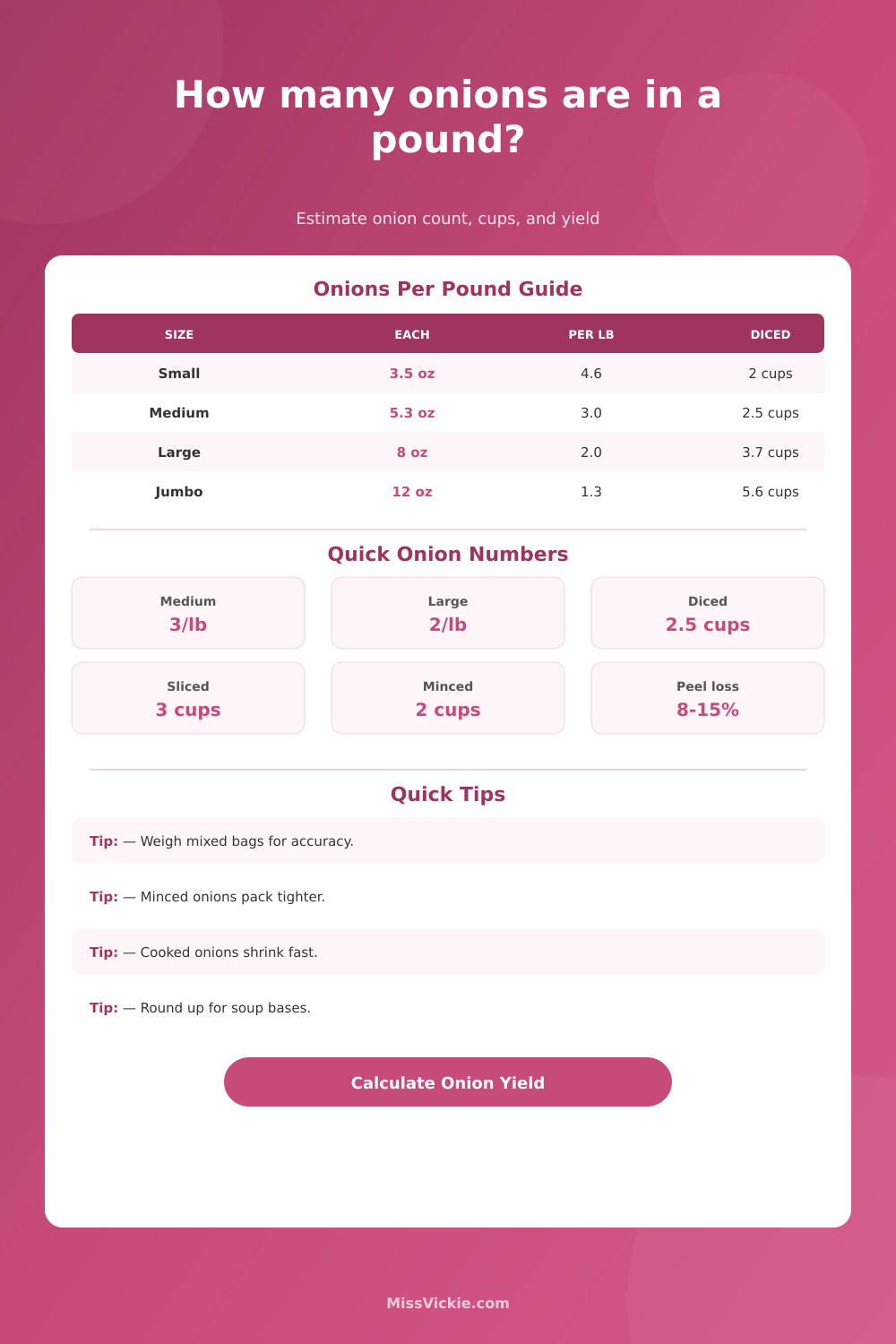
Onions Per Pound Calculator
Estimate onions per pound, total weight, peeled yield, sliced cups, diced cups, minced cups, cooked shrink, and the amount needed for a recipe target.
🧅Onion Presets
Choose a common prep plan, then adjust onion type, count, size grade, trim waste, cut style, cooked or raw use, cup target, and extra cushion.
⚖Onion Yield Inputs
Onion yield summary
Adjust any field to update the onion count and cup estimate.
Weight Breakdown
Volume Breakdown
Recipe Planning Notes
📊Quick Onion Benchmarks
🧅Onion Type Comparison
Balanced sweetness, good for soups, sauces, and browning.
Great for salsa, tacos, chili toppings, and quick saute.
Best for salads, pickles, sandwiches, and ring cuts.
Mild, juicy, and often bigger, so count per pound is lower.
📏Onion Size And Count Table
| Size Grade | Approx Each | Onions Per Pound | Best Use | Planning Note |
|---|---|---|---|---|
| Pearl | 0.7 oz / 20 g | 22 to 24 | Glazes, stews, pickles | High trim time, small roots. |
| Small | 3.5 oz / 99 g | 4 to 5 | Single portions, garnish | Good when a recipe asks for one small onion. |
| Medium | 5.3 oz / 150 g | About 3 | Most home recipes | Common grocery baseline for count estimates. |
| Large | 8 oz / 227 g | About 2 | Soup base, saute, rings | Often enough for 1 to 2 cups chopped. |
| Jumbo | 12 oz / 340 g | About 1.3 | Party prep, caramelizing | Best weighed because one onion can swing results. |
| Mixed bag | 6 oz / 170 g | About 2.7 | Pantry planning | Weigh the full bag for tighter math. |
🥄Cut Style Cup Yield Table
| Prep Style | Raw Cups Per Pound | Raw Grams Per Cup | Typical Use | Kitchen Note |
|---|---|---|---|---|
| Whole peeled | Not cup-based | Varies | Stuffed, roasted, skewers | Use weight and count instead of volume. |
| Sliced | About 3 cups | 72 g | Fajitas, sandwiches, saute | Loose arcs create more cup volume. |
| Diced | About 2.5 cups | 90 g | Soup, sauce, stuffing, chili | Most recipe cup calls assume diced onion. |
| Minced | About 2 cups | 113 g | Meatballs, dressings, marinades | Fine cuts pack tightly and release more juice. |
| Rings | About 3.4 cups | 64 g | Salads, burgers, fried rings | Wide rings look bulky in a measuring cup. |
| Wedges | About 2.2 cups | 103 g | Roasts and sheet pans | Large pieces leave air gaps between layers. |
🔥Cooked Yield Table
| Use | Volume Kept | Weight Kept | Flavor Result | Planning Move |
|---|---|---|---|---|
| Raw or lightly dressed | 100% | 100% | Crisp bite and full volume | Use recipe cup target directly. |
| Sauteed soft | 65% | 78% | Sweet, tender, still pale | Add about one third more raw cups. |
| Browned skillet | 50% | 68% | Deeper flavor, less water | Plan double raw cup volume. |
| Caramelized | 25% | 42% | Jammy, sweet, concentrated | Four raw cups may finish near one cup. |
| Simmered | 80% | 86% | Soft pieces in liquid | Broth captures some onion moisture. |
| Roasted | 55% | 72% | Brown edges and soft centers | Use larger wedges to slow shrink. |
🍽Common Recipe Planning Table
| Recipe Job | Target Onion | Typical Cut | Approx Pounds | Approx Medium Onions |
|---|---|---|---|---|
| Small soup pot | 1.5 cups cooked base | Diced, sauteed | 1 lb | 3 |
| Taco night | 2 cups raw topping | Diced white onion | 0.8 lb | 2 to 3 |
| Fajita skillet | 4 cups soft slices | Sliced yellow onion | 2 lb | 6 |
| Caramelized topping | 2 cups finished | Sliced sweet onion | 3.2 lb | 9 to 10 |
| Stuffing pan | 3 cups sauteed dice | Diced yellow onion | 1.6 lb | 5 |
| Burger tray | 3 cups raw rings | Red onion rings | 0.9 lb | 2 large |
Onion volume varies with knife cut, moisture, and how firmly the cup is filled. Weighing is best for large batches.
💡Onion Measuring Tips
Peeling an onion always seems straightforward; until it’s time to plan for dinner. Maybe they’re on sale, so you grab a few, only to realize that onions can be deceptive and you’re not sure if three heads will fill the pot or just dissapears into thin air. As heavy as an onion seems, once it’s peeled and simmering, it dwindles fast. Here’s a way to close the chasm between “onion in hand” and “meal on table.
The second part seem obvious: Size does matter, and not just in the way it sounds. For instance, a jumbo sweet onion might weigh twice as much as a small yellow one but the skin-to-flesh ratio change slightly. Freshness alters density, too. To prevent guessing, the tool allow you to choose a specific grade (e.g., pearl, medium, etc.) or mixed bag averages. Otherwise, making assumptions about all onions being the same will throw you off. With most of yours being small, for example, the number will adjust accordingly to match what’s in your bag.
How to Measure Onions for Your Recipe
The second consideration is waste. There’s the dry outside layer, there’s the root end of each onion and then there may be some bruise or browning around the bottom. Cooks tend to overestimate their efficiency; they don’t realize how much weight they lose before ever bringing the onion to the stove. Trim-waste input give you an opportunity to account for that loss. Fresh produce doesn’t shrink so much when it’s peeled, use more if you’re starting with old onions. You don’t want to run short on pounds of onions.
Remember, a pound of raw onion isn’t the same as a pound of cooked onion. Volume is very dependent on the cooking method. Because onions are primarily water, the heat of cooking drive off some of this water. If you dice an onion and eat it raw, it will retain its initial volume. If you sauté the onion, it softens and shrinks to approximately 35% of its starting volume. If you caramelize the onion, it reduces even more, down to around 25% of its starting volume.
So if a recipe say “1 cup of caramelized onions,” you’re going to need several cups worth of raw slices. This is why the calculator includes reduction factors: It enables you to calculate how much raw onion you’ll need based off the volume you want in the finished dish. But it’s not just a question of whether an onion will fit in a cup; it is also affected by how the onion is cut. When diced, little cubes fits together well for maximum density. Slices, on the other hand, expand in looser arcs that trap air. A cup of sliced onions will be lighter then a cup of diced onions, even if they both weighed the same before being cut. If you mince your onions, they’ll be somewhere in-between (but closer to dense, since the finer particles will settle down). Depending on how finely you want to chop things, the tool tell you how much weight you need to get a certain number of cups.
But it is also a shield against complexity in recipes. Onions bring sweetness and structure; they are needed in bulk for things like stuffings and soups. Now I know that three pounds of diced, peeled onions is the same as three or four medium onion. That way, I don’t have to guess, and lose any pleasure in cooking, when I shop for only exactly what I want.
That way, your grocery runs are quicker and more effective. There is no point in buying too many onions if they rot before you use them. There is also no reason to stop midway through cooking if you find out you are short on sautéed base. Because the calculator does those conversions for you, you get to do all that chopping, and heating, and stuff.
The foundation of cooking is understanding what you’re working with, both as an ingredient and as a cook. Onions, though inexpensive and versatile, can be tricky because of their water content. These estimates will help you shop, and stash more onions for tweaks and taste tests. Believe it or not, the yield math does add up. You should of planned well to avoid the frantic rush. Plan well for a calm kitchen.