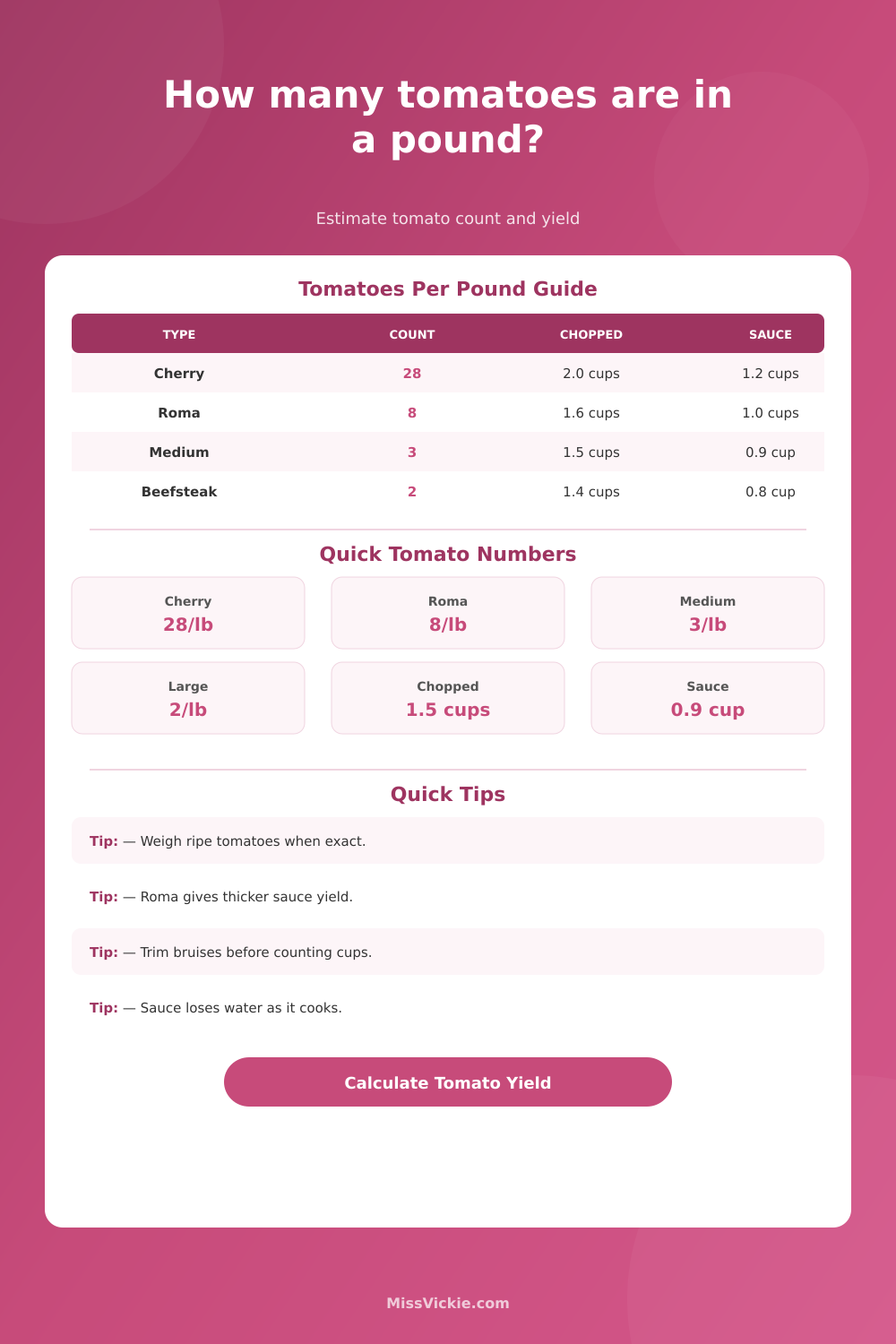
Tomatoes Per Pound Calculator
Estimate tomato count per pound, usable weight, chopped cups, sliced cups, sauce yield, trim loss, and the pounds needed for a recipe target.
🍅Tomato Presets
Choose a common prep plan, then adjust tomato type, count, size, waste, cut style, cup target, sauce moisture loss, and buffer.
⚖Tomato Yield Inputs
Tomato yield estimate
Your tomato estimate appears here.
Count And Weight
Cup Yield Math
Recipe Plan
📌Fast Tomato Count Cards
🔍Tomato Type Comparison Grid
High count, juicy bite, strong salad and garnish use.
Small oval tomatoes with less gel than cherry types.
Snack size tomato with steady slicing yield.
Meaty plum tomato with lower water and good sauce body.
General grocery tomato for salads, wedges, and sandwiches.
Large slicing tomato with wide rounds and more seed gel.
Heavy fruit with variable shape, color, and trim needs.
Dense plum style tomato suited to paste and cooked sauce.
📊Tomatoes Per Pound Table
| Tomato type | Typical count per lb | Average each | Chopped cups per lb | Best kitchen use |
|---|---|---|---|---|
| Cherry tomatoes | 24 to 32 | 0.5 to 0.7 oz | 1.8 to 2.2 cups | Salads, pasta bowls, garnish trays |
| Grape tomatoes | 38 to 50 | 0.3 to 0.45 oz | 1.7 to 2 cups | Snack trays, roasted halves, quick salads |
| Campari tomatoes | 10 to 14 | 1.1 to 1.7 oz | 1.5 to 1.8 cups | Fresh sauce, sandwiches, wedges |
| Roma or plum tomatoes | 7 to 9 | 1.8 to 2.4 oz | 1.5 to 1.7 cups | Salsa, sauce, roasting, canning prep |
| Medium round tomatoes | 2.5 to 3.5 | 4.5 to 6.5 oz | 1.4 to 1.6 cups | Salads, tacos, wedges, cooked dishes |
| Large beefsteak tomatoes | 1.5 to 2.5 | 6.5 to 10 oz | 1.3 to 1.5 cups | Burgers, sandwiches, platters |
| Large heirloom tomatoes | 1 to 2 | 8 to 16 oz | 1.2 to 1.5 cups | Caprese, composed salads, thick slices |
| San Marzano style tomatoes | 5 to 8 | 2 to 3.2 oz | 1.4 to 1.6 cups | Cooked sauce, paste, canning |
🥄Kitchen Use Yield Table
| Kitchen use | Volume factor | Moisture guide | Texture result | Good planning note |
|---|---|---|---|---|
| Chopped or diced | 1.00x | 0 to 10% loss | Standard measured cup yield | Best baseline for salsa and salads |
| Sliced rounds or wedges | 1.12x | 0 to 5% loss | Airier cup measure | Use for sandwich and platter planning |
| Halved small tomatoes | 1.18x | 0 to 8% loss | Loose cup fill | Use with cherry and grape tomatoes |
| Crushed raw pulp | 0.92x | 5 to 15% loss | Denser cup measure | Good for raw sauce and gazpacho |
| Cooked sauce | 0.86x | 25 to 60% loss | Reduced and spoonable | Set moisture loss from simmer time |
| Roasted tomatoes | 0.78x | 30 to 65% loss | Concentrated pieces | Use high loss for wrinkled roasted trays |
🧪Recipe Quantity Table
| Recipe plan | Finished cups | Roma estimate | Medium estimate | Cherry estimate |
|---|---|---|---|---|
| Taco night topping | 2 cups chopped | 10 to 12 | 4 to 5 | 35 to 40 |
| Fresh salsa bowl | 4 cups chopped | 20 to 24 | 8 to 10 | 70 to 80 |
| Caprese platter | 6 cups sliced | 28 to 34 | 10 to 12 | not ideal |
| Pasta sauce pot | 5 cups sauce | 42 to 52 | 18 to 22 | not ideal |
| Roasted sheet pan | 3 cups roasted | 24 to 30 | 10 to 14 | 90 to 110 |
| Canning prep batch | 16 cups sauce | 135 to 160 | 58 to 70 | not ideal |
🔧Trim And Sauce Adjustment Table
| Adjustment | Light setting | Standard setting | Heavy setting | When to use it |
|---|---|---|---|---|
| Trim waste | 3 to 5% | 8 to 12% | 18 to 30% | Cores, bruises, peels, and watery seed gel |
| Raw moisture loss | 0% | 5% | 10% | Draining salted tomatoes or juicy salsa |
| Sauce moisture loss | 25% | 40% | 60% | Short simmer through thick tomato paste style |
| Recipe buffer | 5% | 10% | 20% | Uneven fruit, tasting, spills, and bowl scrape |
💡Tomato Count Tips
Tomato counts are kitchen estimates based on common market sizes. Ripeness, variety, season, growing region, and how firmly cups are packed can change the final yield.
A lot of times, it’s your eye measuring, when you’re in the supermarket staring at an oversized display of tomatoes and think, oh yeah, I’ve got plenty to make a stew, but what turns out are just two skimpy cups of sauce. How many other kitchen mistakes arises from volume versus weight? There aren’t “enough” tomatoes in the shopping basket; they look like it should be enough. And then there you are chopping along, hoping for the best, and discovering there isn’t much more then that to fill the pot.
Here’s why: Some kinds of tomatoes is denser than others. A pound of those Romas won’t act like a pound of cut-up watery beefsteaks. Knowing one from another ends recipe guesswork. And you don’t even need to guess the yield visually: The calculator does the math for you based off how big the tomatoes will be (the inputs are realistic, unlike a rigid chart of yield estimates). Since your entries reflect real kitchen details, like how much seed and gel a jumbo heirloom has compared to a compact Campari… The tool can adjusts to match when you pick the size profile.
Why Volume Matters More Than Weight for Tomatoes
Those seeds go liquidy and drain away; the gel gets reduced down. Without considering such structure, your sauce turn out thinner than expected from the recipe. A tiny tweak, but it make all the difference in texture. The cost of trim is abstract…until you’ve got a pile of cores in your hand. And an eight-percent loss may seem small, but it’s roughly two pounds of lost product from each 20-pound batch you’re planning to can.
That tool allows you to adjust based on how much you prep, such as if it is roughly chopped. Trim losses will be minimal. Peeled and seeded? A lot less of what you bought will make it into whatever you serve. Knowing that will help you choose either to splurge for more fruit, or simply go with a chunkier texture in the finished dish.
The last and perhaps the least-understood variable in how to prepare tomatoes is this: When you cook them, they’ll lose some moisture. To handle this, the calculator wants to know how much moisture will come out of your tomatoes so it can estimate their volume before any boiling occurs. The amount depends on the recipe. A brief simmer may reduce the weight by just a quarter, while a couple-hour reduction into a sauce or paste will get closer to a 60-percent reduction. Unless you adjust for evaporation when planning your shopping trip (that is, knowing how many cups of tomatoes are required in raw form, not cooked), you’ll wind up scrounging around mid-recipe for another bag or two of canned goods. The adjustment will help guarantee that whatever you produce end up getting served at the dinner table.
Another consideration is what kind of tomato you use, which determines how much work you have to do with it. If making chunky salsa or snacking on cherry tomatoes, nice thick skins and a consistent shape makes them easy to handle. Tightly packed tomatoes mean more per pound, but they are not great for breaking down smoothly into a puree. For cooking (like in soups), your workhorse will be something like a Roma or San Marzano, their flesh breaks down and melts nicely, but don’t add too much extra liquid. An heirloom has a distinctive taste profile worth the higher trim rate and won’t necessarily come out exactly the same as the rest, so if you’re aiming for consistency, expect a little more elbow grease, but its flavor is often worth that tradeoff. Know what you need the fruit for, then find the type that works best to avoid wasting time, money, or using the wrong fruit for the job.
A recipe buffer also provides a bit of a cushion for the changes in produce. Some tomatoes won’t be the exact average size, some will arrive bruised en route, others may have hollow cavities that bring down their yield. Adding ten to twenty percent extra accounts for those irregularities, but it doesn’t make doing the prep feel like a math test each time you get around to cooking something. Because, hello, cooking is an inexact science. You’re aiming for a range, not a decimal point.
Knowing how much fruit goes into a cup (or pound) of cooked-down goodness takes away the kitchen stress of planning. You’ll prep confidently, and shop confidently because while the numbers help, understanding these variables gives you a better idea of what to expect in your final dish. It’s all about the volume; it’s how much space your meal takes up. Numbers are nice, but so is understanding the variable and using your head. Next time you pick up that hefty bag of tomatoes, think about weight as only the beginning.