Garlic Cloves Per Head Calculator
Estimate cloves in each head of garlic with bulb size, variety, clove size mix, usable yield, peel state, recipe intensity, and a kitchen buffer for real cooking.
🍳 Garlic Head Presets
Pick a common cooking plan, then adjust the heads, bulb type, yield, peel state, and recipe strength.
⚖ Garlic Head Inputs
Garlic head estimate
Your garlic clove estimate appears here.
Clove Count Breakdown
Kitchen Yield Breakdown
📌 Quick Head Count Cards
🔍 Garlic Variety Comparison Grid
Layered cloves, good all-purpose head count.
Many smaller cloves, strong storage garlic.
Easy peel cloves with rich cooked flavor.
Very large cloves, lower count per head.
Medium count with balanced clove size.
Compact heads, bright flavor, moderate count.
Huge mild cloves, not the same punch as garlic.
Count shifts with age, storage, and dryness.
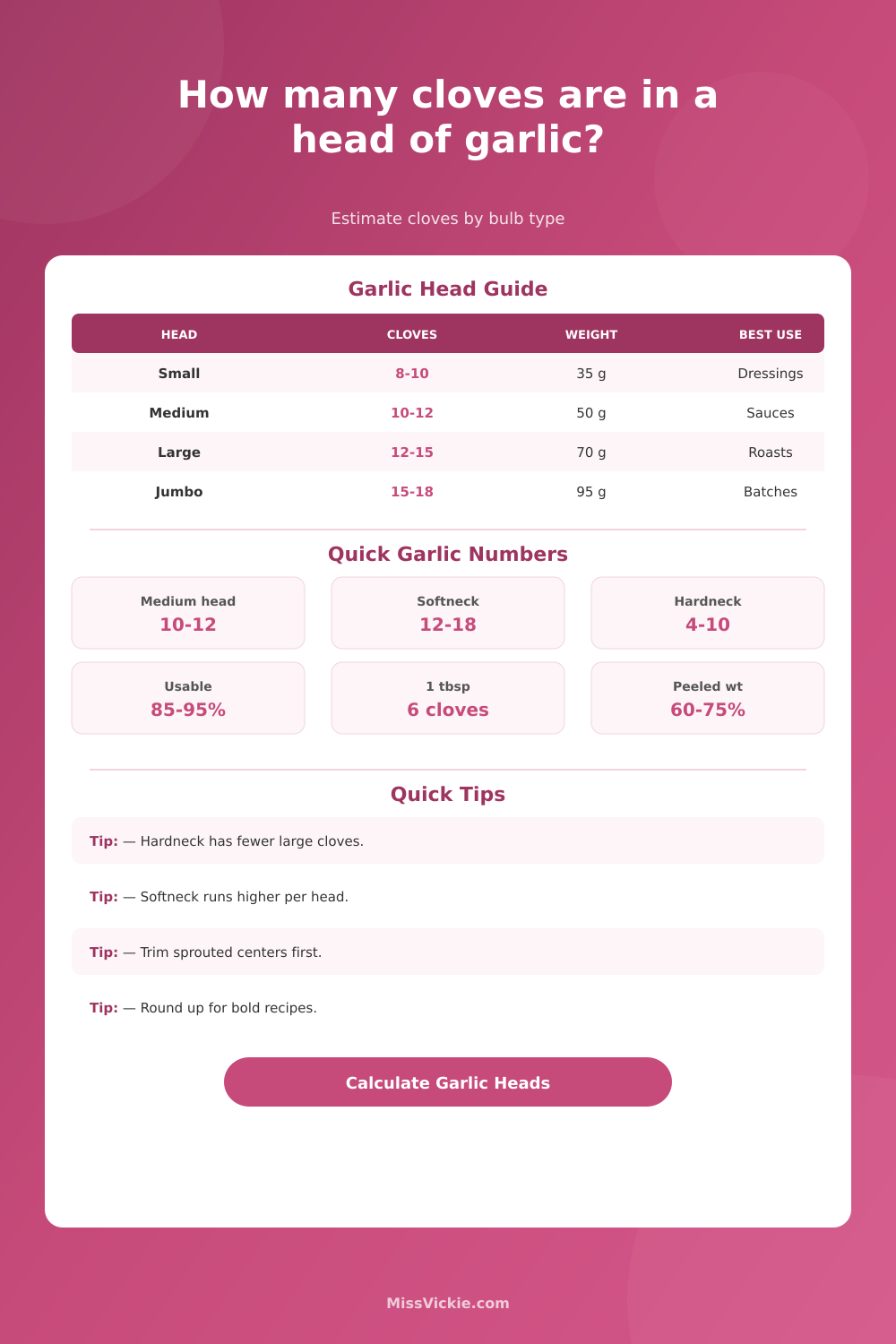
📊 Cloves Per Head by Bulb Size
| Bulb size | Typical cloves | Whole head weight | Peeled garlic weight | Best kitchen use |
|---|---|---|---|---|
| Small head | 7 to 10 cloves | 30 to 40 g | 18 to 26 g | Dressings, single pan meals, dips |
| Medium head | 10 to 12 cloves | 45 to 55 g | 28 to 38 g | Sauces, soups, weeknight dinners |
| Large head | 12 to 15 cloves | 65 to 80 g | 42 to 56 g | Roasts, chili, sheet pan batches |
| Jumbo head | 15 to 18 cloves | 90 to 110 g | 58 to 76 g | Freezer prep, party dips, big sauces |
| Elephant style | 4 to 6 cloves | 150 to 220 g | 105 to 160 g | Mild roasts and mellow garlic spreads |
🧄 Variety and Clove Pattern Table
| Variety type | Clove count pattern | Average factor | Peeling note | Flavor planning note |
|---|---|---|---|---|
| Softneck artichoke | Many layers, mixed sizes | 1.10x | Outer cloves peel faster than inner cloves | Good baseline for grocery garlic |
| Softneck silverskin | Highest small-clove count | 1.25x | Small cloves add prep time | Useful when a recipe counts cloves |
| Hardneck rocambole | Single ring of large cloves | 0.78x | Usually easy to peel | Fewer cloves can still taste full |
| Hardneck porcelain | Few very large cloves | 0.62x | Fastest peel of the group | One clove may equal two small cloves |
| Purple stripe | Moderate count, even shape | 0.92x | Clean skins, steady prep | Good for roasting whole cloves |
| Creole | Compact moderate count | 0.95x | Thin skins can cling | Bright flavor, strong raw use |
📋 Yield, Peel, and Trim Table
| Garlic state | Count impact | Weight impact | Use yield range | Best calculator setting |
|---|---|---|---|---|
| Whole unpeeled heads | Full natural count | Skin and root plate included | 85 to 95% | Use 90 to 94% for fresh heads |
| Broken unpeeled cloves | Missing cloves possible | Some papery skin remains | 82 to 92% | Use when pantry heads are split |
| Peeled cloves | Count is direct | Ready garlic weight | 90 to 98% | Use for deli tubs or prep bowls |
| Peeled and trimmed | Lowest waste | Dry ends removed already | 96 to 100% | Use for mise en place prep |
| Sprouted or dry heads | Some cloves discarded | Lower moisture and usable core | 65 to 85% | Use lower yield and more buffer |
🥘 Recipe Planning Table
| Recipe plan | Mild garlic | Balanced garlic | Bold garlic | Good head estimate |
|---|---|---|---|---|
| Pasta sauce for 4 | 2 cloves | 4 cloves | 6 cloves | Half medium head |
| Garlic bread loaf | 3 cloves | 6 cloves | 10 cloves | One medium head |
| Soup pot for 8 | 4 cloves | 8 cloves | 12 cloves | One large head |
| Party dip bowl | 2 cloves | 4 cloves | 7 cloves | Half to one head |
| Roast pan | 6 cloves | 12 cloves | 18 cloves | One to two heads |
| Tomato sauce batch | 10 cloves | 18 cloves | 28 cloves | Two to three heads |
These counts are cooking estimates. Fresh garlic varies by curing, storage, growing region, age, and how finely the cloves are cut.
💡 Garlic Count Tips
WHEN A RECIPE calls for six cloves of garlic, how many heads of garlic will that be? How many is left in your pantry? That’s what happens when you’re trying to chop some garlic for dinner, unless you use this useful calculator: It do the math for you. Simply enter number of heads and then select the variety (whether it is big or small) and it tell you exactly how many cloves are inside. No more guessing! No more running out mid-recipe. Turn guesswork into plans.
You might not know that heads of garlic vary. In most cases, supermarket garlic is softneck (and typically contain more cloves per head compared to hardneck). And while hardneck types has fewer, their individual cloves tend to be bigger and easier to peel. Why’s that important? Size doesn’t always show how strong the flavor is or how heavy it weighs; also, if a recipe calls for a certain number of cloves, a hardneck head might not provide as many cloves even if it look large. The tool includes this variation in its estimation, taking into account different structure between garlic heads to tell you exactly how many cloves you can expect to end up in your pan.
How to Use a Garlic Calculator
Another factor in yield is bulb size. You’d think something described as a “jumbo head” would go a long way, but many times there’s not much beyond big outside cloves and a handful of tiny ones within. Sometimes small heads are packed so even though they may have fewer total cloves, each one’s a winner. Use the chart on the page (above) to see how weight correlates with clove count across different sizes. Medium heads tend to balance out in terms of usable yield and peeling work while giant ones is nice if you’re roasting them whole but take longer to mince if you want chopped garlic. Knowing this help you decide whether you really need to buy individual bulb now, or if it’s better to just buy heads in bulk for immediate use.
The biggest problem for home cooks is yield. Because of the papery skin, root plate and sometimes bitter-tasting sprouting centers, not all of it can be used. To make up for it, you can enter the percentage of each head that will turn into usable product. Factor in the loss. For a fresh head, approximately 85-90 percent of raw weight remains once peeled out of its skin. If your garlic is starting to sprout, or if it’s older, amount will drop a lot; factor that in first. If your garlic is starting to sprout, or if it’s older, that will dramatically decrease; factor that in first.
When you peel your own garlic, check it beforehand. The trimmed-up cloves will weigh less than the original whole thing and any dry ends only add weight without adding anything else. Don’t want to end up short while halfway through a batch of sauce? Account for the wastage.
How garlicky do you like it? That’s a big factor in determining which recipes call for how many cloves. Bold garlic take center stage; mild garlic provides a slight background note. The tool tells you how many servings a certain number of cloves will yield, depending on desired strength of flavor. For example, a few garlic cloves can flavor a delicate vinaigrette for two. But they won’t have anywhere near enough punch for a soup batch that feeds eight. Adjust the flavor-intensity slider and you’ll see whether you’re going to make do with what you’ve got. It shows difference between how many ingredients you actualy have and how many ingredients you need.
There is also kitchen buffer. In professional kitchens, nothing goes according to plan perfectly. A clove breaks. The skin refuses to let go. You taste the dish, and decide that it really could of used more garlic. That’s where adding a percent buffer to your estimate comes into play, for those inevitable mishaps. Better to have a few extra peeled cloves in a bowl than to be standing over a simmering pot without any garlic left to toss in.
It makes this an exercise not so much math, but rather a practical cooking strategy. Simple: Garlic. Another variable is garlic. When you know what kind (softneck vs. Hardneck) and roughly how large and in what shape your bulbs are, you stop guessing, and start planning. How much? We’ll let our computer do the math, but when you understand why the numbers go where they go…you’re a more confident cook. The next time you grab a head, spend some time looking it over. Is it a tight head? Is it a sprouting one? Is it softneck or hardneck? That’s more important to your yield than the price tag. Now you’ll have just the right amount of garlic, every time. And that makes all the difference in the final dish.