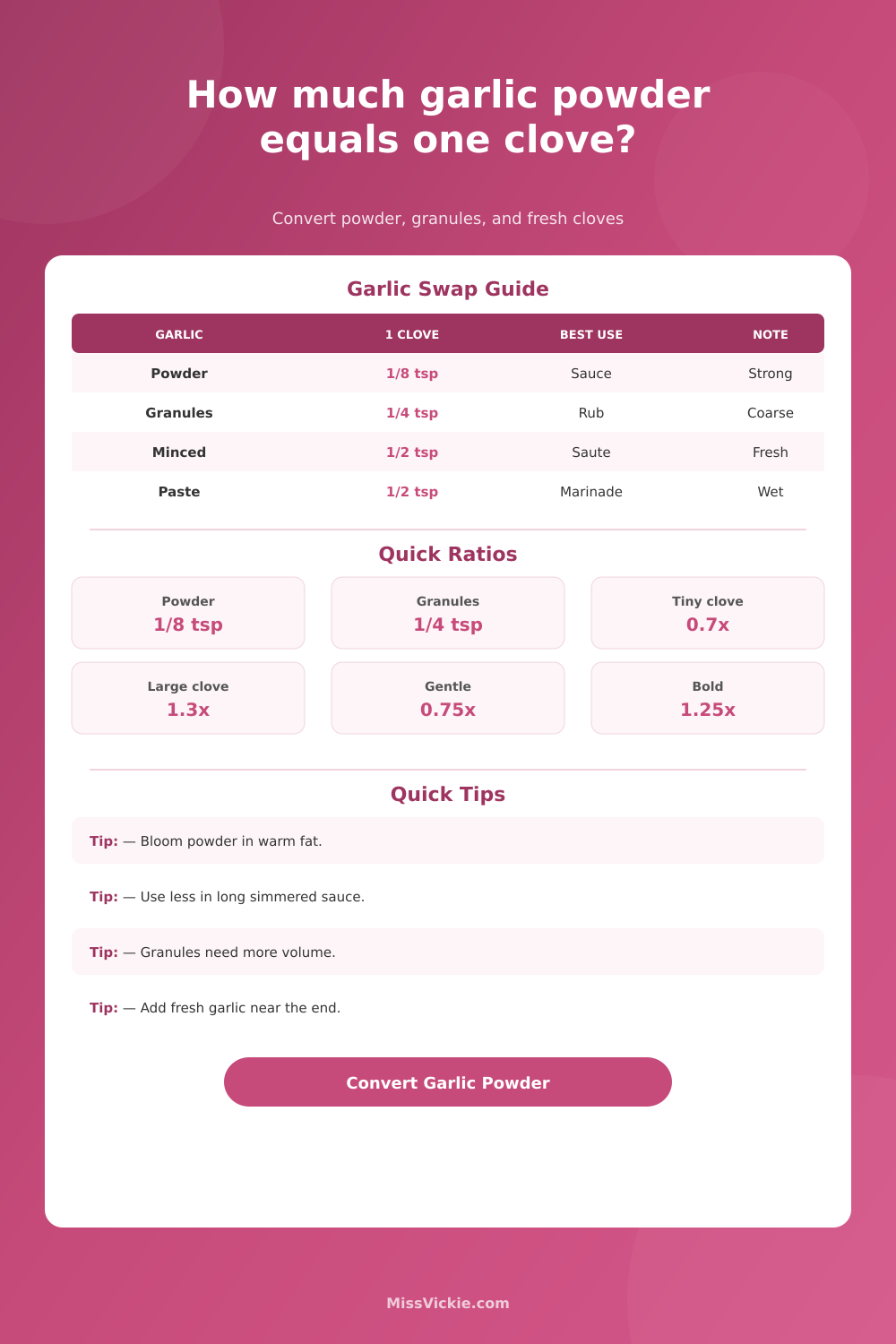
Garlic Powder to Clove Converter Calculator
Convert garlic powder, granulated garlic, minced garlic, garlic paste, and fresh cloves with clove size, recipe style, flavor strength, moisture, and serving adjustments.
🍳 Garlic Swap Presets
Pick a common kitchen case, then adjust the amount, clove size, recipe type, flavor strength, moisture setting, and servings.
⚖ Garlic Conversion Inputs
Garlic conversion
Your garlic swap result appears here.
Conversion Breakdown
Kitchen Use Notes
🧄 Quick Equivalence Cards
📊 Garlic Product Comparison
Disperses quickly in sauces, soups, rubs, and seasoned flour.
Better in dry rubs because it clumps less than fine powder.
Best when cooked briefly or added near the finish for aroma.
Good for marinades, dips, dressings, and garlic butter.
📋 Powder, Granules, and Fresh Garlic Table
| Fresh garlic target | Garlic powder | Granulated garlic | Minced garlic | Garlic paste |
|---|---|---|---|---|
| 1 small clove | Scant 1/8 tsp | Scant 1/4 tsp | About 1/3 tsp | About 1/3 tsp |
| 1 medium clove | 1/8 tsp | 1/4 tsp | 1/2 tsp | 1/2 tsp |
| 2 medium cloves | 1/4 tsp | 1/2 tsp | 1 tsp | 1 tsp |
| 4 medium cloves | 1/2 tsp | 1 tsp | 2 tsp | 2 tsp |
| 8 medium cloves | 1 tsp | 2 tsp | 4 tsp | 4 tsp |
These are cooking-friendly equivalents. Fresh garlic varies by bulb age, variety, storage, and how finely it is cut.
🔍 Clove Size Adjustment Table
| Clove size | Size factor | Powder for 1 clove | Use when | Kitchen note |
|---|---|---|---|---|
| Tiny | 0.7x | About 1/11 tsp | Small tight bulbs | Round to a pinch in most home recipes. |
| Small | 0.85x | Scant 1/8 tsp | Everyday small cloves | Good for delicate dressings and fish. |
| Medium | 1x | 1/8 tsp | Most recipes | The standard kitchen conversion point. |
| Large | 1.3x | About 1/6 tsp | Big loose cloves | Round up slightly for bold roasts. |
| Jumbo | 1.6x | About 1/5 tsp | Elephant-style pieces | Flavor can be milder, so taste matters. |
🥘 Recipe Style Adjustment Table
| Recipe type | Suggested adjustment | Why it changes | Best garlic form | Addition cue |
|---|---|---|---|---|
| Sauce or stew | Standard | Liquid hydrates powder evenly. | Powder or paste | Bloom early, then simmer. |
| Dry rub | Use granules | Coarser grains spread through spices. | Granulated | Mix with salt before sugar. |
| Cold dressing | Use a bit less | Raw garlic flavor blooms sharply. | Paste or fresh | Rest 10 minutes before tasting. |
| Quick saute | Use a bit more fresh | Short cooking gives less mellowing time. | Fresh minced | Add after onions soften. |
| Long simmer | Use less powder | Dried garlic can turn heavy over time. | Fresh cloves | Add part near the finish. |
🥣 Common Batch Conversion Table
| Batch plan | Fresh cloves | Garlic powder | Granulated garlic | Good starting use |
|---|---|---|---|---|
| Dinner for 2 | 1 to 2 cloves | 1/8 to 1/4 tsp | 1/4 to 1/2 tsp | Pan sauce, vegetables, rice |
| Family meal for 4 | 2 to 4 cloves | 1/4 to 1/2 tsp | 1/2 to 1 tsp | Pasta sauce, skillet meals |
| Soup pot for 8 | 4 to 8 cloves | 1/2 to 1 tsp | 1 to 2 tsp | Chili, stew, broth soup |
| Rub for 12 servings | 6 to 10 cloves | 3/4 to 1 1/4 tsp | 1 1/2 to 2 1/2 tsp | Chicken, pork, potatoes |
| Party dip bowl | 3 to 6 cloves | 3/8 to 3/4 tsp | 3/4 to 1 1/2 tsp | Use less at first, then taste |
💡 Garlic Conversion Tips
Three cloves of fresh garlic? Okay, you think to yourself, I have this recipe open and now I see my head of garlic has sprouted a few green shoots, or maybe even turned completey soft. Then there’s the jar of garlic powder in your spice cabinet, but wait: dried garlic is not the same as dehydrated fresh garlic. Depending on how you use it (simmered in a stew, mixed into a dressing, or sitting on oil), it can be a very different thing. Used incorrecty, it will pack a one-two punch of pungent goodness where a more subtle note was called for.
By inputting what kind of recipe you want to make and the level of intensity you desire, you save yourself from having to guess about the strength that will be lost in the cooking process; the calculator do all of the math for you (see above). To explain why these inputs are necessary, let’s take a look at what happens to garlic as it loses its moisture: The water surrounding fresh garlic cloves dilutes their sulfur compounds, and as that water is lost; evaporating into powder, the compounds themselves gets denser and denser. It’s common knowledge that a medium-sized clove of raw garlic roughly translates to one eighth of a teaspoon of powder, but this baseline doesn’t account for your own unique cooking method.
Why Garlic Changes When It Dries
All of this revolves around how the dried texture vary: Granulated garlic is made up of larger flaked pieces that will dissolve slower than finer powders. Flakes release their flavor slowly rather than all at once. They also stick to foods better, like sticking to the surface of meat to make a good dry rub. Because of their larger size, however, they won’t clump together like powder do.
In liquids, powder disperses right away. This is perfect if you are making a marinade or soup and want an even amount of flavor distributed throughout. The device on the page take this texture difference into account, keeping you from oversalting your sauce or undersalting your rub.
Many home cooks also don’t consider that fresh garlic burn easily if cooked for even just a few seconds in hot oil. Dry garlic needs time to warm up, too. Tossing powder into something cold won’t have the same impact as heating it in a warm liquid or fat early on. If you don’t, it will still taste chalky and dusty, though maybe slightly less so.
In a quick saute where the garlic are added at the end, fresh cloves will offer a brighter garlic aroma then anything made from dried garlic can achieve, even if you double or triple the amount. Dried ingredients also require careful handling: A bit of dried garlic, for example, may turn slightly metallic and tough during longer cooking, which is why I suggest adding some fresh clove at the very end to retain its subtle flavors (while using the dried component to start out with full-on depth). This “layered” strategy allow you to dial in the resulting balance.
The calculator will nudge you to match. It recommends smaller quantities when the dish is cooked long enough that heat has time to transform those flavor compounds, and larger when things is cooked fast enough that they don’t need much help.
The point is, it’s really all about balance, not exact measurements with garlic, and your own nose will be the judge of that once you have tasted the finished dish. Take the above conversions as starting points, and go from there, depending on how strong things smell and taste. You should of used these values to help.
An extra pinch of powder here or there (such as in a large pot of soup) won’t make a dent, but in a light vinaigrette, an extra pinch could wreck the entire thing. Knowing how much difference moving from fresh to dried makes frees you up to cook boldly, even if you have few ingredients or don’t have fresh cloves ready for every serving. All you need is to know where to find that power in that tiny jar.