Brownie Cooling Time Calculator
Estimate how long brownies should cool before warm serving, clean cutting, stacking, boxing, or frosting based on pan size, brownie thickness, texture style, room temperature, pan material, toppings, fridge assist, and carryover heat.
🍫 Brownie Cooling Presets
Choose a kitchen scenario, then adjust the pan, thickness, brownie style, room temperature, material, cut target, fridge assist, topping, and carryover setting.
🍳 Cooling Inputs
Brownie cooling plan
Enter your pan and cutting goal to estimate the cooling window.
Cooling Factors
Target Details
Cooling Steps
- Rest the pan on a rack.
- Lift with parchment when stable.
- Cut with a clean warm knife.
📊 Cooling Snapshot
📐 Brownie Cooling Reference Tables
| Cut Goal | Center Or Top Cue | Texture Signal | Knife Or Serving Cue |
|---|---|---|---|
| Warm serving | 115 to 130°F center | Soft center, spoonable edges | Use a spatula or scoop; squares may slump. |
| Casual bars | 95 to 110°F center | Set edges, slightly warm middle | Cut larger bars and wipe the blade often. |
| Clean squares | 80 to 90°F center | Fudgy but stable middle | Lift from pan and use a warm thin knife. |
| Stacking or boxing | 72 to 80°F center | Fully set top and bottom | Chill briefly if crumbs smear on the blade. |
| Ready for frosting | 70 to 76°F top | No surface warmth | Frost only after ganache or buttercream will not melt. |
| Pan Material | Cooling Effect | Best Use | Adjustment |
|---|---|---|---|
| Light metal | Balanced heat release | Most standard brownies | Baseline cooling time. |
| Dark metal | Edges cool a little faster | Chewy edges and clean cuts | Usually 5% shorter than light metal. |
| Glass | Retains heat after baking | Thicker fudgy batches | Add about 15% cooling time. |
| Ceramic | Slowest heat release | Serving from the dish | Add about 25% cooling time. |
| Cast iron | Very high carryover | Skillet brownies | Add about 35% cooling time. |
| Thickness | Typical Pan | Clean-Cut Cooling | Frosting Cooling |
|---|---|---|---|
| Thin, 0.5 to 0.75 in | Half sheet or 9 x 13 | 45 to 70 minutes | 65 to 90 minutes |
| Standard, 0.9 to 1.2 in | 8 x 8 or 9 x 9 | 80 to 115 minutes | 100 to 145 minutes |
| Thick, 1.25 to 1.6 in | Deep 8 x 8 pan | 110 to 155 minutes | 140 to 190 minutes |
| Extra deep, 1.7 in plus | Loaf or deep ceramic | 150 to 220 minutes | 180 to 260 minutes |
| Fridge Assist | When To Start | Chill Window | Best For |
|---|---|---|---|
| Counter only | Right after baking | None | Best texture, no condensation risk. |
| Light fridge | After 20 minutes | 15 to 25 minutes | Cleaner family bars without a hard chill. |
| Firm fridge set | After 25 minutes | 25 to 40 minutes | Lunchbox cuts, stacked bars, neat edges. |
| Brief freezer | After 20 minutes | 8 to 12 minutes | Emergency slicing; watch for wet top. |
Cooling estimates assume brownies finished baking safely before removal from the oven. If the center is liquid rather than fudgy, continue baking instead of relying on cooling time.
⚖ Counter vs Fridge Comparison
Slow cooling keeps the crust drier and the center glossy without sudden condensation.
A short chill firms butter and chocolate once the pan has rested on the rack.
Buttercream, cream cheese frosting, and ganache need no surface warmth.
Thick brownies in heavy pans keep setting from stored heat after the oven.
💡 Brownie Cooling Tips
The brownies are done baking and all that willpower you had to leave them in another minute or two just went right out the window. Resist! Waiting mean the difference between perfectly formed squares and an unattractive pile of goo. Letting something cool lets it set its shape, but screw it up here and you’re messing with dessert. Baked goods actively cool; starch molecules tightens up while fat hardens. Cutting into it prematurely allow gravity to make the middle cave in, which then lead to those unsightly saw-toothed cuts on your cutting board.
It’s a science, and our calculator above can do the math for you by factoring in your room temp and even pan material. The second thing is: What kind of pan are you using? You’d be surprised just how much difference this makes to most home bakers. Aluminum pulls heat out quickly, causing the outside of brownies to cool down while inside stays warm. Ceramic and glass retain heat longer, and they’re basically insulators (they keep heat in once they’ve been removed from oven). So when baking with glass or ceramic, you’ll need to wait a lot longer then you would have if you were going with aluminum. And then there’s cast iron; cast iron holds heat very well, making it take much longer for cool down. The app requests your pan type because it knows that each will cool down at a different rate.
Why You Must Wait for Brownies to Cool
The same is true for thickness. Because a sheet pan brownie is thinner than most other style, it will cool down quickly due to reduced mass. On the flip side, a deep-dish brownie are thick and dense (which people love), but also takes significantly longer for its center to become cool enough for cutting.
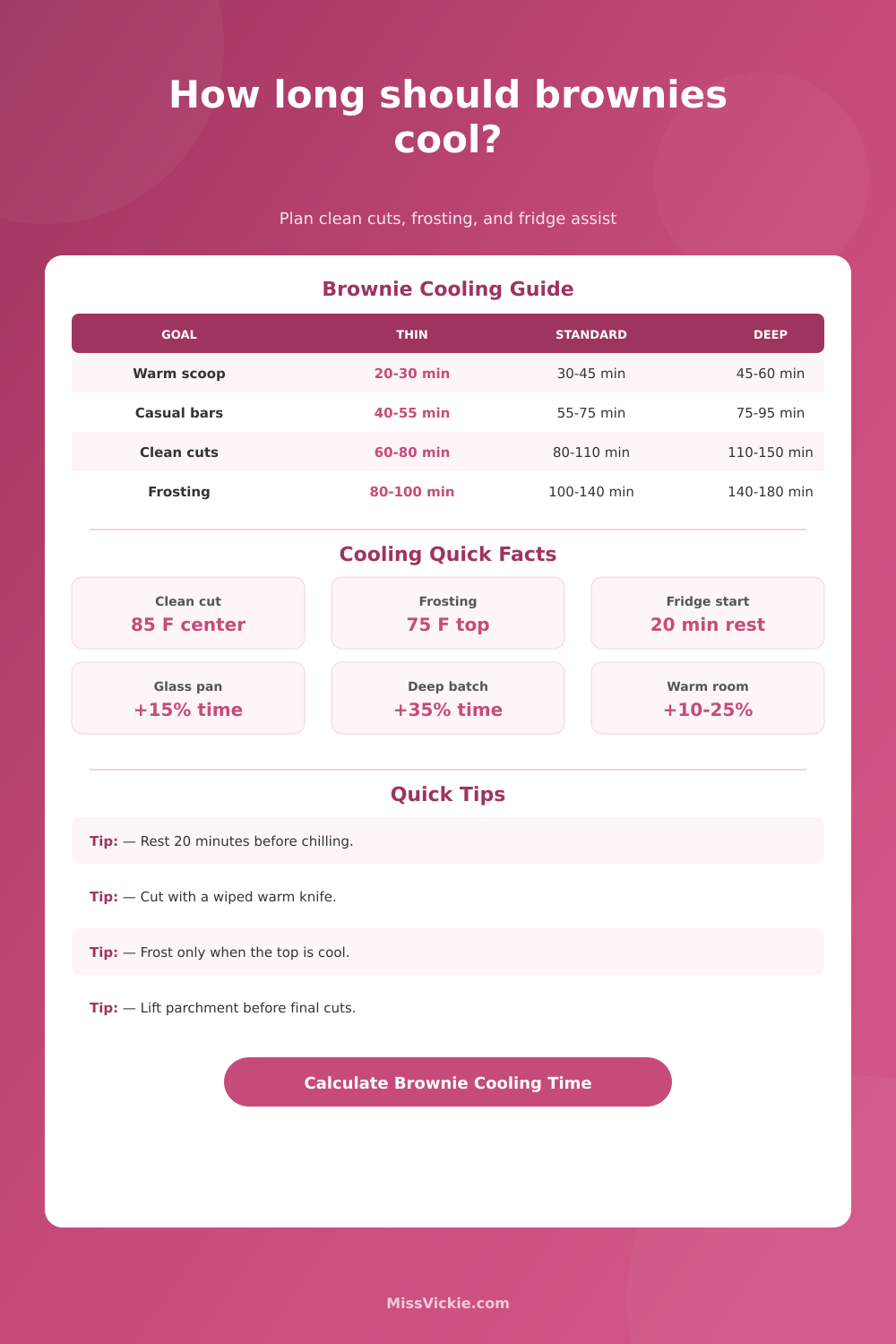
If you’re mindful, you’ll be able to tell how they’re coming along. When you go to check them with your finger, the surface should be totally cold and dry to the touch, whereas interior feels barely warm. By that time, reaching an internal temperature of about eighty-five degrees Fahrenheit ensures that middle has set up enough to cleanly cut through without sacrificing any texture.
Frosting is one more level of complication. Applying a warm ganache or buttercream will simply melt off surface instead of smoothing out. Because it’s open to the air, the top has to cool quicker then inside. When you’re going to frost, let it cool completely on top, even if it feels cool everywhere else in pan. This one takes time, and rushing it result in a soupy mess that melts back into warm chocolate underneath. A little thing, yes, but it’s what’ll make or break your presentation.
The clock ticks. For some dishes (like those being served to a group) waiting for things to cool naturaly isn’t an option. In those cases, the fridge will do. But dropping a still-piping-hot pan inside it will trap steam under the crust, causing condensation which will dull its shine and make the top all soggy. First thing: Let the brownies rest on a wire rack for at least 20 minutes so they loses their initial shot of moisture. Then give ’em a quick chill in fridge, which firms edges just enough to ensure cleaner cuts without hurting the texture.
The timing also depends on room temperature. A cool autumn day will cause it to cool more quickly than a warm summer’s day baking in the kitchen. Add a few minutes to the wait if you’re noticing that your house itself is heating up just from the oven. It is better to wait an hour longer then five minutes less. Patience keeps slice from falling apart.
And so, the bottom line with awesome brownies: Respect the setting stage. Don’t expect instant-magic; watch your batter go from liquid to solid as the temperature gradualy drops around it. Control the finished texture by understanding how heat flows through different materials and thicker or thinner layer. Treat timing like money: Use it now for warm scoops, or save up for the perfect square to pack into a lunchbox. Let ’em steam until the middle sets. Then let them sit and get their clean cut before enjoying. This will result in a glossy, rich, perfect-to-the-slice slice that hold together just right.