Pie Crust Chilling Time Calculator
Estimate how long pie dough should rest and chill from crust style, butter and shortening balance, dough thickness, shaped state, fridge or freezer temperature, gluten target, blind-bake plan, and kitchen humidity.
🥧Pie Crust Presets
Choose a real pastry scenario, then tune the crust type, fat balance, thickness, disc or rolled state, appliance temperature, gluten rest target, blind bake plan, and humidity.
⚖Crust Inputs
Your Pie Crust Chill Plan
Enter your dough details to estimate the resting and chilling window.
Timing Factors
Handling Notes
Suggested Schedule
- Mix and shape.
- Wrap or cover.
- Chill until firm.
- Fill or bake.
⏱Common Chill Targets
📋Crust Type Timing Table
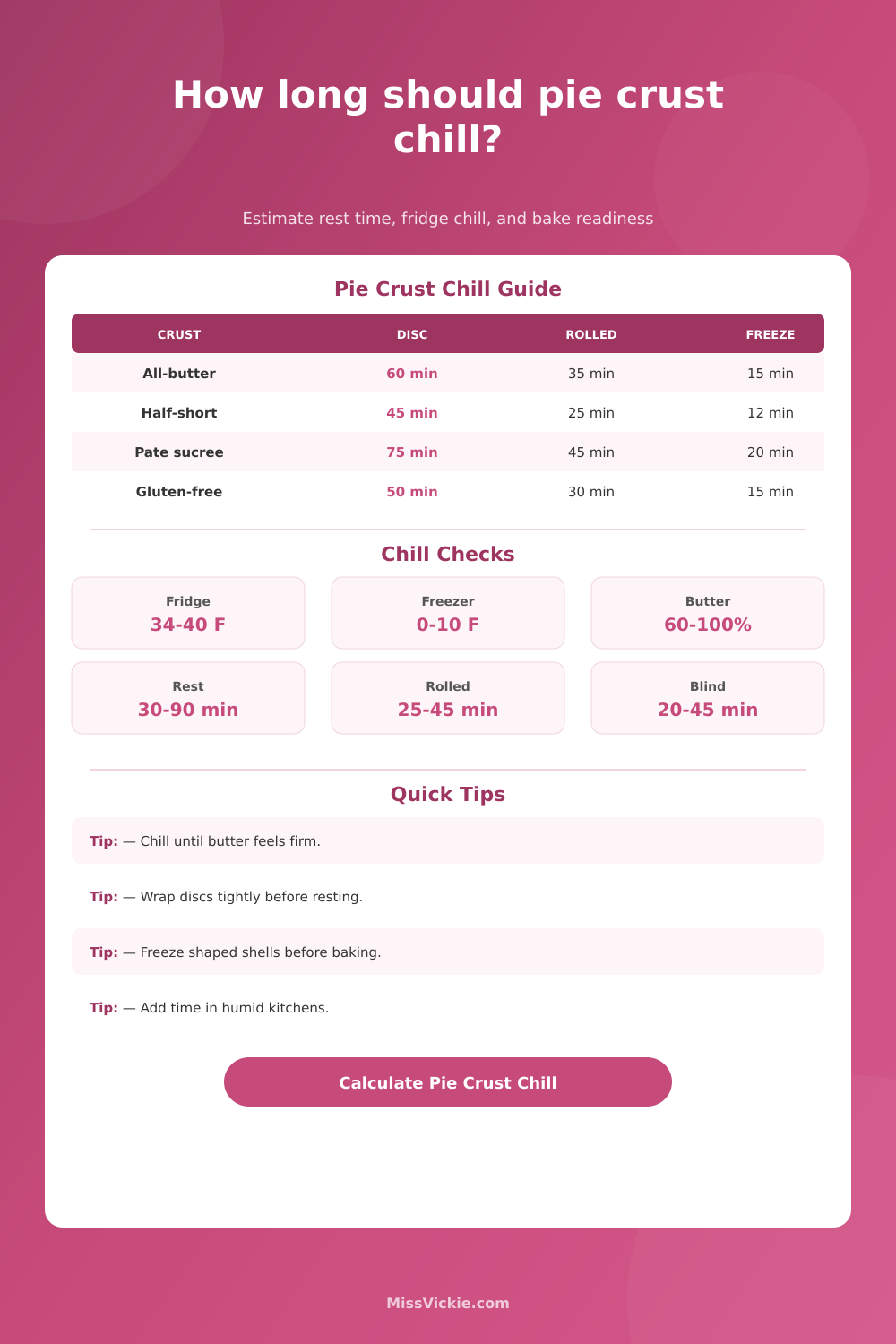
| Crust type | Base disc chill | Rolled shell chill | Why it changes |
|---|---|---|---|
| All-butter flaky pie dough | 60 minutes | 35-45 minutes | Butter needs time to firm so flaky layers survive rolling and baking. |
| Butter and shortening dough | 45 minutes | 25-35 minutes | Shortening stays workable longer, so the chill can be a little shorter. |
| Mostly shortening dough | 35 minutes | 20-30 minutes | Less butter means less snap-firming, but the flour still needs a short rest. |
| Pate brisee | 55 minutes | 35-45 minutes | Savory tart shells need enough rest to prevent sidewall shrinkage. |
| Pate sucree | 75 minutes | 45-60 minutes | Sugar softens the dough, so a longer chill protects crisp edges. |
| Cream cheese pastry | 65 minutes | 40-55 minutes | Dairy fat softens quickly and benefits from firm handling temperature. |
| Whole wheat dough | 70 minutes | 40-55 minutes | Bran absorbs moisture more slowly and rewards a longer rest. |
| Gluten-free dough | 50 minutes | 30-45 minutes | No gluten rest is needed, but hydration and fat firmness still matter. |
🥢State And Thickness Guide
| Dough state | Typical thickness | Chill direction | Ready cue |
|---|---|---|---|
| Wrapped dough disc | 3/4 to 1 inch | Longest chill | Firm edges but not rock-hard center. |
| Rolled sheet before pan | 1/8 inch | Moderate chill | Cold enough to lift without stretching. |
| Shaped shell in pie pan | 1/8 inch | Moderate to long | Crimp holds shape when touched lightly. |
| Crimped shell ready to bake | 1/8 inch | Extra firm-up | Edges look matte and feel cool. |
| Lattice strips or cutouts | 1/8 inch or thinner | Short chill | Flexible but not greasy. |
| Hand pie rounds | 1/8 to 3/16 inch | Short to moderate | Rounds stack cleanly with parchment. |
❄Temperature And Humidity Table
| Condition | Use this range | Timing effect | Kitchen move |
|---|---|---|---|
| Cold refrigerator | 34-36 F / 1-2 C | Firms butter faster | Check early so dough does not become brittle. |
| Standard refrigerator | 37-40 F / 3-4 C | Normal timing | Best default for wrapped discs and shaped shells. |
| Warm refrigerator | 41-45 F / 5-7 C | Add time | Move dough to the coldest shelf or use a sheet pan. |
| Freezer firm-up | 0-10 F / -18 to -12 C | Shortens timing | Use briefly, then bake or fill before thawing. |
| Dry kitchen | 20-40% humidity | Little change | Keep dough wrapped to avoid dry edges. |
| Humid kitchen | 65-90% humidity | Add 10-25% | Chill tools, flour lightly, and work in shorter bursts. |
🔥Blind Bake Planning Table
| Plan | Extra chill | Weighting | Best use |
|---|---|---|---|
| No blind bake, filled raw | 0-10 minutes | No weights | Fruit pies, double crust pies, and galettes. |
| Partial blind bake | 10-20 minutes | Use parchment and weights | Pumpkin, pecan, and custard pies that bake again. |
| Full blind bake | 20-30 minutes | Weights first, then uncovered | Cream pies, lemon pies, and cooked fillings. |
| Freeze before blind bake | 25-35 minutes | Heavy weights recommended | Decorative edges and high-shrinkage doughs. |
| Custard pie with lined shell | 15-25 minutes | Dock lightly if recipe allows | Quiche and soft-set dairy fillings. |
🧈Chilling Route Comparison
Slow fridge rest hydrates flour and makes rolling easier.
Thin dough firms quickly, but it must be covered well.
Chill after crimping when clean edges matter most.
Use for short firm-ups, not for replacing a full gluten rest.
💡Pie Crust Chilling Tips
These estimates are practical kitchen planning ranges. Always follow food safety guidance for perishable fillings and your recipe's baking instructions.
Here’s what happens: You spend twenty minutes cutting butter into flour till it resembles coarse meal, then you press it together and roll it out with high hopes. And when you lift that dough towards the pie plate, it stretches like taffy and springs back to its original shape. Your perfect apple filling is now sitting on a ragged, thickened mess.
It happened because you didn’t chill it, or thought it would be okay without chilling it enough. Because chilling isn’t about coldness, it’s about chemistry. The numbers work based off chemistry. Knowing why they matter saves you from guessing each time. But what do the numbers mean?
Why You Must Chill Your Pie Dough
There are two main reasons why we chill our dough: 1) The cold hardens the fat. Fat in any amount, whether your dough contains only butter or you’ve mixed in some shortening as well… Is made up of tiny pockets of solid fat. As these pockets heat up in the oven, they trap steam, which pushes on the layers and makes the dough flaky. If the fat melts before reaching the oven, however, your dough won’t be flaky at all; just a dense, crumbly cookie crust.
Chilling also relaxes the gluten. Flour and water combine to form elastic protein networks. These networks tightens again when you roll out your dough. Giving the dough time to rest lets these networks loosen up again, so your dough doesn’t slump or shrink back during bake time, it stays in place. A small thing, but it will make all the difference in the finished texture.
The fat used will determine how long it takes during this rest. Recipes made with all butter contain more water than those made with shortening, and therefore take longer to chill thoroughly. Fats such as shortening holds their shape well at slightly higher temperatures. This may cause them to appear ready before they truly are. Again, this is not an excuse to skip the rest altogether. To make up for that possibility, the estimation of when to remove dough from fridge is adapted depending on how much butter you use.
For example, if you’re shaping into a sweet tart shell, one containing sugar within the crust, the sugar acts as a magnet to moisture, weakening the dough’s grip and requiring additional time to harden. This is reflected in the chart on the page that breaks down the differences, and explains why pate sucree should of receive almost 20 minutes more relaxation than regular flaky pastry.
This is also where thickness comes into play. A thicker disk will hold heat longer then a thinner disk that has been rolled out. If you think about it, it makes total sense: It has more mass, so it takes longer to cool down. However, if you roll your dough out too thin, then place it in the pan, it will chill quickly, but be careful! Don’t tear the shell.
I see many bakers rush through this process since they’re impatient to get their baking on. They’ll place a warm shell into the oven and witness the butter melt out in the first ten minutes of the bake time. You cannot speed up physics with impatience. Impatience doesn’t solve for physics.
And then there are other variables that come from your environment. For example, a typical fridge holds a consistent temperature of about thirty-eight degrees Fahrenheit, perfect for consistently cold storage. But maybe your humid kitchen gets really steamy during the summer months; when you set out that dough to pinch off its top crust, it’s going to warm on the countertop. High humidity also affects how quickly surface dries or softens, which changes the amount of time needed to work with it.
If you want a shortcut, try popping the dough in the freezer, where it will greatly reduce chill time, but risk making it brittle if it sits too long. The calculator takes all of this into account so you get a reasonable estimate based off your conditions. Does it need an hour to fully relax the gluten? Or does it need only fifteen minutes to stiffen up enough for blind baking?
There’s also the added challenge of blind baking: If you’re baking a shell without any filling (such as when making quiches and other custard pies), there’s an increased risk of slumping and shrinking. A firmer, cooler shell will hold up better against weight of the pie weights and parchment paper. That means you want to have some extra time in advance so the fat has firmed sufficiently to resist the first heat shock without deflating. How long do you need? It depends on what you want to cook, and that is where the tool helps.
In short, you need restraint. Chilling is chilling. It forces you to put down your tools when you still want to keep making things happen. You’ll cover the dough, tuck it in, then walk away. This pause lets the fat solidify, the gluten relax, and the flour properly hydrate. Then, when you come back, your dough will be firm to the touch, but never rock-hard. It will roll out easily and retain its crimps without resisting you.
The payoff is a crust that shatters satisfyingly at each forkful. It is flaky perfection on the first bite, and it’s worth the wait. Set the timer, take a step back and let the cold do what it does best.