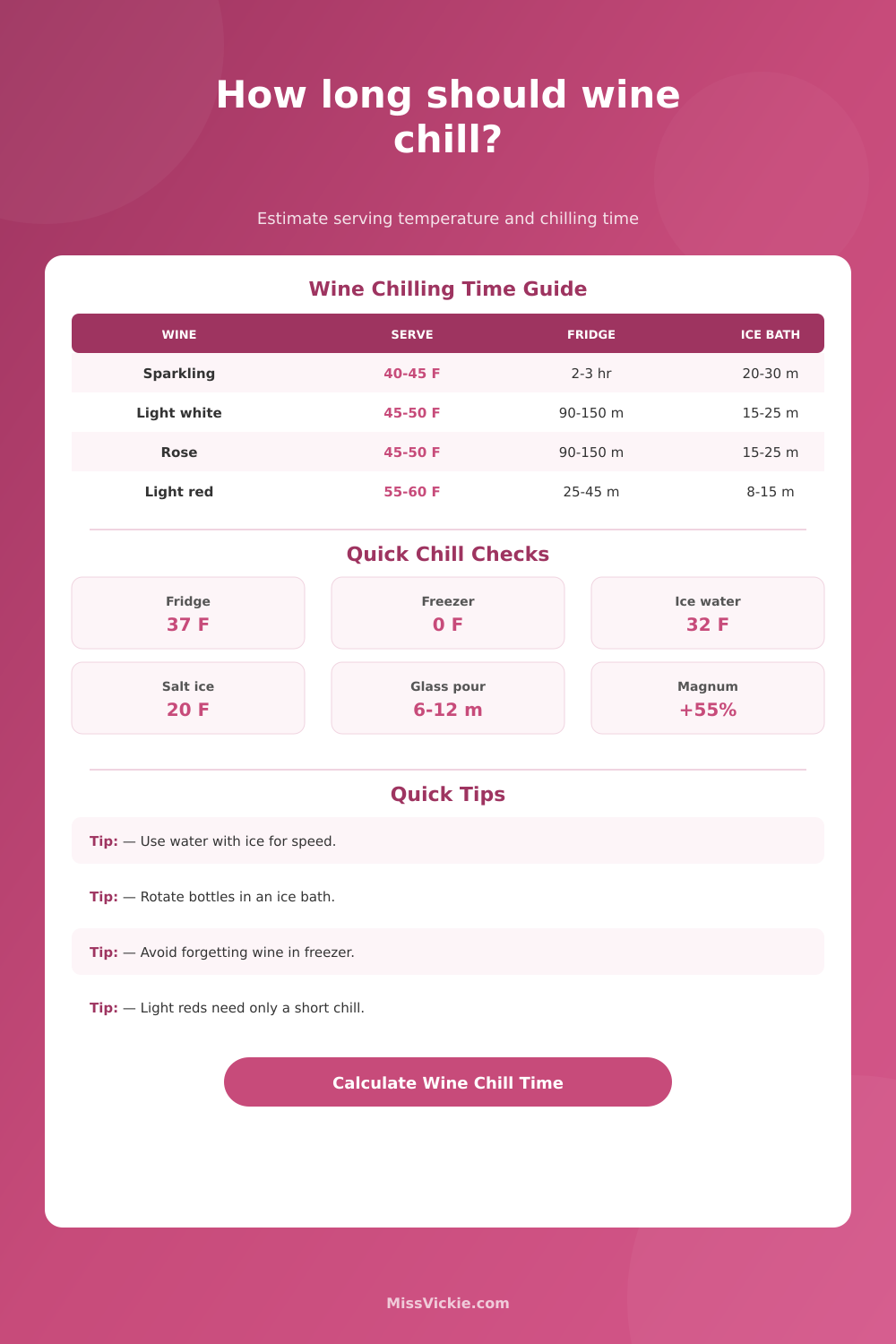
Wine Chilling Time Calculator
Estimate how long to chill wine from its starting temperature to a target serving temperature using wine style, bottle size, chilling method, ice-and-salt strength, fridge temperature, glass versus bottle service, and serving time.
🍷 Wine Chilling Presets
Pick a common serving situation, then adjust the bottle size, starting temperature, target temperature, chilling method, ice bath salt, appliance temperature, service format, and deadline.
⚖ Chilling Details
Light white wine chilling plan
Estimate updates automatically as you change the wine, method, and deadline.
Temperature Breakdown
Method Breakdown
Serving Plan
🌡 Serving Temperature Snapshot
📋 Wine Style Serving Temperature Table
| Wine style | Typical serving temp | Why that range works | Common warning |
|---|---|---|---|
| Sparkling wine or Champagne | 40-45 F | Cold service keeps bubbles lively and acidity crisp. | Too warm can foam and taste broad. |
| Light white wine | 45-50 F | Highlights citrus, mineral notes, and freshness. | Too cold can mute aroma. |
| Full-bodied white wine | 50-55 F | Lets texture, oak, and ripe fruit show. | Too warm can feel heavy. |
| Rose wine | 45-50 F | Keeps fruit bright without flattening the finish. | Very cold can hide delicate aroma. |
| Light red wine | 55-60 F | A short chill sharpens fruit and softens alcohol heat. | Freezer time is easy to overdo. |
| Full-bodied red wine | 60-65 F | Cooler than a warm room keeps alcohol balanced. | Overchilling can make tannin feel hard. |
⏱ Chilling Method Time Table
| Method | Best use | Typical 750 ml drop | Control note |
|---|---|---|---|
| Refrigerator shelf | Planned chilling with low risk | 90-180 minutes | Slow but gentle and predictable. |
| Freezer, monitored | Fast correction before dinner | 35-70 minutes | Set a timer to avoid frozen wine or pushed corks. |
| Ice water bath | Best all-around quick chill | 15-35 minutes | Water contact beats ice alone. |
| Ice and salt bath | Emergency chilling | 10-25 minutes | Rotate and check often because it can overshoot. |
| Frozen sleeve | Tabletop touch-up | 25-55 minutes | Works best on standard bottles with full contact. |
| Ice bucket without water | Holding already chilled wine | 45-100 minutes | Slower because air gaps insulate the bottle. |
🍾 Bottle Size Modifier Table
| Container | Volume | Time effect | Planning note |
|---|---|---|---|
| Split or piccolo | 187 ml | About 45% faster | Excellent for quick sparkling service. |
| Half bottle | 375 ml | About 25% faster | Check sooner than a standard bottle. |
| Standard bottle | 750 ml | Baseline | Most reference charts assume this size. |
| Liter bottle | 1 L | About 15% slower | Useful for porch wines and large formats. |
| Magnum | 1.5 L | About 55% slower | Start early or use a deep ice-water bucket. |
| Glass pour | 5-6 oz | Very fast | Chills quickly but warms back up quickly. |
📐 Calculation Factor Table
| Factor | Faster setting | Slower setting | How it changes the estimate |
|---|---|---|---|
| Temperature gap | Small drop from cellar temp | Warm room to sparkling cold | Uses a cooling curve, so the last few degrees take longer. |
| Chilling medium | Moving ice water or salt bath | Still refrigerator air | Water and contact area increase heat transfer. |
| Container mass | Glass pour or half bottle | Magnum or boxed pouch | More liquid mass slows the temperature change. |
| Service deadline | More time than needed | Less time than needed | Calculator compares estimate with minutes until serving. |
| Ice bath salt | Standard or strong salt bath | No water, no rotation | Salted slush can cool below 32 F, so checks must be frequent. |
🔍 Chilling Method Comparison Grid
Best when dinner is hours away and you want low-risk, even chilling without close attention.
Good for quick correction, but use a timer because the bottle keeps cooling after you forget it.
Usually the fastest controlled method for a whole bottle because water hugs the glass.
Useful for one warm serving, but the wine warms quickly once it leaves the cold source.
💡 Wine Chilling Tips
This calculator estimates chilling time for serving quality, not food safety. Freezer chilling should be monitored with a timer, especially for sparkling wine and cork-finished bottles.
With good intentions, you pop open a crisp white whine but find yourself sipping something flat and one dimensional. While the vintage might not be the issue, it’s usually due to how (and at what temperature) you serve it. When we go for wine, most of us is guessing, switching wildly between lukewarm heaviness and freezer burn numbness. Temperature make all the difference: cold kills aroma while warming up pumps up the alcoholic bite.
To hit that sweet spot, though, intuition isn’t enough. Heat transfer is a slow physical process. The calculator above do the math for you, so you can remove guesswork from deciding when to pull it out of the fridge (or ice bath).
How to Serve Wine at the Right Temperature
This also goes to chemistry: wine is deeply affected by temperature. Pouring a bottle of Sauvignon Blanc at forty degrees taste acidic, sharp, with muted floral features. Increase that same bottle to fifty-five degrees and the fruit flavors dissapears, replaced by aggressive acidity. A big Cabernet served at room temperature can be hot and disjointed; the alcohol vapor reaches your palate too fast. Serving a big red slightly cooler than standard cellar temperature soften the harsh tannin and reveals the subtle layers of fruit. This counterintuitive fact trips up many a drinker who thinks all reds should be in the warmest part of house. It’s not about just cooling the wine but preparing it for its intended style, and this is what tool accounts for in terms of these very specific stylistic targets.
Thermal conductivity and surface area contact determines chilling speed. Air is an insulator, so an empty ice bucket is not great. The air pockets between ice cubes and bottle prevent good heat exchange. However, if you add some water to that bucket, it all changes. Liquid conducts heat better than solid ice. This simple physics lesson is why a standard bottle will chill in about twenty minutes in an ice-water bath, but can takes over two hours on a refrigerator shelf. Because people under-estimate just how long air-based cooling will take, wine is too often served warm right before dinner.
Volume is yet another dimension that goes unnoticed by the casual drinker. Although a double-bottled magnum contains twice as much wine, it’s not going to chill at half the speed since mass have some resistance to heat transfer. To put it simply, it will take way longer for inner portion of a big bottle to reach coldness compared to its glass exterior. That translates into much colder (or much longer) conditions for your party bottle different than its normal-sized seven-fifty milliliter counterpart. The table below spells this out nicely and shows why you have to plan differently depending on format. If you ignore the volume issue, you’ll end up under-chilling the edges while the middle stay warm: a recipe for an uneven pour experience.
In an emergency, adding salt creates a chemical short cut. When put into ice water, the salt will reduce the freezing point of mixture and cause the water to turn into a slush that cools far below thirty-two degrees fahrenheit. This rapid cooling is effective but dangerous because it has the potential to cool the wine down way past where you intended. Too cold wine contracts expanding the fluid which can push out corks or in extreme cases crack the glass. Monitor this quickly to avoid harm and reach your goal fast. Remember you wouldn’t of want to overshoot and go into freezing territory.
And then there’s the issue of timing: Once out of the cold, wine will still continue to warm, particularly if you pour it into a room-temperature glass. An opened bottle will lose coolness faster than a decanter or even a single-serving glass left sitting in the room, exposed to air. This calls for planning, accounting for that temperature delay and bringing the wine out a little bit ahead of time, rather than waiting until the very last second. What you want is to have the wine perfectly timed for when your guests sit down, not twenty minutes beforehand.
The truth is, there aren’t strict rules to mastering wine temperature. It’s all about making heat transfer as efficient as possible. What medium do I use? Should I use water, air, or salted slush? The faster, the better. How much do I cool? How much mass am I cooling, such as large format or standard bottles? What temp should I hit? You need a narrow temperature range where the wine’s character shines without being hidden.
If you pick the right technique at the right time, each glass will be intentional. The wine you poured was delivered to your table exactly as the winemaker intended, with the fruit, acid, and alcohol perfectly balanced.