
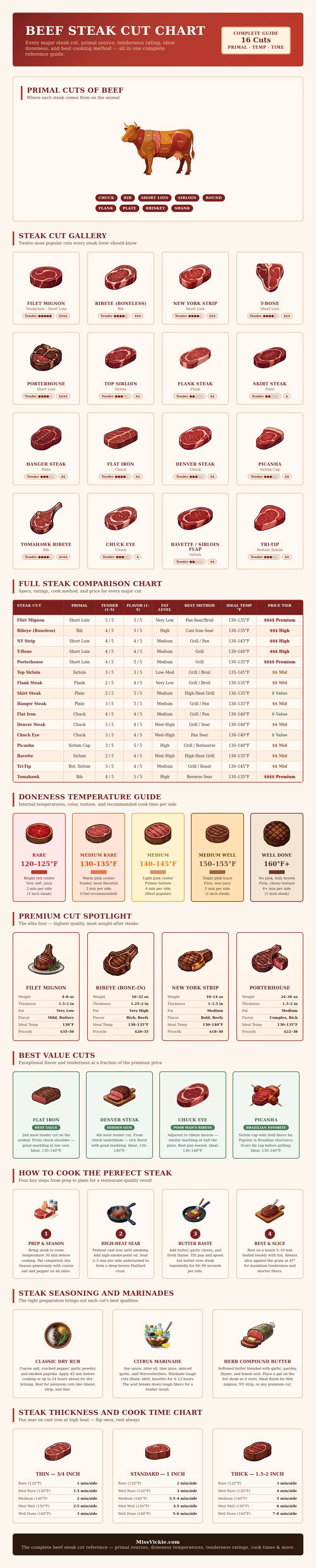
Butcher shops are no different: in order to know what to get at the butcher shop, you need to understand which cuts comes from what part of the body. For example, if you’re looking for something very tender, yet strongly flavored with the taste of beef, you’ll probably find those two traits on opposite sides of animal.
Understanding where your cut originates will determine how you plan to prepare it. For instance, the rib, the round, and the chuck areas produces certain cuts (the chart above). From this, you can guess about meat’s texture without even taking it home.
How to Choose and Cook Steak
Along the spine is where you find the tenderloin. Because it doesn’t do much work throughout the animal’s lifespan, it stays mild and soft. Since it contain no hard connective tissue, it has a buttery texture. Because of its tenderness, filet mignon (a cut of tenderloin) are also expensive. You’re not getting a ton of flavor; you’re paying for the texture.
Other cuts. Those taken from the hind quarter or shoulder, is different. Those muscles work harder and therefore create more connective tissue which in turn creates richer flavor. The tougher cuts needs to be handled carefuly. Cook a flank steak like a ribeye and it’ll get tough. A lot of folks make this error because they think all steaks should of being prepared the same way.
Good results come from knowing how to control temperature. The length of cook time isn’t as critical than maintaining the proper internal temperature. If you have a thick cut, let it cook first over indirect heat in the oven or off the grill then apply high heat. For a thinner cut like skirt steak, put it directly on fire, only a couple seconds. Aim for an internal temp of about 130 degrees when your goal is medium rare (juicy). If it goes over 150 degrees, meat will get chewy, fast. Moisture leaves faster then that. Resting the meat after cooking lets the juices move around. Small step, big difference in taste.
There’s no reason for buying expensive cuts of meat to enjoy a good steak. In the chuck section, there is some good values to be found. There is the flat iron steak, which is tender with marbling, but at a lower price tag different than ribeye. Just make sure when cutting into it that you cut across the grain, otherwise it will lose tenderness. Then you have hanger steak, which holds its own in strength of flavor when compared to pricier steaks. Know how to prepare these cheaper cuts and they’ll do just fine. It’s better to sear a cheap cut right than grill an expensive one wrong.
Before applying heat, prepare. Letting the meat come up to room temp help it cook evenly. Dry the meat off with paper towel. Moisture doesn’t allow browning. A dry surface let the Maillard reaction occur. That’s how the brown crust forms and adds flavor. Season with salt & pepper and wait. Salt will go into the meat, instead of sitting on top.
Put the steak in a hot pan away from you (that’s where the oil would splash). Don’t mess with the steak as it sears or no crust will ever form. Turn it over when the crust is formed and finish. Good cuts is better handled simply.
Selecting a steak is an art of price, taste, and texture. Ribeye has strong flavor; tenderloin provides tender leanness. You can see it in image guide. But how do you execute? It’s technique. Let the meat rest, let the grill cook with patience and follow the grain of the muscle.