Rice Noodle Soaking Time Calculator
Estimate rice noodle soaking time from noodle width, dry weight, water temperature, dish type, finish method, brand thickness, batch size, target chew, and drain rest.
🍜Rice Noodle Presets
Pick a common noodle job, then adjust the exact noodle width, dry weight, water temperature, brand thickness, dish style, finish method, batch size, chew target, and drain rest.
⚖Noodle Soak Inputs
Rice noodle soaking plan
Enter your noodle details to calculate a soaking window.
Hydration Breakdown
Serving and Finish
Step Plan
📌Current Batch Snapshot
📊Soak Method Comparison
Gentle for fragile noodles, but slow for flat or thick cuts.
Best control for stir-fry noodles that finish in a pan.
Fastest option; test early so edges do not turn mushy.
Soak less because simmering broth completes the center.
📘Rice Noodle Width Reference
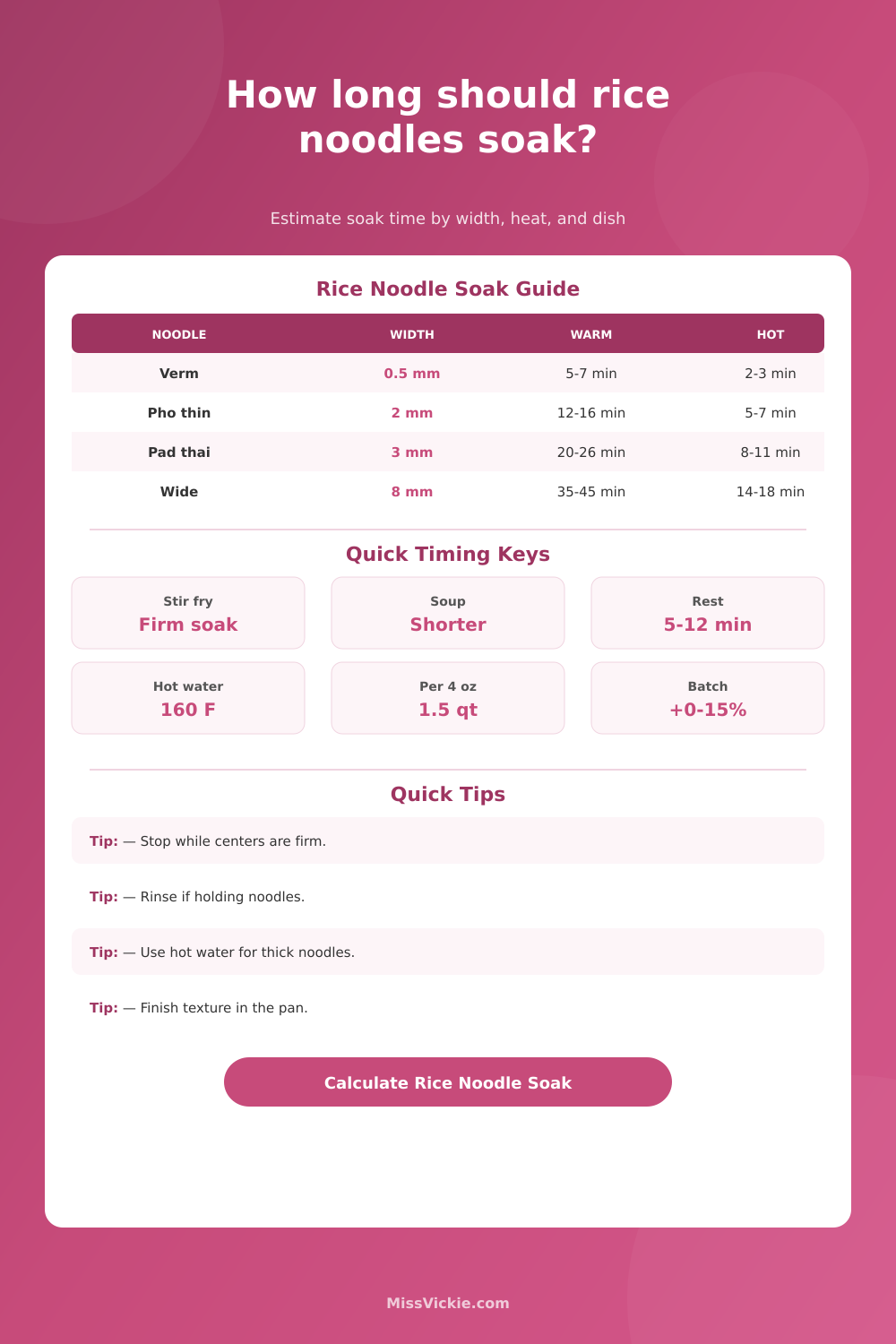
| Noodle Style | Typical Width | Warm Water Start | Best Use | Stop-Soak Cue |
|---|---|---|---|---|
| Rice vermicelli | 0.5 mm | 5 to 7 min | Salads, rolls, bun bowls | Flexible strands, no chalky core |
| Small bun noodles | 1 mm | 8 to 11 min | Bowls and light soups | Springy, slightly firm center |
| Thin pho noodles | 2 mm | 12 to 16 min | Pho, quick soups, stir-ins | Soft edges with a faint center line |
| Pad thai sticks | 3 mm | 20 to 26 min | Pad thai and wok noodles | Bends easily but still underdone |
| Medium flat noodles | 5 mm | 26 to 34 min | Saucy stir fries | Center is firm, not brittle |
| Wide rice noodles | 8 mm | 35 to 45 min | Pad see ew style dishes | Supple sheet, no cracking |
| Extra-wide cut sheets | 12 mm | 45 to 60 min | Very wide stir fries | Evenly bendable from edge to center |
| Round thick noodles | 4 mm | 24 to 32 min | Laksa, curry soup, sauced bowls | Round center still lightly chewy |
🔥Dish and Finish Adjustment Table
| Dish Type | Soak Target | Finish Heat | Texture Goal | Common Mistake |
|---|---|---|---|---|
| Hot wok stir fry | Firm, slightly underdone | 2 to 3 min | Springy, separate noodles | Soaking until fully tender before frying |
| Saucy stir fry | Firm to medium | 3 to 4 min | Sauce absorbed without breakage | Skipping the drain rest |
| Soup bowl | Shorter soak | 1 to 5 min in broth | Tender center after broth contact | Starting with fully soft noodles |
| Cold salad | Nearly tender | No extra heat | Clean bite after rinsing | Using boiling water on vermicelli |
| Fresh rolls | Soft and pliable | No extra heat | Easy rolling, not sticky | Over-resting in a pile |
| Meal prep hold | Firm and rinsed | Reheat later | Loosened with sauce or broth | Holding wet noodles uncovered |
🌡Water Temperature Timing Guide
| Water Temperature | Best For | Timing Effect | Risk | Kitchen Cue |
|---|---|---|---|---|
| 70 to 85 F | Fragile or thin noodles | Slowest, most forgiving | Long waits for wide noodles | Feels barely warm or room temp |
| 95 to 115 F | Controlled stir-fry prep | Moderate hydration | Needs occasional stirring | Warm tap water feel |
| 120 to 145 F | Pad thai and medium flats | Fast but manageable | Edges soften before centers | Steamy but not scalding |
| 150 to 170 F | Thick brands and wide noodles | Very fast hydration | Can over-soften quickly | Hot kettle water cooled briefly |
| 175 to 190 F | Emergency quick soak only | Shortest time | Mushy edges, breakage | Near-boiling, test early |
🥣Batch Size and Water Volume Table
| Dry Noodles | Approx Servings | Minimum Water | Better Water | Stir During Soak |
|---|---|---|---|---|
| 2 oz / 57 g | 1 light serving | 3 cups / 0.7 L | 1 qt / 0.95 L | Once halfway |
| 4 oz / 113 g | 1 to 2 servings | 1 qt / 0.95 L | 1.5 qt / 1.4 L | Once or twice |
| 8 oz / 227 g | 3 to 4 servings | 2 qt / 1.9 L | 3 qt / 2.8 L | Every 5 to 8 min |
| 14 oz / 397 g | 5 to 7 servings | 3.5 qt / 3.3 L | 5 qt / 4.7 L | Several lifts with tongs |
| 24 oz / 680 g | 9 to 12 servings | 6 qt / 5.7 L | 8 qt / 7.6 L | Separate in a wide pan |
Reference times are starting points for dried rice noodles. Fresh rice noodles, instant noodles, and wheat noodles need different timing.
💡Rice Noodle Timing Tips
There’s a particular type of desperation that comes from purchasing vacuum-sealed packages of dried rice noodles. When you bring those home, what appeared harmless on the shelf becomes stiff sticks on the countertop. Snap! They does not bend. Oh, no, I wanted to eat some Pad Thai, not break off chunks and eat them in a bowl.
There’s nothing wrong with the recipe; it’s just about getting the rice noodles hydrated at exactly the right time and under exactly the right conditions. If you cook them like pasta, they will be mushy by the time the sauce is done. If you soak them in cold water for an hour first, some piece might not finish cooking in the wok. It’s all about catching them at just the right instant. They should of be pliable yet still have a solid core, leaving enough space for the rest of the heat to complete the cooking process.
How to Cook Rice Noodles Perfectly
That’s where the calculator comes in (above). It take away all the guesswork. It factors in things that home cooks usually just overlook. It factors in brand and thickness of the noodle, it factors in the batch size, and most importantly it factors in the width of the noodle.
Thinner vermicelli noodles is quick to absorb the water. Because Pad see ew noodles are wide, they take longer for water to soak through. Based off these details, the calculator tweaks your soak window so you don’t end up with broken noodles or gooey gunk.
And then it factors in the size of your batch. Why? They hydrate unevenly when piled into a big bowl compared to when they are spread out on a large pan. The variable you have the most direct influence on is water temperature. For thick noodles, hot water will speed up everything. But there’s a greater chance that your center remain chalky and your edges gets all mushy. With warm water, you’ll have more time to check in before they’re done, you won’t be rushed.
That’s where the calculator can help. By selecting the type of noodle you’re making and the temperature of your water, it will tell you exactly how many minutes you should wait. It will even calculate the amount of water you need so you don’t make the same mistake everyone else makes: not having enough liquid to evenly hydrate your noodles, resulting in sticky noodles.
Just as critical is how you intend to serve it. Do you want slightly underdone pasta after soaking? For example, do you want it for stir fries? Agitate it in the hot wok and it’ll complete cooking while absorbing some sauce and getting some good texture. Or do you want to serve it in soup? Then maybe soak it a bit more, because soup does not have such fierce heat than a screaming-hot pan. The implement takes that into account. Use a shorter soak time if serving in a pot of quickly simmered broth, so you don’t start out with completely tender pasta that falls apart in the hot liquid.
Another no-no is not resting the noodles after draining. When left alone, the excess water on top has time to balance out with the inside where it’s drier. You’ll end up with more evenly cooked noodles and a better chew. Your noodle thickness and soaking time determine how long it should rest (the calculator tells you).
There’s also an explanation of how much they will swell (by weight) when soaked. Knowing this makes planning your portion size easy… Since rice noodles typicaly double or even triple their original dry weight once hydrated. Avoid running out of ingredients at the last minute.
Rice noodle perfection is all about timing (and, of course, expectations). Don’t rush the process. Rushing will ruin the texture because the noodles won’t have enough time to soak up water propery. What’s important is that you get the noodles nearly-done beforehand, and your cooking technique can finish them off. Submerging them in broth? Tossing them around in a wok? Soaking them sets the stage.
Decide what kind of noodles you’re going to use and how you want to serve them, and you’ll be less worried about breaking noodles and more concerned with perfecting the sauce. That confidence make the whole meal better.