
Next thing you know, you’re holding a package of ribeye in your hand in meat aisle. It sounds great on paper, but then it’s dry on the plate. Why? Because you think all beef are created equal when it comes to cooking.
Freshness isn’t everything. There’s also muscle usage and fat distribution, things which actualy affect the quality of the beef. Knowing this makes shopping less about guesswork; it is now a matter of calculation. Here’s where the USDA grading system come in, although there’s a lot of nuance within it that most consumers don’t see (or notice).
How to Choose and Cook Beef
Only a sliver of all graded meat are considered Prime. That’s the super-marbled stuff that melts away as it cooks, keeping muscles moist and soft even if you overshoot target by just a hair. Then you’ve got Choice grade, the workhorse of the grocery store. Small- to moderate-sized marbling mean that it needs a little bit more care than Prime. However, it will reward your efforts with great results if you take proper care of it. Next, you have Select grade. Very little fat mean very little moisture from meat itself. So, it depends much less on its own chemical makeup and more on what you do to it.
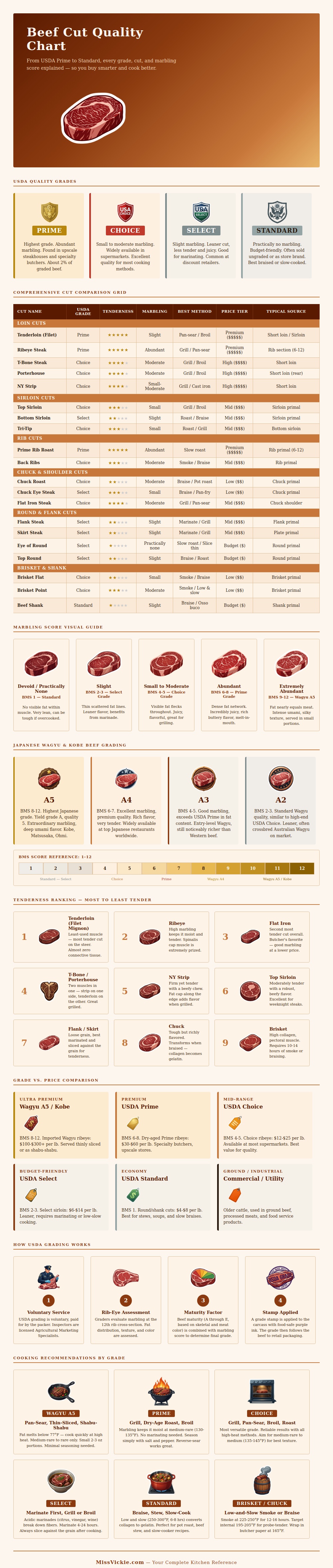
Here’s the chart, which lays out this quite plainly: The chart shows connection between marbling score, price level and tenderness. Generally speaking, more marbling means a higher price and (usually) more forgiveness at grilling time.
Next, consider more than just grade. There’s also question of primal cut. Naturaly, the more a muscle is used, the less tender it will be. If you look at the tenderloin, which resides along the spine and is hardly exercised. It’s incredibly soft but also fairly light in flavor compared to richer cuts.
Then there are muscles at the opposite end: the brisket and chuck. These gets exercised a lot and are full of dense connective tissue. When cooked quickly over a hot grill, that tissue results in tough meat. That’s where a lot of home cooks goes wrong. They’ll apply high-heat methods to low-value cuts, slap them on a hot grill and ask “why is this meat so chewy?
It is not because your knife is bad; you just need to put it in oven and wait. Slow smoking or braising those tougher cut breaks down the collagen into gelatin, converting what would of been a chewy steak into something meltingly tender.
The prices are often misleading (why do they appear to scale up and down quality strangely?). You’ll see a Wagyu A5 ribeye that’s a couple hundred dollars per pound (because of its special breeding standards and super-high level of marbling). And you’ll have another cut at the opposite end off the spectrum (such as a chuck roast). But a well-made inexpensive cut can taste superior to an overpriced fancy cut made badly.
This graph shows this connection between marbling levels (as indicated by the score) and appropriate preparation (as suggested by the recommended cooking methods). Observe how the recommendations moves from “sear” for more highly-marbled selections to “braise” for tougher, less marbled options. It’s not necessarily about your bank account; it’s about choosing the right technique for the proper meat structure.
In sum, purchasing beef well is not a quest for the most expensive grade regardless of price. It’s about knowing the animal’s history and reading the label. You need to know which muscle you’re getting, choose a cooking style that respects that muscle, and go all-in on how that cut needs to be prepped. This applies whether you’ve spent $20 on a prime steak or just a few bucks on a round roast.
Preparation in harmony with the nature of the cut is the only way to change an ordinary slab of protein into something memorable. That is when the whole experience, from butcher shop to plate, completes itself.