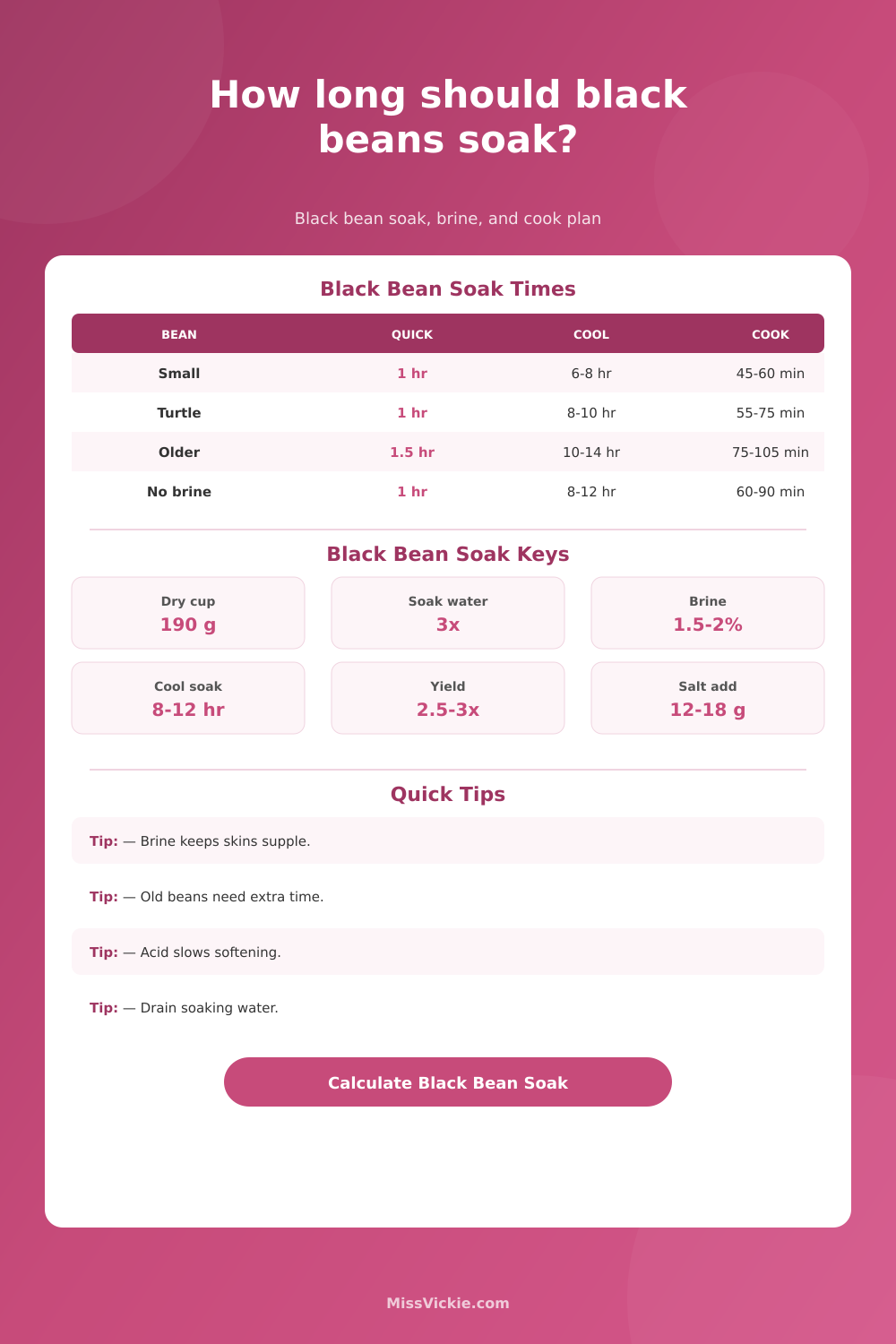
Black Bean Soaking Time Calculator
Estimate black bean soaking time, brine salt, soak water, stovetop or pressure cooking time, and cooked yield from bean age, bean size, soak temperature, water chemistry, altitude, and texture goal.
🫘 Black Bean Presets
Pick a kitchen scenario, then tune the dry amount, bean age, soak style, brine strength, water hardness, altitude, cooking method, and target tenderness.
⚖ Soak And Cook Inputs
Black Bean Soak Plan
Your soaking, brining, and cooking window will appear here.
Measured Batch
Timing Adjustments
Kitchen Sequence
📌 Batch Snapshot
📊 Black Bean Reference Tables
| Black Bean Type | Best Soak | Stovetop Time | Cooked Yield |
|---|---|---|---|
| Small black beans | 6 to 8 hours cool, 4 to 6 warm | 45 to 60 minutes | 2.6 to 2.8 cups per dry cup |
| Standard turtle black beans | 8 to 10 hours cool, 5 to 7 warm | 55 to 75 minutes | 2.5 to 2.8 cups per dry cup |
| Large black beans | 9 to 12 hours cool, 6 to 8 warm | 65 to 90 minutes | 2.6 to 2.9 cups per dry cup |
| Older pantry black beans | 10 to 14 hours cool, brine preferred | 75 to 105 minutes | 2.4 to 2.7 cups per dry cup |
| Broken or split-heavy bag | 4 to 6 hours cool, sort well | 35 to 55 minutes | 2.2 to 2.5 cups per dry cup |
| Dry Amount | Soak Water | 1.5% Brine Salt | Cooked Beans |
|---|---|---|---|
| 1 cup / 190 g | 3 cups / 0.7 L | 11 g fine salt | 2.5 to 2.8 cups |
| 2 cups / 380 g | 6 cups / 1.4 L | 21 g fine salt | 5 to 5.6 cups |
| 4 cups / 760 g | 12 cups / 2.8 L | 43 g fine salt | 10 to 11.2 cups |
| 1 lb / 454 g | 7.2 cups / 1.7 L | 26 g fine salt | 6 to 6.7 cups |
| 2 lb / 908 g | 14.3 cups / 3.4 L | 51 g fine salt | 12 to 13.4 cups |
| Use Case | Texture Goal | Brine Choice | Finish Cue |
|---|---|---|---|
| Tacos and bowls | Creamy but intact | 1.5 percent salt | Bean mashes with a fork |
| Black bean soup | Brothy and soft | 1 percent salt | Some beans split naturally |
| Salads and freezing | Firm and separate | 2 percent salt | Center is tender, skin holds |
| Dips or refried beans | Very soft | 1.5 percent salt | Beans crush easily |
| Chili base | Intact after simmering | 0 to 1 percent salt | Finish in chili liquid |
| Factor | Soak Change | Cook Change | Reason |
|---|---|---|---|
| Hard water | Add 1 to 2 hours | Add 10 to 20 percent | Minerals slow skin softening |
| Acid added early | Add 2 to 4 hours | Add 20 to 35 percent | Acid firms bean cell walls |
| Warm soak | Trim 25 to 35 percent | Trim 5 to 10 percent | Water enters beans faster |
| Very old beans | Add 3 to 5 hours | Add 30 to 50 percent | Moisture loss slows hydration |
| Pressure cooking | Still useful | Trim about 65 percent | Higher pressure raises heat |
🔍 Soak Method Comparison
Best for pressure cooking, but stovetop skins can split before centers soften.
Good same-day option after a brief boil, especially for normal pantry beans.
Most predictable for black beans that need creamy interiors and intact skins.
Helps skins soften evenly and usually reduces split, chalky beans.
💡 Black Bean Timing Tips
Calculator estimates assume dry black beans that are rinsed and sorted. Actual cook time varies with storage age, pot shape, burner output, and how often the lid is opened.
Soaking dry black beans is more of a chemistry experiment than a vague suggestion. To soak them, rinse the beans, pour water over them and wait until morning. If all goes right, lucky!… You’re in business. If your water is hard, your beans are old, or you toss in some tomatoes before the skins loosen, it won’t work well.
How does moisture get inside bean (without disrupting its internal structure)? It’s the key to whether you have creamy legumes… Or a chalky mess. Control the variables by using precision. One variable that spoils so many batches is how old your beans are. Moisture escaped through tiny pores in bag over time. Dry seeds will be slower to plump up and they does so unevenly.
How to Soak Black Beans Correctly
Soaking older beans for eight hours can mean their outsides will have gone soft while centers stay hard as a rock come cooking time. Longer soak for older beans, and sometimes a salt brine is helpful. The salt relaxes the pectin in their cell walls making it easier for water to penetrate more consistentely. The skins will not burst before the insides soften.
Water chemistry is equally significant. Calcium and magnesium ions in hard water form bonds with compounds that softens plant tissues. In hard water areas, no amount of soaking time will make your beans become creamy. This calculator assumes a hard water setting. It adds to the suggested soak time to match the mineral barrier that slows down diffusion.
Other acidic ingredients such as vinegar or tomato paste has an effect on texture as well. Acid firms up protein, which is good for bean salads but not so much for refried beans. Wait to add any acid till after beans are softened.
Cooking changes at higher altitudes As you go higher in elevation, the boiling point of water is lowered. Your simmering pot will be cooking slower then it would otherwise. Because of this, the beans won’t fully cook until later than expected. By entering the new elevation into the tool, it extends the cook window to compensate for this. That way, you aren’t left with crunchy centers after waiting another hour.
There is no one right way because that depends on the texture you desire. Beans for mashing (or for dips) need to be as soft as possible; a gentle simmer after a long cool soak will help them split naturaly. Salad or other whole beans (such as taco filling) need to retain some of their form. To achieve this, use a firmer brine concentration which will strengthen the skins a bit against the agitation. The tables of reference link combinations of cook time and brine strength to desired texture. Choose the texture desired; the math provides when it’s ready.
I’ve seen many people avoid soaking altogether, particularly those who use pressure cookers. When cooking straight-from-the-package without pre-soak in a pressure cooker, you never know how evenly cooked your beans are going to turn out: some will be perfectly tender, while others will still be rock-hard. By soaking first, all the seeds begins at roughly equal levels of moisture. Spending a little more time at first leads to steady results later.
If you’re forgetful like me and haven’t thought ahead about an overnight soak, there’s a middle ground: quick soak. To do this, just cover with water, bring to a boil, then remove from heat and let stand for an hour. While this won’t achieve the same gradual, gentle re-hydrating as a cool-overnight soak, it’ll get you significantly closer than dried beans alone.
Growing black beans is all about moving water around. You move it in, but only enough so that it doesn’t tear down the structure too fast. Plugging in your unique conditions into the calculator makes it run the numbers for you. It removes variables like hardness of the water or age of the beans from the guessing game. When things don’t go according to your plan, understand those variables so you can make adjustments.
Before you put the beans into the pot, mush one between your finger tips. If it mashes without being gritty in the middle then you’ve done good. If not, wait longer. More patience means better results.