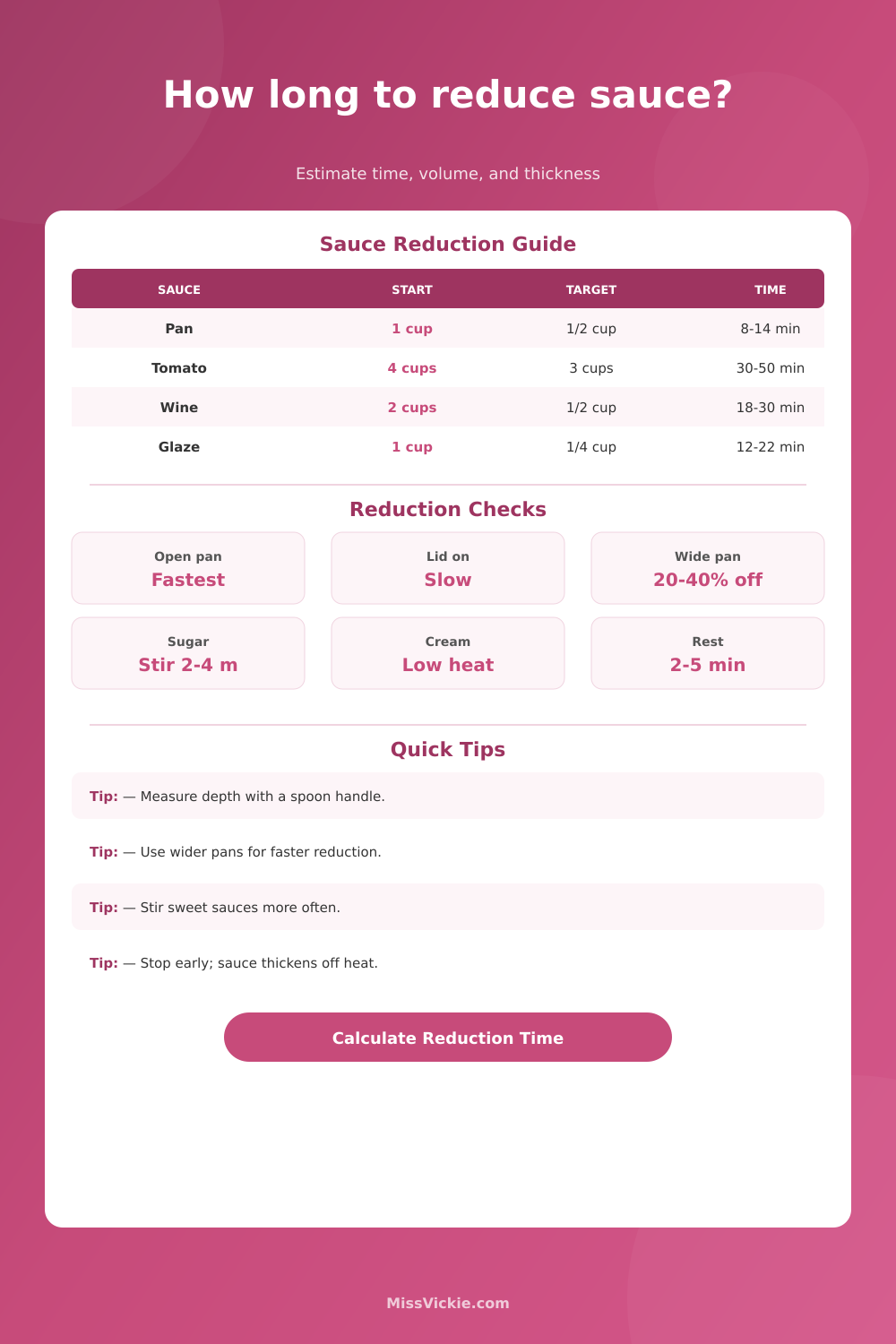
Sauce Reduction Time Calculator
Estimate how long a sauce reduction will take from starting volume, target volume and thickness, pan diameter, heat level, sugar or fat content, lid position, simmer vigor, sauce type, and stirring interval.
🥄Reduction Presets
Choose the closest kitchen situation, then tune the volume, pan width, heat, lid, simmer vigor, sugar or fat level, and stirring rhythm.
⚖Reduction Details
Sauce reduction plan
Enter the sauce setup to estimate time, volume loss, stirring, and finish texture.
Time Factors
Volume And Thickness
Reduction Schedule
📏Reduction Snapshot
📋Sauce Reduction Time Table
| Sauce Type | Typical Reduction | Best Heat | Stirring | Stop When |
|---|---|---|---|---|
| Pan sauce or skillet jus | 25% to 60% | Medium-low to medium | Every 1 to 3 minutes | Sauce lightly coats a spoon and looks glossy. |
| Tomato sauce | 15% to 35% | Low to medium-low | Every 5 to 10 minutes | Watery edge disappears and tomato flavor tastes round. |
| Wine or vinegar reduction | 50% to 75% | Medium-low | Every 2 to 4 minutes near the end | Raw alcohol or vinegar bite has softened. |
| Cream or coconut sauce | 10% to 30% | Low to medium-low | Every 2 to 5 minutes | Small bubbles thicken the sauce without breaking. |
| Fruit sauce or glaze | 35% to 70% | Low to medium-low | Every 1 to 3 minutes | Drops run slowly and the sauce looks shiny. |
| Stock or demi-glace | 50% to 90% | Low to medium-low | Every 5 minutes, then often late | Flavor is concentrated and the texture is syrupy. |
🔥Heat, Lid, And Pan Diameter Table
| Setup | Speed Effect | Best For | Watch For | Practical Move |
|---|---|---|---|---|
| Wide open skillet | Fastest evaporation | Pan sauce, wine, glaze | Final minutes move quickly | Lower heat once bubbles get thick. |
| Narrow saucepan | Slower evaporation | Small batches and cream sauce | Longer time than expected | Use a wider pan if flavor is ready. |
| Splatter screen | Slightly slower | Tomato, berry, sweet glaze | Hidden thickness changes | Lift and check spoon coating often. |
| Cracked lid | Much slower | Messy sauces and meat gravies | Steam returning to the pan | Uncover for the last third. |
| Mostly covered | Minimal reduction | Holding or braising | Sauce may not thicken | Remove lid before reducing. |
🥄Target Thickness Table
| Target | Visual Test | Common Use | Carryover | Stir Pattern |
|---|---|---|---|---|
| Loose spoonable | Runs freely from spoon | Pasta, stew sauce | Low | Normal stirring is enough. |
| Coats spoon | Thin film on spoon back | Pan sauce, gravy | Moderate | Stir more near the end. |
| Nappe | Finger line stays clear | Restaurant-style sauce | Moderate to high | Scrape corners and edges. |
| Glossy glaze | Slow thick drips | Meat glaze, fruit sauce | High | Stir constantly in final minutes. |
| Concentrate | Syrupy and intense | Demi, stock reduction | Very high | Use low heat and a clean pan. |
🧂Sugar And Fat Behavior Table
| Content | Effect On Time | Scorch Risk | Breaking Risk | Adjustment |
|---|---|---|---|---|
| Lean stock or wine | Evaporates cleanly | Low | Low | Reduce to taste, then mount butter late. |
| Moderate sugar | Thickens slightly early | Medium | Low | Lower heat once bubbles look larger. |
| High sugar or honey | Appears thin until concentrated | High | Low | Use low heat and frequent stirring. |
| Butter or pan fat | Can slow visible thickening | Medium | Medium | Reduce liquids first, whisk fat in late. |
| Cream or coconut | Reduces gently | Medium | High | Avoid hard boiling and sudden high heat. |
| Roux or starch | Thickens before much evaporation | Medium | Low | Judge by texture, not volume alone. |
🔍Reduction Method Comparison Grid
Wide skillet, open pan, medium-low heat, and small starting volume after deglazing.
Lower heat protects cream, coconut milk, and mounted butter from splitting.
Sugar makes the last few minutes risky, so stir closely and stop before it looks too thick.
Stock and demi-glace reductions reward low steady heat and flavor checks as water leaves.
💡Sauce Reduction Tips
This calculator estimates reduction timing for kitchen planning. Actual timing changes with pan material, burner output, altitude, sauce solids, and how often the sauce is stirred.
It happened to you before, maybe right now, the pan sauce you made was thin and watery, but not so much that it lacked any body whatsoever. You wanted make it cling to the meat, glossy, not pool on your plate. So what do you do? Crank up burner and wait…for magic.
In cooking, magic doesn’t happen too often. Instead we rely on science. Reducing is nothing more than controlling evaporation to turn water into concentrated flavors. But here’s the issue, kitchens are all over the place. Evaporation isn’t driven by temperature so much as surface area. If one pot piles liquid high while another spreads it out, the exact same sauce on each stove eye can result in very different outcomes… Even though the sauce itself may be the same.
How to Make Your Sauce Thick and Glossy
It’s usually the reason why recipes don’t reproduce well at home, and it comes down to geometry. Plug in your initial volume and target thickness into the calculator above and it does all the math for you, no need to guess if 10 minutes is too short, or double that. It even takes into consideration things other cook fail to: How hard are you simmering? Is lid on? It traps steam against the metal or glass, which cools the top of the liquid and slows water loss considerabley. Cracking the lid open will help, but for truly efficient reduction, it’s best with no lid at all.
Since sweetness changes how heat moves in liquid, the sugar content must also be taken into account. Because it increases boiling point just a bit, the sauce may get dangerously hot before any bubbling occurs on the surface. That dangerous zone where it doesn’t bubble, but still scorches… Is invisible. Three minutes later, the fruit coulis or glaze has reached its critical temperature (the point where the sugars on bottom start burning). You don’t stir; instead, you see some gentle steam and assume it’s low heat, you’ll walk away from stove but only for three minutes. The calculator tells you when to shorten your stirring time. This is an important safety net on fruit coulis and other glazes.
Our intuitions also often trick us about thickness. Texture isn’t synonymous with lost volume. For example, you can evaporate half the volume from a wine reduction. You might still end up with thin reduction depending on what is in it. The same applies to gelatinousness and natural pectin. Evaporating even just a small amount of moisture can turn a thin tomato sauce into something thick as mud due to the solids contained within.
How do you know? How do you know when enough’s enough? That’s the tricky part. It’s easier to say how to get started. On page, there’s a reference table that lines up the type of sauce you’re trying to reduce and at what point it should be pulled off stove. With dairy-based sauces, don’t push them too far or cool them down too fast; the fat will separate. Cream sauces won’t hold an emulsion under rough treatment and crack. Gently simmering it keep that structure intact while letting go of the water.
And if you’re after demi-glace and are reducing some stock down to achieve it, then patience should of been your first ingredient. Slow and low lets the proteins sort themselves out instead of clouding the brew. This way, you end up with that jewel-like quality that good restaurants aim for. There is so much solid material in pan that you are afraid you might break or burn the scales. Pure water boils off cleanly and dissapears into air. Collagen in stock does not. The acid in tomatoes and the sugar don’t. Tannin in wine and alcohol don’t. Every ingredient responds differently when heated.
A good cook watches the bubble pattern to see signs of distress. A skilled cook doesn’t merely check the clock but the pattern of bubbles. Gentle simmer: bubbles remains on top of the surface. Violent eruption: rolling boil. Agitation will tear apart emulsions and fats. You desire quiet, steady bubbling along the rim of the pot.
At the final moment, regardless of what your timer tells you, stir frequently. When liquid reaches the stage where it sticks to itself and moves slowly, its temperature rise more slowly. It also carries heat less effectively, which forms hot spots beneath layers of concentrated flavors. That’s why the last 10% of the reduction can require as long as half the entire cooking period.
Reduction is also, in a sense, an act of respect: an awareness of the ingredient’s limit. Go too far, and what you have isn’t bitterness but separation. Pull back too soon, and instead of sauce, you have soup. Pans vary; stoves lie. Minutes aren’t absolutes. The visual clues is all you’ve got.
Follow recipe’s time estimate as a guide, then make adjustments based off how the spoon behaves in the pan. If it leaves a line behind that momentarily maintains form before filling in again, you’re at the moment. Remove from heat promptly. As the mixture cools, it will thicken further, settling into the ideal nappe consistency, which adheres to food surfaces nicely. That luster is the prize for learning to manage the steam, not fight it.