Dough Rise Time Calculator
Estimate first rise and second rise timing from dough temperature, room temperature, yeast type and percent, flour strength, enrichment, salt, dough mass, and target rise.
🧁Choose a Dough Scenario
Presets load realistic baker's percentages and temperatures. Adjust any field to match your bowl or shaped loaf.
⚖Dough Inputs
Estimated Dough Rise Window
Adjust temperature and target rise to tune the timing.
Formula Breakdown
Rise Readiness
What to Watch
- Bulk: expanded and domed, with bubbles at the bowl edge.
- Shape: dough should feel gassy but still hold tension.
- Proof: poke returns slowly and leaves a slight dent.
📊Rise Benchmarks
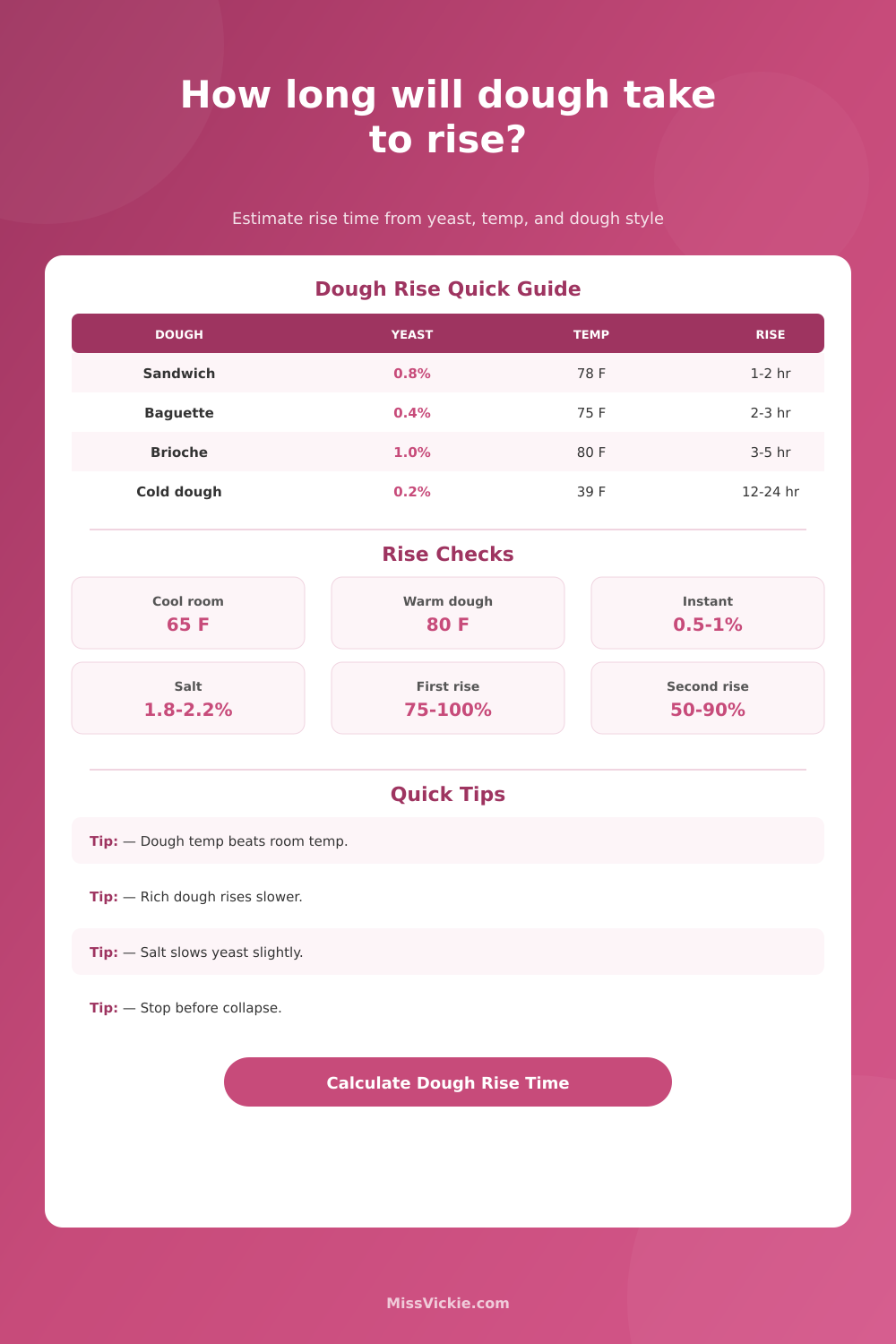
🍞Temperature and Yeast Table
| Condition | Typical Setting | Effect on Rise | Kitchen Move |
|---|---|---|---|
| Cool dough | 65-68°F / 18-20°C | Slow, steady fermentation | Expect a longer clock and more flavor development. |
| Moderate dough | 74-78°F / 23-26°C | Balanced activity | Good target for sandwich bread, rolls, and lean loaves. |
| Warm dough | 80-84°F / 27-29°C | Fast rise and softer dough | Check early; rich dough benefits most from this range. |
| Cold retard | 37-42°F / 3-6°C | Very slow fermentation | Use low yeast and allow bench time before shaping or baking. |
⚗Flour, Enrichment, and Salt Effects
| Input | Faster Rise | Slower Rise | Readiness Clue |
|---|---|---|---|
| Flour type | All-purpose, bread flour | Whole wheat, rye, high-gluten | Strong dough can proof longer before weakening. |
| Enrichment | Lean dough | Butter, egg, milk, sugar | Rich dough may need more expansion before it feels light. |
| Salt percent | 1.5-1.8% | 2.3-3.0% | High salt tightens gluten and slows yeast. |
| Dough mass | Small rolls, divided dough | Large bulk batch | Large masses hold heat and can accelerate later. |
⏱First Rise vs Second Rise
| Stage | Target Rise | What It Should Look Like | Stop Before |
|---|---|---|---|
| First rise, lean loaf | 75-100% | Domed top, bubbles, elastic feel | Collapsed center or sharp sour smell. |
| First rise, rich dough | 75-125% | Puffy and soft, not necessarily doubled fast | Greasy surface or slack structure. |
| Second rise, pan loaf | 70-90% | Crowns near pan rim and springs slowly | Dough spilling over the pan edge. |
| Second rise, hearth loaf | 50-75% | Light, slightly jiggly, slow poke return | Wrinkles, bubbles popping, or no spring. |
🧮Common Dough Timing Examples
| Dough Style | Yeast Percent | Dough Temp | Estimated Plan |
|---|---|---|---|
| Soft sandwich bread | 0.7-1.0% instant | 76-80°F | First rise 1-2 hr, second rise 45-75 min. |
| Lean artisan dough | 0.2-0.5% instant | 70-76°F | First rise 2-5 hr, second rise 45-90 min. |
| Sweet roll dough | 0.8-1.5% osmotolerant | 78-82°F | First rise 2-4 hr, second rise 60-120 min. |
| Cold fermented dough | 0.05-0.25% instant | 37-42°F | Cold rise 12-48 hr, then warm finish. |
🔄Comparison Grid
Mixes directly into flour and usually needs less by weight.
Often rises a little slower unless well hydrated first.
Use more grams than dry yeast for similar fermentation power.
Starter strength and acidity make the window wider.
💡Rise Timing Tips
This calculator estimates timing for yeasted dough. Very wet doughs, naturally leavened doughs, unusually acidic starters, and high-sugar formulas can need wider judgment at the bowl.
Until you learn that yeast reacts to physical conditions, baking bread with a timer isn’t an option. You’ll just stand in front of the bowl staring at it, waiting for dough to rise without going too far. It becomes a guessing game. Knowing how your yeasty beasties react to temperature shows you how sensitive they are. This sensitivity is key to their activity, as it controls the rate of fermentation.
Since you don’t need to guess anymore thanks to calculator (above), you can let it do the math. But what’s important is what it means, not necessarily that you did the calculation. A warm house speeds up the time, while a cold draft immediatey slows things down. The assumption is that most recipes is baked on a steady day in a perfectly warmed room. And they presume there’s no heat produced by the act of mixing, no residual warmth stored in the dough once removed from the bowl. But it’s the dough’s interior temperature we want to track; it isn’t ambient air temperature that should guides our clock. In fact, if your mixer heats up, your dough could ferment sooner then planned, even prior to covering the mixing bowl!
Why Dough Rises At Different Speeds
Fat coats the strands of gluten, slowing their ability to work (the same way sugar takes water out of yeast cells via osmosis). A lean baguette doesn’t behave different than a rich brioche. There are a few other variables, salt being one, that novice bakers might not think about, at least until they bake bread that’s risen too slowly, or has been flat. Why? Because salt slows yeast growth; in other words, you can expect a dough containing one and a half percent salt to proof considerably faster than a dough containing three percent salt. The calculator changes the rise time to match your chosen percentage. Just make sure you understands the reason for this change. A higher-salt dough also creates a tighter gluten matrix, resulting in a stronger but harder-to-overproof loaf. Great for structural integrity, tough on patience.
Once the clock begins ticking, there’s less room for error. The enrichment part alters it all; it slows things down (creating more time for flavor development), while also softening the crumb. The yeasts is insulated from the flour by butter and eggs, which slow the rise (and make up for it by deepening flavor). Even with equal room-temperature conditions, expect your sweet rolls to take twice as long than sandwich bread. This is why the calculator considers not only ingredients, but also their relative weights and types:
The actual skill comes in knowing when the dough’s ready not by time alone, but when you look at it. You’re looking for a domed, bubble-filled surface with bubbles lining the sides of the bowl, rather than just checking the clock to see how many minutes have passed. Most home bakers are guilty of making an expensive error in the second rise: waiting to serve dinner guests before baking, leaving their shaped loaves out too long. Because gluten has already been stretched in the shaping process, the second rise is shorter and more delicate. When you do pull your loaf from the oven, overproofing will of destroyed its ability to retain the gases that give your bread its lift; expect a dense crumb and flat bottom. To avoid this pitfall, check every fifteen minutes towards the end of your estimate, and you’ll still have time to get them in the oven before the structure caves in on itself.
There’s no need to be a scientist to make good bread. In fact, yeast acts like a living organism that can change how you feel about working in the kitchen. Let the tools do their job and adjust temperatures accordingly while trusting your senses and watching the dough. If you realize that heat makes it go faster and richness slows it down, you won’t get anxious about the wait time. Knowing what to look for allows you to read the dough and it’ll show you exactly when it’s ready. It’s always better than looking at something on a screen.