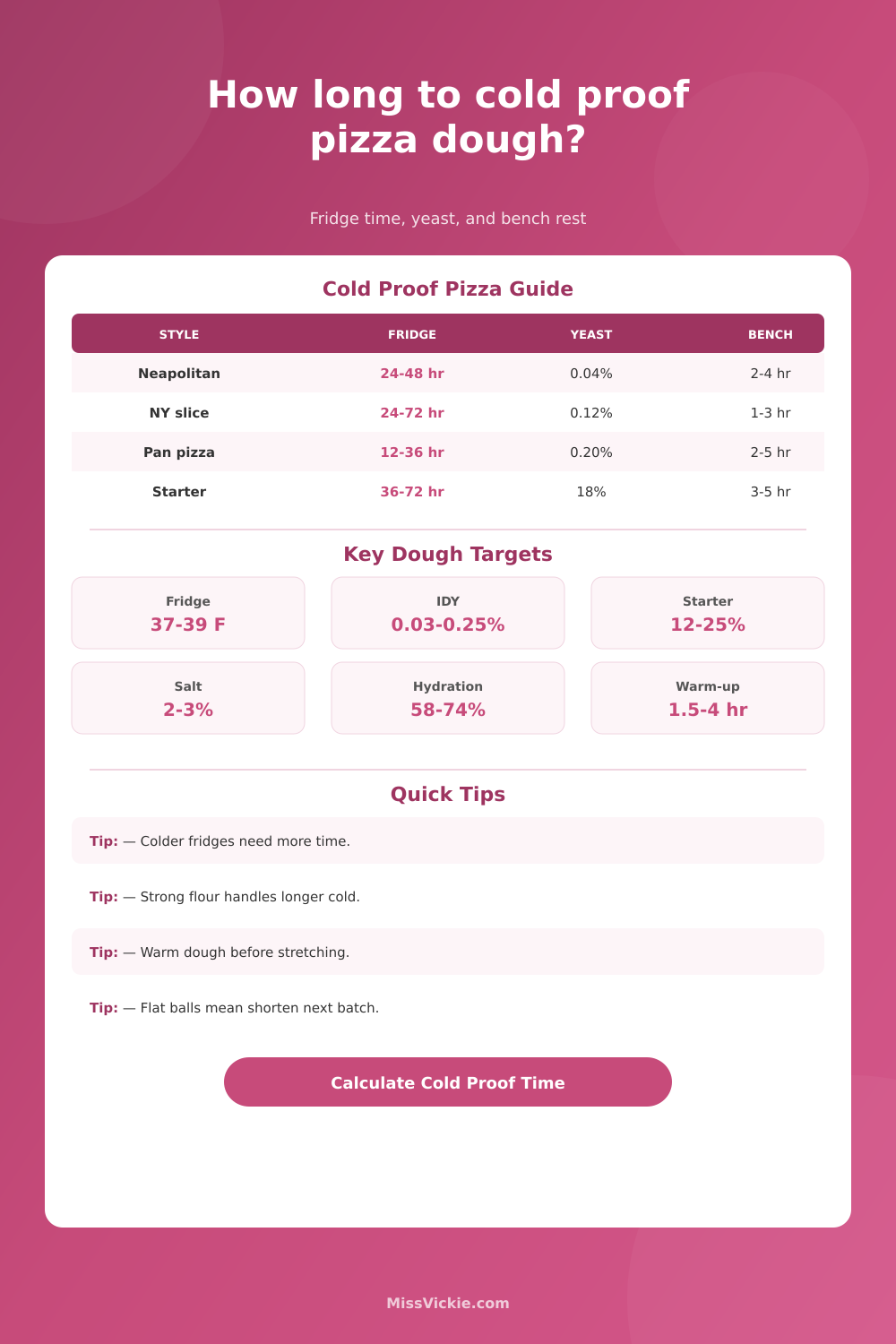
Cold Proof Pizza Dough Time Calculator
Estimate the best cold proof window, bench warm-up time, yeast or starter amount, and bake-readiness cues from fridge temperature, dough ball size, flour strength, hydration, salt, inoculation, and pizza style.
🍕 Cold Proof Presets
Pick a real pizza dough schedule, then tune the fridge temperature, starter or IDY percentage, dough ball weight, flour, hydration, salt, warm-up window, and bake style.
🧮 Dough And Fridge Inputs
Cold Proof Estimate
Adjust the inputs to calculate a cold fermentation schedule.
Formula Breakdown
Fermentation Breakdown
Readiness Plan
📋 Batch Formula Snapshot
🌡 Cold Proof Reference Tables
| Fridge Temperature | Cold Activity | Best Use | Calculator Effect |
|---|---|---|---|
| 33-35 F very cold | Very slow fermentation | Long 48-96 hour doughs | Adds cold time and keeps bench rest important |
| 36-39 F steady fridge | Balanced cold proof | Most 24-72 hour pizza dough | Baseline flavor and gluten protection |
| 40-42 F warm fridge | Noticeable yeast activity | Short 12-36 hour schedules | Shortens the recommended cold window |
| 43-46 F risky warm | Fast cold fermentation | Only low yeast, short proofing | Raises overproof risk for long cold proofs |
| Flour Strength | Typical Pizza | Cold Proof Comfort | Watch Point |
|---|---|---|---|
| All-purpose, W180-W220 | Thin crust and quick home dough | Up to about 24 hours | Can slacken or tear after long refrigeration |
| Bread flour, W240-W280 | Home oven and New York style | 24-48 hours | Usually reliable for overnight dough balls |
| Strong 00, W300-W340 | Long cold Neapolitan dough | 48-72 hours | Needs enough bench time to relax |
| High-gluten, W340-W380 | Large slices and chewy crust | 48-96 hours | Can feel tight if warmed too briefly |
| Starter Or IDY Level | Cold Proof Range | Flavor Target | Adjustment Cue |
|---|---|---|---|
| 0.03-0.07% IDY | 48-96 hours | Long, gentle cold fermentation | Use strong flour and steady cold storage |
| 0.08-0.18% IDY | 24-72 hours | Balanced home oven dough | Reduce if fridge is warmer than 40 F |
| 0.20-0.40% IDY | 8-36 hours | Short cold or same-day chill | Watch for fast puffing and flat dough balls |
| 12-25% starter | 24-72 hours | Mild sourdough depth | Starter strength changes the real schedule |
| Pizza Style | Target Rise | Warm-Up Cue | Overproof Sign |
|---|---|---|---|
| Neapolitan or very hot steel | 40-55% dough ball rise | Soft center, still rounded | Flat ball that sticks and tears |
| Home oven stone or steel | 55-70% dough ball rise | Easy stretch and airy rim | Weak center with sour aroma |
| New York slice | 60-75% dough ball rise | Gassy but not slack | Large bubbles under a loose skin |
| Pan, Detroit, or Sicilian | 75-95% final pan rise | Jiggly, dimpled, and bubbly | Collapsed bubbles or oily spreading |
🔍 Cold Proof Comparison Grid
At 34-36 F, the dough may need more cold time and a fuller bench warm-up.
At 41-44 F, yeast keeps moving and long proofs need very low inoculation.
W300-plus flour supports longer cold fermentation before the dough weakens.
Starter strength, acidity, and maturity can shift the schedule by several hours.
💡 Cold Proof Tips
This calculator estimates timing for pizza dough fermentation. Dough temperature, mixing intensity, starter strength, container shape, and refrigerator cycling can change the actual readiness window.
You wake up at 4 AM wondering, “Is this good anymore?” after your pizza dough has been chilling in the fridge for three days. Or am I doomed?”, yes, you know the panic. You don’t see anything inside the container, and the thought of pulling out those flat, sticky disks that tear at the slightest touch are enough to make you shake with fear. It’s bake-by-vibes instead of bake-by-chemistry; you’re going in blind.
With the calculator, you plug in your fridge temperature, your hydration and flour strength. And it spit out a concrete answer about when to stretch (or when to scrap). No more guesswork.
How to Get Perfect Cold Pizza Dough
The other thing most newbies misunderstand about cold proofing are that it’s not only about halting fermentation. It isn’t: Yeast doesn’t shut off in the fridge. It merely slows down. Enzymes continue to break down proteins and starches into flavor compounds, something that no amount of room-temperature proving can duplicate.
The secret is controlling that slow-down process, so the gluten network can hold together. Your fridge may be operating warmer than normal (say, at forty-two degrees versus the standard thirty-eight). In that case, the yeast will remain relatively active. Less is more here. You might need less time to get the same result, or less yeast to prevent overproofing. The tool accounts for this by adjusting its recommended range based off what you tell it your fridge reads.
Another overlooked variable is flour strength. While forty-eight-hour ferments might produce the perfect flavor, the gluten structure may have already broken down then, causing weak flour to disintegrate during shaping. Strong Italian zero-uno types or higher protein bread flours is more sturdy, maintaining their form even at extended rests. You won’t be able to accurately guess this balance between time and texture unless you know W-value of your flour. The tool’s reference tables neatly plot out the relationship between cold proof duration and flour strength so that your dough remains elastic, not slack.
What most people screw up is the yeast percentage. For their marathon seventy-two-hour proof, they’ll use the same small pinch of yeast that they used for a quick, twelve-hour rest. You don’t want the fermentation to be so strong that it blows through your dough. For long cold proofs, low yeast percentages are typical, generally lower then ten percent by baker’s percentage. While high yeast will hasten things along, it can produce harsh flavors if let sit too long. By tying your inoculation rate directly to your desired proof time and type, the calculator enable you to dial this in.
The second equally important part of letting dough rise in the cold is the warm-up time. Cold causes the gluten in the dough to stiffen and make the dough feel tight and resistant when you first get it out of the refrigerator. If you try to stretch it immediately, it will snap back or tear, so you must allow it to come to room temperature slowly. Covering it helps the gluten soften and the gas inside expand gently. The length of time depends on how hydrated the dough is and what the kitchen temp is, but plan for between two and five hour, sometimes longer on the bench. Rushing the warm up time is one of the most common mistakes that will ruin an otherwise perfect proof.
Additionally, while salt is not a major player in regulating fermentation rates, it does contribute quietly by strengthening the gluten network and slowing down the yeast just a little bit. A typical recipe will ask for anywhere from two to three percent salt by flour weight, sufficient to create some structure but not overwhelm any flavors.
Hydration is another factor. The wetter your dough, the quicker it ferments, and the more likely it is to be mishandled. Practice helps get these figures dialed in, but following a methodical process eliminate the guesswork.
The secret to cold proofing is precision and patience… Turning simple ingredients into complex crusts via controlled time. Once you get a handle on what works (yeast, flour strength, temp) with each other, you’ll begin trusting the process and see the fridge as your best ingredient. Not something to fear.
It’s not about making pizza per se but rather making pizza that tastes like you spent hours crafting when in reality you just spent minutes mixing. Trust the process, have some patience, respect the cold, and let the dough do the talking. You should of practiced more if you want perfect results.