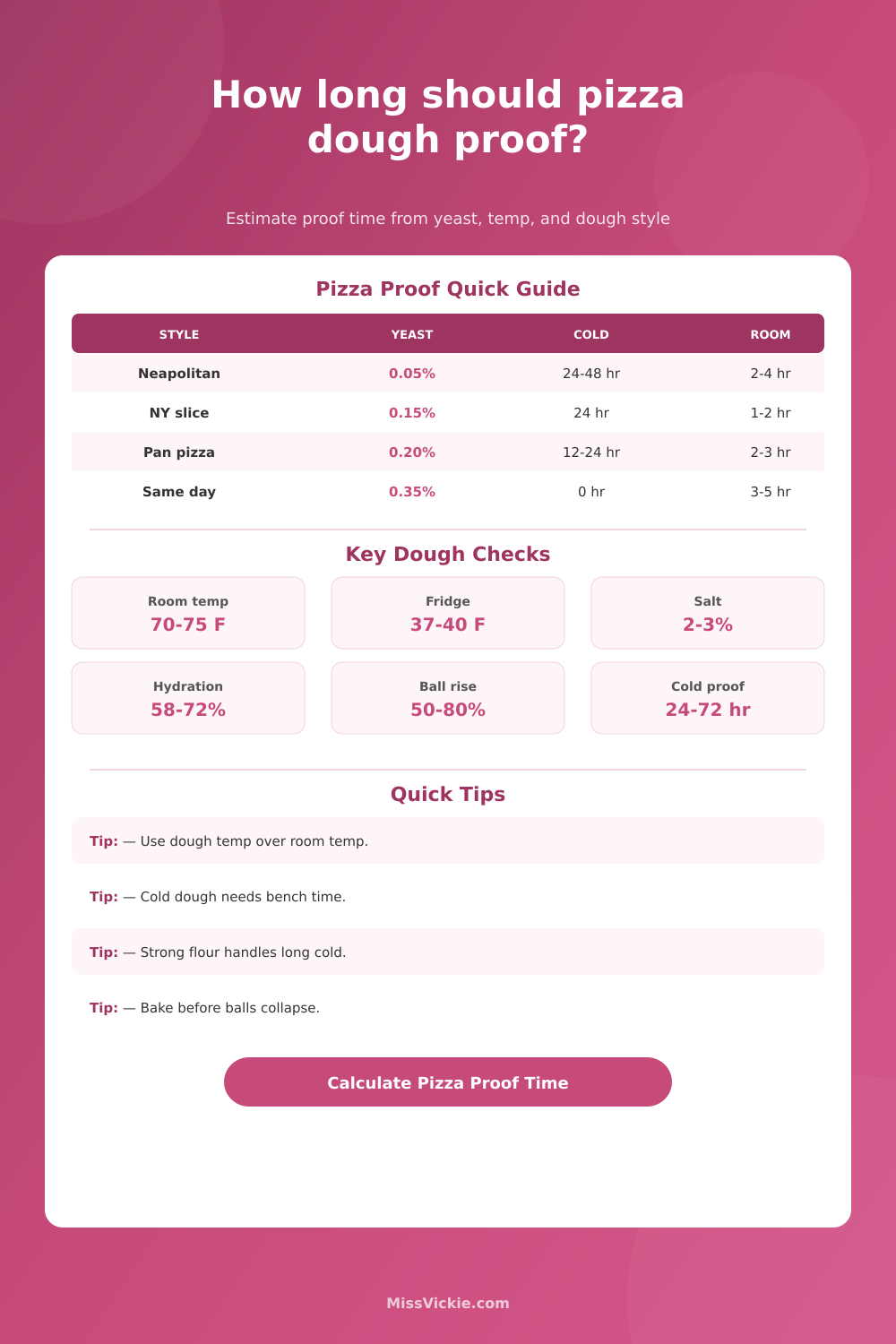
Pizza Dough Proofing Time Calculator
Estimate pizza dough proofing time from dough ball weight, yeast percentage, room and fridge temperature, hydration, flour strength, salt, cold proof plan, desired rise, and bake style.
🍕 Pizza Dough Presets
Choose a dough style, then adjust the baker's percentages and temperatures to match your kitchen.
🧮 Dough and Proofing Details
Estimated Pizza Dough Proof Plan
Adjust the dough ball, yeast, temperature, and cold proof settings to estimate timing.
Formula Breakdown
Timing Breakdown
Proofing Schedule
Readiness Checks
📌 Current Batch Snapshot
📊 Pizza Proofing Reference Tables
| Pizza Style | Common Ball Weight | Hydration | Yeast Range | Best Proof Pattern |
|---|---|---|---|---|
| Neapolitan or high-heat pizza | 230-270 g / 8-9.5 oz | 58-65% | 0.03-0.12% IDY | 24-48 hours cold plus 2-4 hours at room temperature |
| New York style pizza | 280-340 g / 10-12 oz | 60-66% | 0.10-0.25% IDY | 12-48 hours cold plus 1-2 hours bench time |
| Pan pizza or focaccia-style base | 350-650 g / 12-23 oz | 68-78% | 0.15-0.45% IDY | Room rise until bubbly, then pan proof until jiggly |
| Thin crust or tavern style | 170-260 g / 6-9 oz | 50-58% | 0.15-0.35% IDY | Moderate rise, long rest for rolling or sheeting |
| Temperature | Fermentation Effect | What To Watch | Calculator Adjustment |
|---|---|---|---|
| 35-38 F fridge | Very slow yeast activity | Flavor improves before big volume appears | Counts as a small room-time equivalent |
| 39-42 F fridge | Noticeably faster cold ferment | Dough can overproof by day three | Adds more cold activity and less bench time |
| 68-72 F room | Steady proof for most recipes | Good balance of gas and extensibility | Baseline room proof range |
| 76-82 F warm room | Fast yeast activity | Shorter window and more collapse risk | Shortens proof and raises watch status |
| Flour Strength | Typical Use | Cold Proof Limit | Proofing Note |
|---|---|---|---|
| All-purpose, W180-W220 | Quick home pizza, thin crust | Up to about 24 hours | Extensible but can weaken in long cold fermentation |
| Bread flour, W240-W280 | Home oven pizza and New York style | 24-48 hours | Reliable balance of strength and stretch |
| Strong 00, W300-W340 | Long cold Neapolitan-style dough | 48-72 hours | Needs time to relax before opening |
| High-gluten, W340-W380 | Large slices and chewy crust | 48-96 hours | Can feel tight if under-rested after refrigeration |
| Desired Rise | Best For | Dough Ball Look | Risk If Pushed Further |
|---|---|---|---|
| 35-45% | Wood-fired, very hot bakes | Slightly puffy and relaxed | Dense rim if the dough is still tight |
| 50-65% | Most stone or steel pizzas | Airy edge, smooth top, holds shape | Weak center if left too warm |
| 70-85% | Pan pizza and thick crust | Bubbly, soft, and jiggly | Collapse or sour flavor if overproofed |
| 90-100% | Very airy tray dough | Large bubbles and fragile surface | Difficult stretching and deflation |
🔍 Cold Proof Comparison Grid
Best for same-day dough with enough yeast and a moderate room temperature.
Good flavor and easy scheduling for home oven pizza.
Better extensibility and browning when yeast is kept low.
Use strong flour, low yeast, and a cold refrigerator to avoid collapse.
💡 Proofing Tips
This calculator estimates fermentation timing for yeasted pizza dough. Flour, mixing intensity, dough temperature, and refrigerator cycling can change the real proof window, so use the visual checks before baking.
So there’s a bowl of dough sitting on your counter in the kitchen, and you’re standing there staring at it. Looks still, doesn’t it? You mixed that dough up three hours ago. You found the recipe on the internet. Did I mess up? The most likely answer is proofing time.
The thing about proofing isn’t so much ticking a clock as knowing what’s happening biologically inside the bowl. Yeast are alive; yeast eats sugar; yeast expels carbon dioxide. Different flours has different strengths. Different levels of hydration affect things. Temperatures will impact how quickly this process occur.
How to Make Perfect Pizza Dough
Most home cooks treat proofing as a single step, but it is really a negotiation between time and temperature. It’s a dance of temperature vs time. A gentle structure allow Neapolitan pizza to puff, but not explode. Heavy gas retention and dense crumb make thick pan pizza better.
With the click of a button, the calculator adjusts the variables so you don’t have to guess when dough is ready. When fermentation slow in cold temps, it adjusts for that. And at this cold ferment stage, complex flavor develop, over days, not hours. That turns simple ingredients into something with depth. You can’t get that depth by rushing it.
The whole timing depend on the percentage of yeast. Less yeast equal slower rise time. It has better flavor. It creates a stronger gluten network. More yeast are quicker rise but sacrifices some subtlety. Depending on the weight of your dough balls and your proof window, it calculates how much to use so you don’t add too much (which tastes like alcohol).
It also take into account hydration level. Yeast moves around better when it’s in a wet environment, meaning that wetter dough ferments quicker. High hydration requires careful observation. Overproofing happen without noticing the rise in volume first.
The trick of pizzeria-style replication is the type of flour: Strong flours contains more protein. They resist longer cold fermentations. Weaker flours breaks down quicker. They expel gas too soon and deliver flat discs. Which style matches a given flour? See the reference tables for which ones to combine.
Don’t expect to memorize all the points, but here’s an example of what to learn: Strong flour enjoys longer cold rest. Weak flour seek a quick room-temp proof. Knowing this allow you to choose wisely even if your pantry doesn’t actualy fit your plan.
The last variable is temperature control. That’s the tricky one. The room temperature varies depending on where your kitchen is and whether you get sun. It also depends on how your HVAC system work. So does the time. Consistently slowing down fermentation with refrigeration means that you can bake whenever it’s convenient for you.
The calculator takes into account both fridge and room temps, and provides a reasonable estimate of when to pull dough out for the final bench rest. This is the warm-up period. If the dough hasn’t warmed up sufficiently, it will be stiff and resistant to stretch. The dough may tear or shrink back in the oven. Allowing the dough to relax at room temp restore its stretchiness, so it keeps its shape.
Math isn’t enough. You can tell when baking is ready by how it feels. Are there bubbles showing? Is the surface smooth? Does it look domed slightly? When pressed lightly with your finger, does it feel firm yet light? If yes then it’s ready. If no, if it flattens out and doesn’t spring back fast enough, then it still has some work to do.
The calculator helps set the structure. Your hands and your eyes is what verify the outcome. Trust in the process. Respecting the biology. The good part of the pizza begins well before it lands on the steel or the stone.
You should of seen how much better it is when you use moddern methods. It’s naturaly easier to get a luxurius crust.