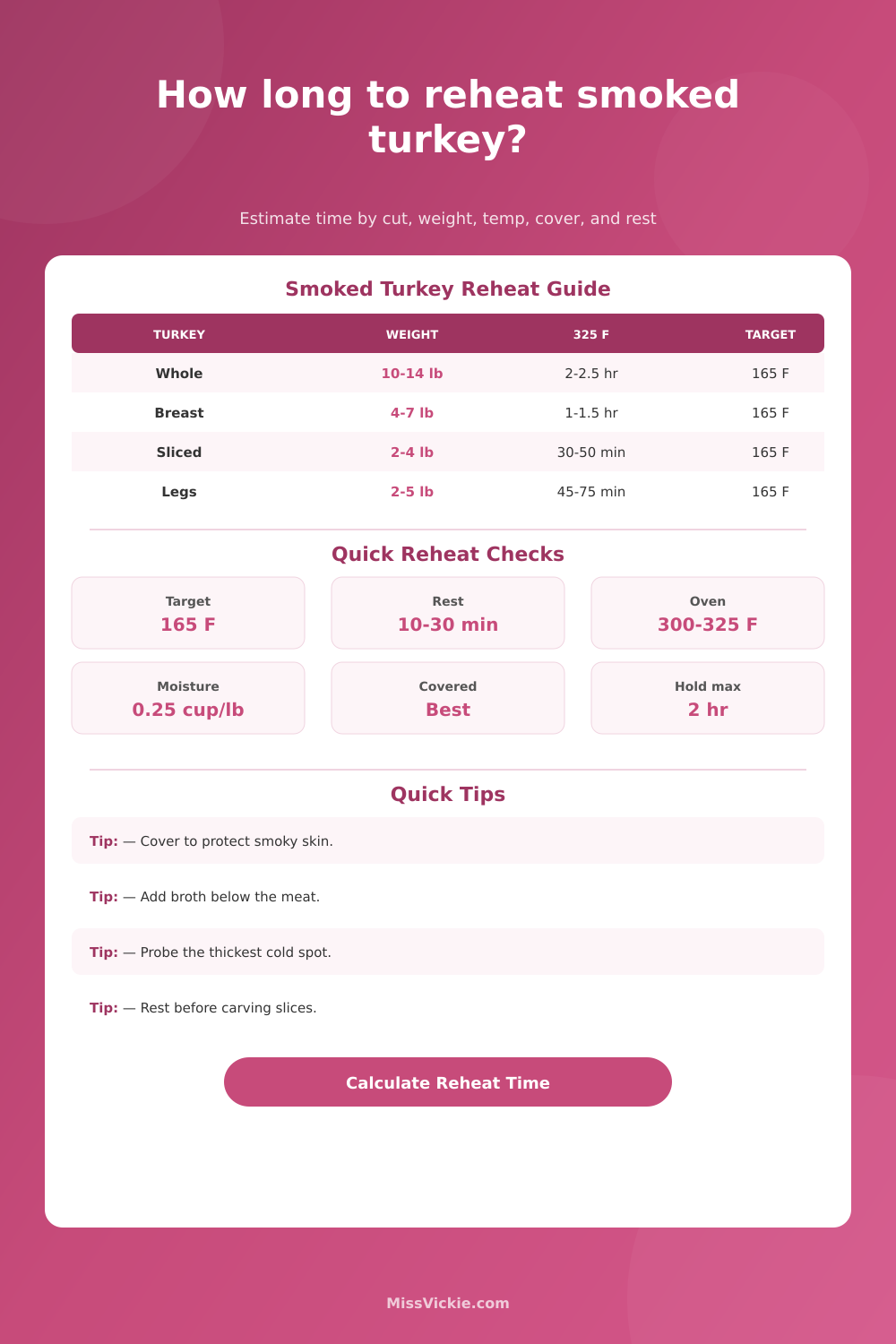
Smoked Turkey Reheating Time Calculator
Estimate how long to reheat whole smoked turkey, turkey breast, legs, wings, or sliced smoked turkey to a safe 165°F target using weight, start temperature, oven or smoker heat, cover, added moisture, and rest.
🦃 Smoked Turkey Presets
Choose a real reheating scenario, then adjust the exact cut, weight, heat setting, pan setup, moisture, and rest plan.
🌡 Reheating Details
Smoked turkey reheating plan
Your reheating window, pull temperature, rest, liquid, and serving notes will appear here.
Timing Breakdown
Food Safety And Serving
Suggested Reheat Stages
- Set pan and liquid.
- Heat covered.
- Probe center.
- Rest before slicing.
📊 Current Plan Snapshot
🧾 Cut Timing Reference
| Smoked Turkey Form | Typical Weight | Covered At 325 F | Best Probe Spot |
|---|---|---|---|
| Whole smoked turkey | 8 to 16 lb | 8 to 11 min per lb | Deep breast and inner thigh, away from bone |
| Bone-in smoked turkey breast | 4 to 8 lb | 11 to 14 min per lb | Center of thickest breast section |
| Boneless smoked turkey breast | 2 to 6 lb | 12 to 15 min per lb | Middle of tied roast or netted breast |
| Sliced smoked turkey tray | 1 to 6 lb | 18 min plus 8 min per lb | Middle of the tray, under top layer |
| Smoked turkey legs | 2 to 6 lb | 28 min plus 7 min per lb | Thickest meat near the bone |
| Mixed smoked turkey pieces | 2 to 10 lb | 32 min plus 7 min per lb | Largest piece and center of pan |
These are reheating estimates for fully cooked smoked turkey. Always verify the thickest or coldest section reaches the target internal temperature.
🔥 Heat Setting Adjustment Table
| Chamber Temperature | Timing Effect | Best Use | Moisture Note |
|---|---|---|---|
| 225 F smoker | About 55 percent longer than 325 F | Gentle reheat when smoke flavor matters most | Cover tightly; smoker airflow can dry edges |
| 275 F oven or smoker | About 23 percent longer than 325 F | Large whole birds and party schedules | Use broth below the bird and a tight foil seal |
| 300 F oven | About 11 percent longer than 325 F | Reliable balance of moisture and speed | Check liquid halfway through long reheats |
| 325 F oven | Baseline calculator timing | Most smoked turkey reheating instructions | Cover until the final few minutes if crisping skin |
| 350 F oven | About 7 percent faster than 325 F | Small breasts, legs, or sliced pans | Add moisture and check early to avoid dryness |
💧 Cover And Moisture Reference
| Pan Setup | Calculator Factor | Texture Result | When To Choose It |
|---|---|---|---|
| Tight foil with light broth | Fast, steady center heating | Moist meat with softened skin | Whole turkey, breast, and sliced trays |
| Loose tent with pan liquid | Neutral timing | Some skin texture, moderate moisture | Turkey legs, mixed pieces, and carving boards |
| Covered roaster with rack | Fastest gentle reheat | Steamy, very forgiving meat | Large birds or buffet holding plans |
| Uncovered dry pan | Slower center heating | Firmer skin but drier edges | Only short reheats or final crisping |
🍽 Portion And Hold Table
| Serving Style | Cooked Turkey Per Person | Use With | Hot Hold Guidance |
|---|---|---|---|
| Carved holiday plate | 6 to 8 oz | Whole turkey or bone-in breast | Rest 20 to 30 min, then serve soon |
| Sandwich tray | 4 to 5 oz | Sliced smoked turkey breast | Hold covered with a little warm broth |
| Buffet mixed meat | 5 to 6 oz | Legs, wings, sliced breast, and dark meat | Keep above 140 F after reheating |
| Small appetizer plate | 3 to 4 oz | Wings, legs, or sliced smoked turkey | Use shallow pans for quicker service |
⚖ Method Comparison Grid
Best all-purpose choice for whole smoked turkey, breasts, and sliced trays at 300 to 325 F.
Use lower heat for extra smoke aroma, but cover the pan because airflow dries exposed meat.
A covered roaster acts like a gentle steam chamber and usually shortens the reheating estimate.
Start covered for safety and moisture, then uncover briefly near the end for firmer skin.
💡 Reheating Tip Boxes
The first time you cook, you spend hours tweaking temps and playing with the smoke rings to get things just right. Then some klutz tries to reheat it, spoiling everything you worked so hard to achieve by turning tender meat into shoe leather.
That’s a sad scene played out in kitchens everywhere, and it’s usualy caused by misunderstanding: they think reheating is like cooking, only on a small scale. It isn’t. Now you’re not trying to render any more fat or break down any more collagen. You’re just increasing the temperature of previously-cooked protein without extracting moisture that makes it edible.
How to Reheat Smoked Turkey Properly
You can estimate reheating times by calculating how much heat energy are needed to warm the protein to serving temperature. This page’s calculator does exactly that. But knowing about physics underlying those calculations is what really saves dinner.
But there’s one other huge variable: the thermal origin of your turkey. What does it mean if the turkey came fresh from the fridge, versus what it means if the turkey’s been on the kitchen counter for an hour? The answer is obvious: You’ll need to handle the former much different, because colder meat take more time to come up to temperature, which means it stays longer in the unsafe zone. So the tool also asks you how cold the food was initially. It then calibrates timing accordingly.
You don’t want to rush a cold turkey by turning oven up all the way; cooking it at five-hundred degrees will cause the breast to get dried out long before the inside of the thigh are barely warm. It’s a race between you and physics… And physics always wins. Lower is always better.
Equally important (and frequently overlooked) is moisture control. Adding liquid to the pan doesn’t make meat more juicy; it simply prevents it from drying on the exterior as the inside heats up. How much stock or broth are you going to add? The calculator takes that into account.
Covering the pan also helps, as it forms a mini-steam chamber that moves heat efficienty and doesn’t strip away whatever small amount of moisture exists in the fibers. Pouring your liquids over the meat wash off the seasoning and softens the bark you went to all that trouble developing. Keep the liquid beneath the meat instead.
But it all depends on the heat source. A conventional oven gives you dry heat and even cooking. A pellet smoker will inject some pretty aggressive airflow into your food, particulary if you’re doing something as thin as wings or sliced turkey. Depending on what chamber you use, it’ll either take significantly more time (three hours versus one hour) to smoke things at a lower temp (two hundred twenty-five degrees Farenheit) then in an oven (three hundred twenty-five), or preserve its texture more effectively due to the gentler temperature gradient.
In the case of a smoker, covering your pan should of become a non-negotiable option, if you don’t, you’ll end up with smoked jerky, not turkey.
The most important part of this whole thing is that you skipped right past resting! As soon as the inside of your meat reach its safe minimum temp (one hundred sixty-five degrees Fahrenheit or so) there’s still plenty of heat working its way inward. Carve too soon and you’ll send that delicious hot juice gushing out on the cutting board, not back into the meat. That’s why the calculator factors in a wait time to its grand total: Those fifteen-to-thirty minutes is vital for spreading that goodness throughout the meat. They also give the muscle fibers some time to cool off and soak up all the juice they squeezed out while cooking.
So what is the main point? Reheating smoked turkey is more about patience than the power. It’s about preserving something, not changing it. And this tool takes the guesswork out by simply plugging in the details, cut, weight, and starting temp. But what makes the difference between a good meal and a waste is understanding why they’re all important; why cold mass require time, why steam helps preserve texture, and how resting seals the deal.
Bring it back to life but don’t ask too much of it.