Boston Butt Smoking Time Calculator
Estimate Boston butt smoke time from raw weight, bone-in or boneless cut, pit temperature, wrap style, stall behavior, target internal temperature, rest, yield, servings, and wood plan.
🍖 Boston Butt Presets
Pick a real cook, then tune the inputs for your pork shoulder, smoker, bark goal, and serving plan.
⚖ Smoking Details
Boston butt smoking plan
Your cook time, stall window, rest, yield, and serving count will appear here.
Time Formula
Yield And Servings
Smoking Schedule
📊 Quick Cook Summary
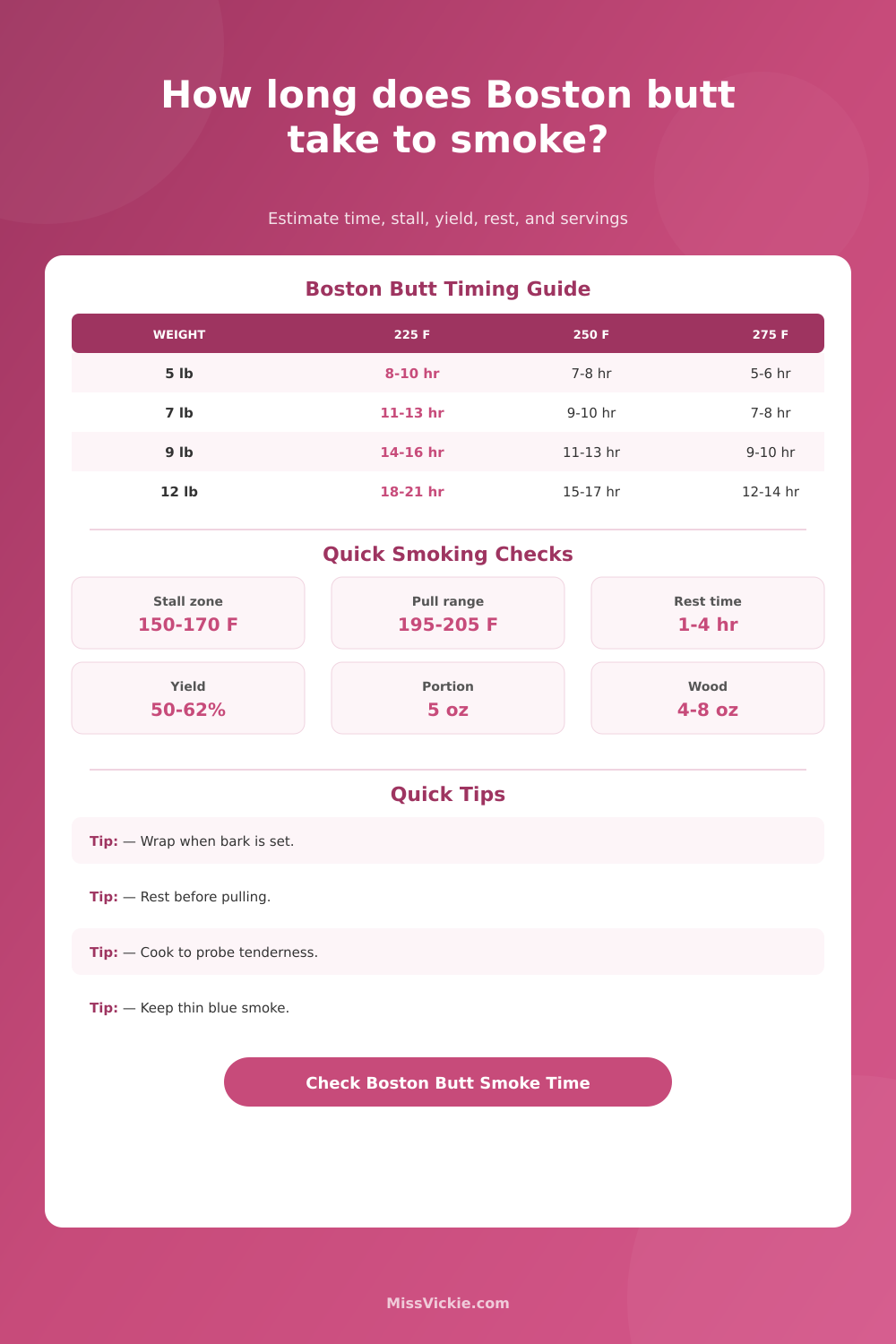
🌡 Weight And Temperature Table
| Raw Boston Butt | 225°F No Wrap | 250°F Foil Wrap | 275°F Paper Wrap | Typical Rest |
|---|---|---|---|---|
| 4 to 5 lb small butt | 7.5 to 10 hr | 5.5 to 7 hr | 5 to 6.5 hr | 1 to 2 hr; small cuts cool faster. |
| 6 to 7 lb average butt | 10.5 to 13 hr | 7.5 to 9.5 hr | 6.5 to 8.5 hr | 1.5 to 3 hr for cleaner pulling. |
| 8 to 9 lb full butt | 13 to 17 hr | 10 to 12.5 hr | 8.5 to 11 hr | 2 to 4 hr for schedule buffer. |
| 10 to 12 lb large butt | 16.5 to 22 hr | 12.5 to 16.5 hr | 11 to 14.5 hr | 3 to 5 hr if held safely warm. |
🧻 Wrap And Stall Table
| Wrap Choice | When To Wrap | Time Effect | Bark Result | Stall Note |
|---|---|---|---|---|
| Foil wrap | Usually 160 to 170°F after bark is set | Shortens cook roughly 10% to 18% | Softer bark, very moist pulled pork | Best for schedule control when the stall is dragging. |
| Butcher paper | Usually 165 to 175°F with deep mahogany bark | Shortens cook roughly 4% to 9% | Firmer bark than foil with good moisture | Still allows some steam to escape during the stall. |
| Foil boat | After stall begins, fat cap exposed | Shortens cook roughly 2% to 6% | Protected bottom, stronger top bark | Helpful when bark is good but the flat bottom is drying. |
| No wrap | None | Adds roughly 10% to 20% | Firmest bark and deepest smoke color | Expect the stall to be most obvious between 150 and 170°F. |
| Early foil | 145 to 155°F before bark fully sets | Fastest finish, often 15% to 22% shorter | Softest bark, pot-roast lean | Useful when serving time matters more than bark texture. |
🍴 Yield And Serving Table
| Cut Style | Finished Yield | 5 oz Sandwich Servings | 6.5 oz Plate Servings | Use Case |
|---|---|---|---|---|
| Bone-in Boston butt | 50% to 56% of raw weight | About 1.6 to 1.8 servings per raw pound | About 1.2 to 1.4 servings per raw pound | Most classic pulled pork cooks. |
| Boneless tied butt | 56% to 62% of raw weight | About 1.8 to 2.0 servings per raw pound | About 1.4 to 1.5 servings per raw pound | Good for slicing the raw roast into even portions. |
| Heavy-trimmed butt | 48% to 54% of raw weight | About 1.5 to 1.7 servings per raw pound | About 1.1 to 1.3 servings per raw pound | Competition-style trim with more fat removed up front. |
| Picnic shoulder | 45% to 52% of raw weight | About 1.4 to 1.7 servings per raw pound | About 1.1 to 1.3 servings per raw pound | More skin, connective tissue, and trimming variation. |
🪵 Wood And Fuel Reference
| Smoker Style | Smoke Wood Plan | Fuel Check Rhythm | Best Flavor Use | Calculator Note |
|---|---|---|---|---|
| Pellet smoker | Oak, hickory, or cherry pellets through the full cook | Check hopper before overnight or long holds | Easy steady smoke for overnight pork | Estimate about 0.75 to 1.25 lb pellets per hour. |
| Charcoal basket | 3 to 6 fist-size chunks mixed through charcoal | Check vents and charcoal bed every 3 to 5 hr | Strong smoke ring with stable heat | Use less wood after wrapping because bark absorbs less smoke. |
| Offset smoker | Small seasoned splits, mostly oak with fruit wood accent | Add a split when coal bed thins and smoke clears | Deep smoke flavor and bark color | Fire management matters more than exact wood weight. |
| Electric or gas smoker | Chips early, then lighter smoke after wrap | Reload chips during the first 3 to 5 hr | Mild smoke without tending a live fire | Too many chips late can taste sharp instead of clean. |
Cook times are estimates. Pork shoulder is done when a probe slides in with little resistance, not only when the thermometer reaches a single number.
🔥 Smoking Style Comparison
Longest cook, deep smoke color, and a wide stall. Best when time is flexible.
Reliable pace for most backyard cooks. Good bark without turning the day endless.
Shorter cook with a slightly firmer bark. Watch the bottom and sugar-heavy rubs.
A warm rest gives collagen time to settle and protects your serving schedule.
💡 Boston Butt Smoking Notes
With a brand-new eight-pound Boston butt, high hopes, and the smoker fired up, you’re staring at a pile of glowing embers in the middle of the night at 2am, asking yourself: Is that thing ever going to move? Did I just stop time for the rest of my life? Nope. That’s not bad luck. That’s physics fighting against biology. The calculator does the math for you, but what are the whys?
Time Is Not A Destination, Most cooks thinks of time as a destination: I’ll cook for ten hours and stop when my clock says so. This is the number-one reason pulled pork come out tough/dry. Connective tissue doesn’t give two shits about the clock; it only cares about heat over time. Collagen has to be broken down into gelatin, which happen dramatically from one hundred fifty to one hundred seventy degrees Fahrenheit.
Why Time Is Not The Only Thing That Matters
When you hit this range, the temperature of your meat will stop rising, while the meat itself sweat water out in an effort to cool itself. It feels like failure; but it’s really physics doing its work. Most schedules goes off the rails here: Because foil seals in moisture and creates a pressure cooker effect, it’ll push through the stall fast, but also soften up the bark you labored so hard to develop. Butcher paper prevents this. It allow some steam to escape, which creates a firmer outside while still shortening the cooking time.
These variables is accounted for in the calculator, folding the foil over at one-hundred-forty five may shave an hour off your schedule, but it will leave you with pot roast rather than barbecue. For a firm crust and the depth of smoky flavor we’re after, you need to sit tight until you hit the uncomfortable stall. You must do this not just for heat management, but also for your patience.
The other figure that gets folks surprised when they plan to feed a crowd is yield. Twelve pounds of meat sounds like it should make twelve pounds of food on the plates. It is not quite that way. Half of your starting raw meat weight are lost to evaporation and things like bones in a butt. You’ll get maybe half of what was on package when it arrived home. Want to check my math? There’s a reference table that makes that clear. But the general rule: Plan ahead and account for shrink before you go shopping. Nine pounds of butt won’t take care of eighteen people unless you’re serving tiny portions and pairing them with lots of sides.
Never skip resting the meat. You don’t want to pull pork off the smoker and cut into it for messy sandwich. All the juice will run down your plate instead of staying within the meat. Those juices will redistribute when rested in a cooler for two hours, making tough fibers into tender bites. And it provides a buffer. It is great if the cook’s finished early so you have time to rest it more. Running behind? The hold time keeps the meat warm and safe while not drying it out.
What’s missing? Flavor (but not necessarily when). Though all wood imparts some taste, oak is particularly good at giving a solid structure to longer cooking times. Fruit woods sweeten things up and go well with the inherent richness of pork. The calculator also tracks fuel usage. Important when refilling the charcoal basket on your smoker, or if you’re using an offset. Just keep in mind: Smoke does not cook food, it seasons it. If there’s too much smoke, even your best temperature regulation will make the food taste bitter.
Ultimately, the best cooks learn that the numbers aren’t everything; they learn to look at the meat. The real goal is to check for tenderness with a probe. You’re finished once the thermometer glides right in as if it were penetrating a stick of room-temperature butter. Use the times as guides to plan out your night. Don’t use them as a ruler to determine whether you did anything wrong.
Let the collagen do the work for you; just keep the smoke thinnish, get through the stall with faith, and trust the process. You’ll be glad you waited when it’s time to dig into your dinner. You should of listened to the physics.