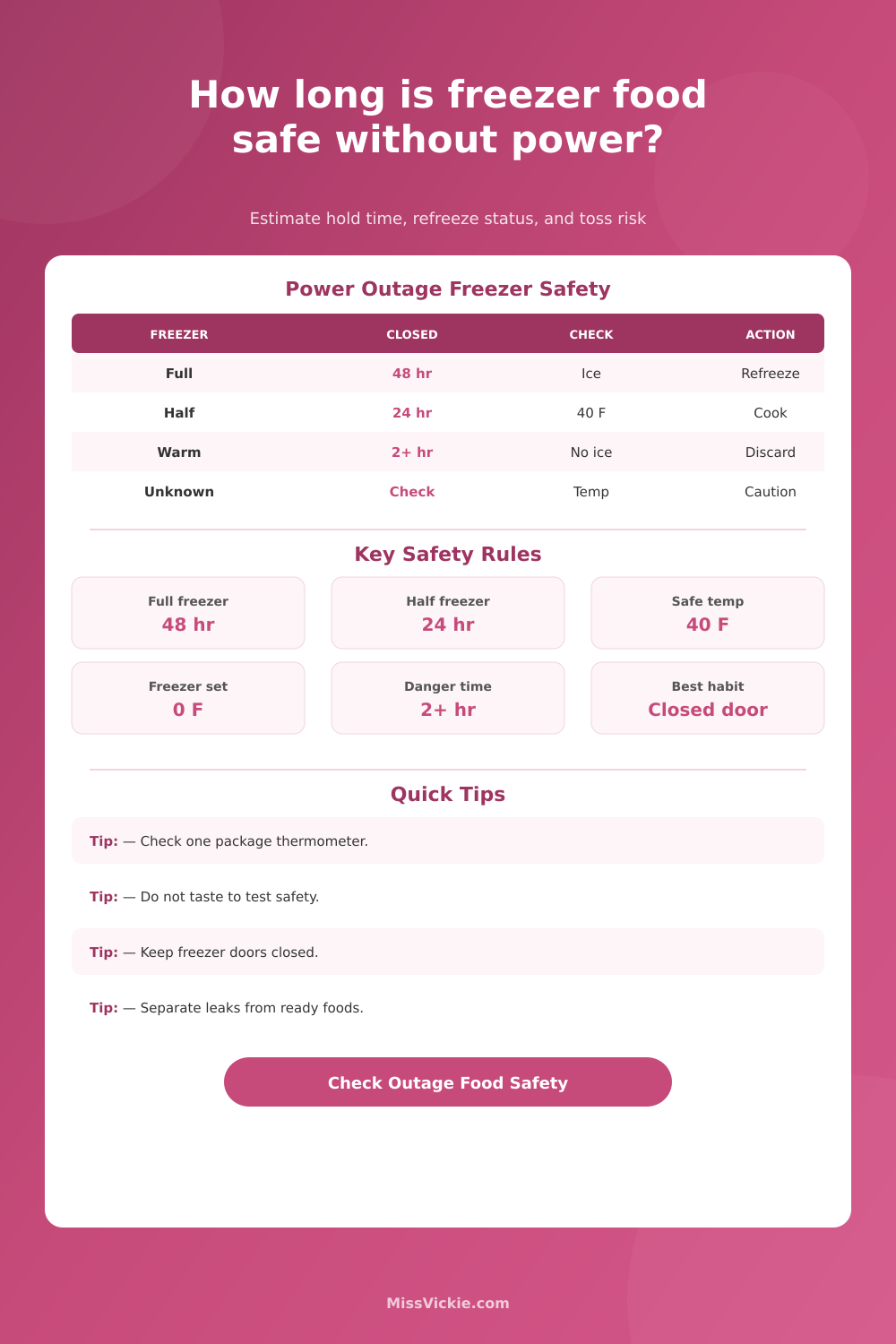
Freezer Without Power Food Safety Time Calculator
Estimate whether freezer food stayed in the safe zone during an outage using fullness, appliance type, door openings, room temperature, starting freezer temperature, ice crystals, and the 40 F rule.
⚡ Outage Presets
Pick the situation closest to your freezer, then adjust the details. These presets are based on practical outage patterns, not serving sizes.
🧊 Freezer Outage Details
Freezer Safety Estimate
Enter outage details to estimate hold time and the safest next action.
Safety Breakdown
Next Steps
- Keep the door closed until you are ready to inspect food.
- Check package temperature or look for ice crystals.
- Discard perishable food above 40 F for 2 hours or more.
- Refreeze only items that meet the ice crystal or 40 F rule.
📊 Safety Benchmarks
This calculator uses public food safety guidance as a decision aid. Always check individual packages; never taste food to decide whether it is safe.
📋 Closed-Door Hold Time Reference
| Freezer condition | Official benchmark | Best signs | Calculator adjustment |
|---|---|---|---|
| Full, door kept closed | About 48 hours | Hard packages, heavy frost, ice crystals | Highest thermal mass and slowest warming |
| Three-quarters full | Between full and half-full | Items still firm in the center | Modeled at 42 hours before other factors |
| Half full, door kept closed | About 24 hours | Some frost, cold packages, crystals visible | Core benchmark for mixed household freezers |
| Quarter full or sparse freezer | Shorter than half-full | Rapid softening, empty air space | Modeled at 12 hours before modifiers |
🌡 Appliance and Room Comparison Grid
Top opening holds dense cold air better when briefly opened.
Good insulation, but front opening spills cold air faster.
Smaller compartment and shared use usually warm sooner.
Lower mass and thinner insulation shorten the safe window.
🚫 Refreeze or Discard Guidance
| Package finding | Meat, seafood, leftovers | Produce and bread | Decision note |
|---|---|---|---|
| Hard frozen or still has ice crystals | Refreeze or cook | Refreeze | Safe if crystals remain, though texture may suffer |
| Package thermometer is 40 F or below | Refreeze or cook soon | Refreeze or use soon | Food may be safely refrozen at or below 40 F |
| Above 40 F for less than 2 hours | Cook promptly or chill below 40 F | Use judgment by food type | Do not refreeze high-risk food blindly |
| Above 40 F for 2 hours or more | Discard | Discard if perishable or leaking | Do not taste; discard unsafe perishables |
| No thermometer and no ice crystals | Discard if thaw history is uncertain | Keep only low-risk dry foods | Uncertain temperature history raises risk |
🍲 Food-Specific Triage Table
| Food group | If icy or 40 F or below | If warm or fully thawed | Quality warning |
|---|---|---|---|
| Raw meat, poultry, seafood | Refreeze or cook safely | Discard after 2+ hours above 40 F | Texture and purge increase after thawing |
| Cooked leftovers, soups, casseroles | Refreeze or reheat properly | Discard after 2+ hours above 40 F | Sauces may separate after refreezing |
| Dairy, egg dishes, custards | Refreeze only if cold and safe | Discard if warm or uncertain | Texture often breaks after thawing |
| Fruits, vegetables, bread | Refreeze if quality is acceptable | Use judgment unless moldy or leaking | Produce gets soft from ice damage |
| Ice cream, frozen yogurt | Usually refreeze only if still hard | Discard if melted or warm | Softening is an early warning sign |
📐 Formula and Modifier Table
| Factor | Low-risk setting | Higher-risk setting | How calculator uses it |
|---|---|---|---|
| Freezer fullness | Full equals 48 hour baseline | Quarter full equals 12 hour baseline | Sets the starting cold-mass estimate |
| Room temperature | 55 F or cooler extends estimate | 90 F or hotter shortens sharply | Multiplies hold time by heat load |
| Starting freezer temperature | Minus 10 F or colder adds buffer | Above 10 F removes buffer | Adjusts how far food starts from 40 F |
| Door openings | Zero openings keeps benchmark | Many openings reduce hold time | Applies a repeated warm-air penalty |
| Package condition | Ice crystals or 40 F or below | No ice, unknown, or above 40 F | Overrides the estimate for final decision |
💡 Outage Safety Tips
Freezer hums to silence; power’s gone. Your produce/meat may be already spoiled, right? Wrong! Frozen foods actualy stay safe much longer then you think. Ice is slow at conducting heat. A full freezer holds its coolness like a thermal battery.
How full is yours, and how warm is the air around it? That’s what the calculator above will estimate: how long before your setup loses temperature. Guessing doesn’t work; understanding does.
How to Keep Your Freezer Cold During a Power Outage
First of all: the more food you had already in the freezer prior to the outage, the longer it will last. Mass is colder than empty space. Keeping the door closed to a FULL freezer should preserves food for almost two days. If the freezer is only half full, it might only last about twenty-four hours because there is less food to keep the cold air from escaping in the warm room. The calculator takes this into account depending on what kind of fridge/freezer you have, as well as the ambient room temperature.
The freezer in my basement behaves very differently than the one in my garage during middle of summer; so exact information are useful here. Every few minutes, many homeowners makes the mistake of opening their door during an outage to check on things. That means you’re losing cool air! Because cold air is heavier then warm air, it will fall down and out whenever you pop the seal, allowing warmer air to come rushing up inside. If you open the door, the tool will reduce your estimated safe time, but if you continue to peek in there, you’ll actually be losing more than what the tool says in real world terms. Trust the insulation until either the time runs out or you get your power back.
When you do open that door, avoid sniffing the air; smell isn’t always a good indicator of potential early spoilage. Ice crystals are an obvious giveaway. Is it still frozen? Then it’s probably been close to freezing, so it can go back in the freezer. Is there some visible ice in it (or does it feel hard to the touch)? It’s OK to eat if it hasn’t been warmer than 40°F for over two hours, regardless of whether it was fully defrosted.
This is where many people gets confused about food safety versus food quality; while your ice cream may now be soup-like in consistency following an outage, it should still be safe to consume (as long as it remained sufficiently cold throughout). Use the calculator to see how your specific food compares to the estimated time outside the safe zone, and determine what to do: throw away, refreeze, or cook.
The two-hour rule is critical for high-risk foods such as raw proteins (seafood, poultry). Bacteria multiply rapidly in the warmth of any protein, so even short periods of being warm can be unsafe. Bread and vegetables without sauce or spices are generally lower-risk. They might lose quality, but they is usually not an immediate danger after just being slightly warm. Refer to the table on the page for guidance on how different categories should of be triaged based off their moisture content and historical safety risks.
High-risk. If you’re unsure about something, apply the ice crystal test, or use a thermometer where available. Warning: Never assume anything is safe by tasting it! Pathogens aren’t detectable by taste.
If you’re like me, stress or tiredness combined with a power outage happens often. But with a solid food-safety gameplan in place, you’ll avoid panicking and wasting perfectly good furnitures. When the lights come back on, open each package separately. Keep the fridge and freezer doors shut as much as possible. Pitch any food with no ice crystals if it has been sitting around too long, or any food that seems slightly warm to the touch. Better safe than sorry, and worse, food-poisoned, after a week of recovery time. Let your freezer do its thing, trust the physics of ice, and wait until you’re ready to take a peek before worrying.