Rice Fridge Shelf Life Calculator
Estimate the safer refrigerated window for cooked rice by rice type, cooling delay, container depth, fridge temperature, portions, reheating target, and eater risk level.
🍚 Rice Storage Presets
Pick a common cooked rice situation, then adjust the exact time, temperature, depth, portions, and reheating target for your container.
🧊 Storage Details
Rice Storage Estimate
Based on conservative cooked-rice fridge handling logic.
Safety Breakdown
Recommended Action
📊 Rice Safety Snapshot
This tool estimates a conservative use-by window for cooked rice. Discard rice that smells sour, feels unusually slimy, has visible mold, or sat warm beyond safe cooling limits.
📘 Rice Type Reference Table
| Cooked Rice Type | Calculator Base Window | Main Risk Driver | Best Handling |
|---|---|---|---|
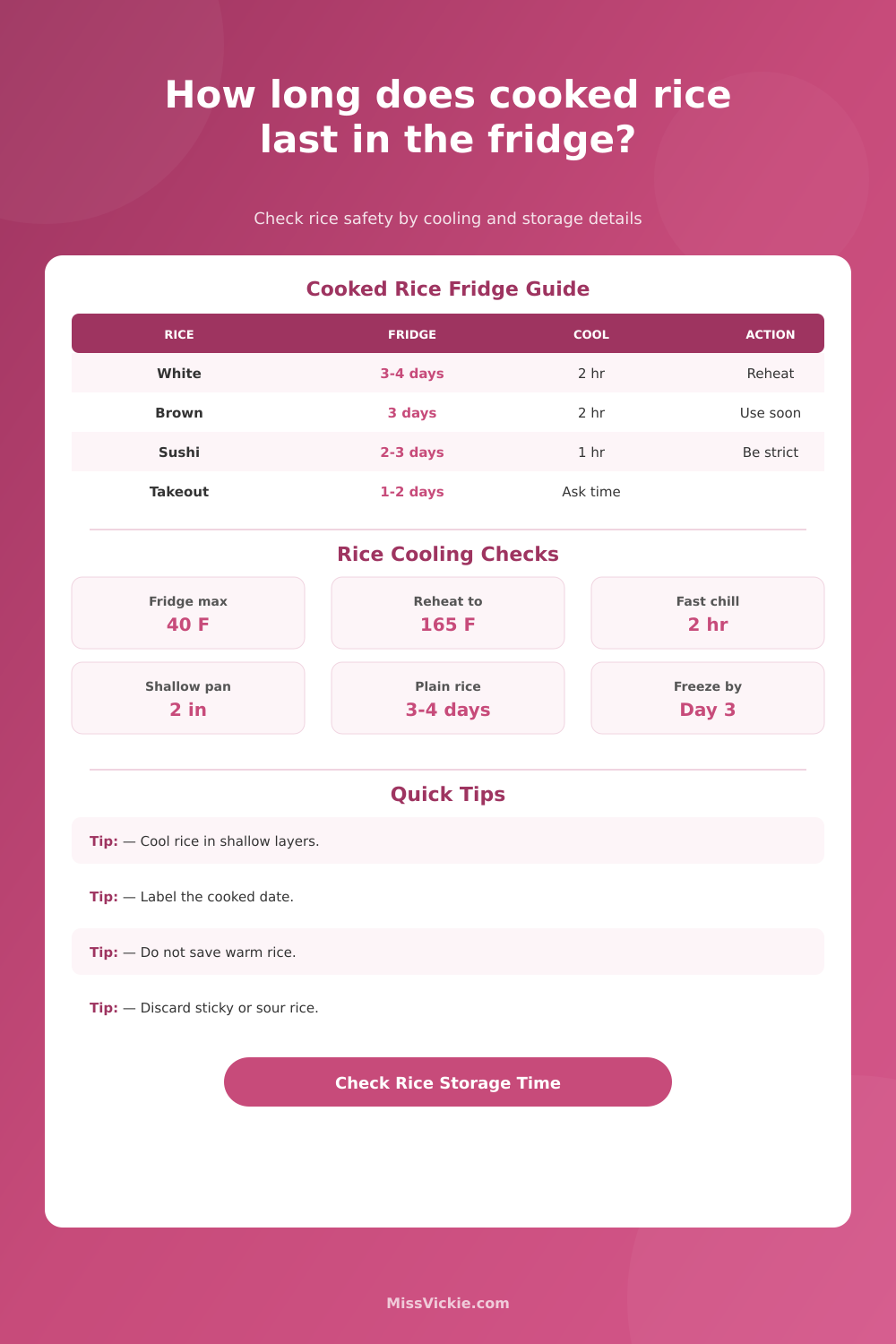
| Plain white rice | 96 hours / 4 days | Cooling delay and fridge temperature | Divide shallow, seal, eat within 3 to 4 days |
| Jasmine, basmati, long-grain | 96 hours / 4 days | Large fluffy batches hold heat inside | Spread before lidding, then refrigerate promptly |
| Brown or wild rice blend | 84 hours / 3.5 days | Bran oils and denser grains reduce quality | Use by day 3 for best flavor and texture |
| Sticky, glutinous, or sushi rice | 72 hours / 3 days | High moisture and compact texture | Use shallow containers and avoid room-temp holding |
| Rice saved for fried rice | 72 hours / 3 days | Future cooking can hide storage age | Chill fast, fry in small batches until steaming hot |
| Mixed rice with beans, egg, vegetables, or meat | 72 hours / 3 days | Added ingredients may have shorter windows | Follow the most perishable ingredient |
| Risotto, paella, creamy rice | 72 hours / 3 days | Moisture, dairy, seafood, or broth additions | Store in thin layers and reheat thoroughly |
| Congee or rice porridge | 60 hours / 2.5 days | Very wet rice cools slowly in deep pots | Move from pot to shallow containers before chilling |
| Takeout or buffet rice | 48 hours / 2 days | Unknown cook, hold, and transport time | Use quickly or discard if the timeline is unclear |
⏱ Cooling and Container Table
| Storage Detail | Lower-Risk Range | Calculator Penalty | What To Do |
|---|---|---|---|
| Cooling delay | Under 2 hours, under 1 hour on hot days | 0 to discard flag | Move rice into shallow containers while still warm |
| Container depth | 2 in / 5 cm or less | 0 to 30 hours | Split big pots into several thin containers |
| Fridge temperature | 40 F / 4 C or below | 0 to discard flag | Use a refrigerator thermometer, not just the dial |
| Portioning | Several sealed meal portions | 0 to 10 hours | Open one portion at a time instead of one large tub |
| Reheating | 165 F / 74 C or steaming hot | 0 to 18 risk points | Stir rice during reheating to remove cold spots |
🌡 Fridge Temperature Adjustment Table
| Measured Fridge Temperature | Metric Equivalent | Calculator Effect | Rice Storage Meaning |
|---|---|---|---|
| 34 to 36 F | 1 to 2 C | No extension beyond base | Cold enough for the standard rice window |
| 37 to 40 F | 3 to 4 C | No penalty | Normal safe refrigerator range |
| 40.5 to 42 F | 4.7 to 5.6 C | Subtract 18 hours | Use rice sooner and fix the fridge setting |
| 42.5 to 45 F | 5.8 to 7.2 C | Subtract 36 hours | High caution, especially for older rice |
| Above 45 F | Above 7.2 C | Discard flag | Rice may not have been kept cold enough |
⚖ Comparison Grid
Plain rice, chilled fast, shallow container, fridge at or below 40 F.
Sticky rice, risotto, congee, or sauced rice needs a shorter window.
Takeout, buffet, and party trays get a tighter estimate.
Rice held warm too long or stored above 45 F should not be saved.
📝 Practical Rice Storage Tips
It sounds delicious; the pot of rice smells good. And it certainly appears innocent enough on your plate. You dig in, and all goes well…until several hours later when you wake up with the sensation as though someone just kicked your stomach. Don’t worry, you’re not paranoid; it’s just science.
Unlike most leftovers, rice tends to harbor bacillus cereus spores, a tiny, heat-proof shell that makes it past your cooking process. When left sitting around, they simply wait until the rice cools. Then? Time to multiply. This is why reheating leftover rice is such a risky thing to do (and why you shouldn’t treat it like every other kind of leftover).
How to Keep Leftover Rice Safe
Thankfully, the calculator above does the math for you. It considers factors like how deep your container is and how long you waited before refrigerating food. Then, it calculates exactly how long it’s safe to wait before having that late-night snack.
Rice safety hinges entirely on speed of cooling following cooking. After a giant pot finishes cooking, most home cooks turns off the burner and leave it sitting on stovetop for another hour; figuring they’re being careful with their appliances by giving it time to gradually cool down. And that’s precisely when things go wrong.
Between 140 and 40 degrees Fahrenheit lies the danger zone: At those temperatures, spores doubles every few minutes (and so on). If you leave the cooked rice at this temperature for even one hour, rapid growth will occur, which will then continue once the rice reaches cooler temps. Your safe storage period decreases by whatever time you allow the food to cool in room temperature. This is why the tool asks about your cooling delay, the longer it has, the shorter your total safe time gets.
A shallow container can help. Piling up rice inside a deep bowl allows it to stay hot longer than if you spread it out to two inches or shallower. Heat escapes faster with more surface area exposed. A second factor people overlook is fridge temp. Sure, maybe you set the dial at 40 degrees, but does your fridge actualy maintain that? Maybe it’s a few degrees higher.
Here’s where the reference table on the page come in handy. Even if your rice still looks fine, any time your fridge is running warm, and by warm, I mean more than 45 degrees, the calculator will ding the rice as something that should of been thrown out. Why? Because bacteria grows much faster once the fridge hits that temp. Just because it doesn’t yet stink doesn’t mean it isn’t bad. And germs don’t always alter the flavor and/or texture of food; they just wait around until they sicken you.
That time frame varies by type of rice as well: Perfectly stored white rice will keep for four days. But brown rice, whose outer bran layers contain oils that spoil quicker than refined white rice… Will only be good for about three days. Sushi rice and sticky rice, which retain more water, create an ideal breeding ground for bacteria (and thus have a much lower shelf life). Cold, dry starch is what you’re aiming for when frying leftover grains into rice. Slimy old rice doesn’t fry up nicely (and it certainly won’t taste safe). The tool takes those differences in the actual structure of the grain into account and shifts the baseline window to match.
The last line of defense is reheating. Ensure that every part reaches at least 165 degrees Fahrenheit. Why? Because microwaving causes hot spots, and there’s no negotiation on the stirring front. Any cold center provides a place where spores can survive and continue to cause damage later. For anyone in a higher-risk group, such as older adults with weakened immune systems, pregnant people, or very small children, there is no room for error. In those cases, their bodies reacts far more poorly to foodborne illness than does a healthy adult, so the calculator will make smaller allowances for them. When it’s someone else’s health on the line, better safe than sorry.
Don’t trust your eyes or your nose. Slimy and sour happen at the end. Rice doesn’t smell nasty until after it’s been bad for some time. Write down the date on the container so you’re honest to yourself about how long that bag of goodness has been sitting in the back of the fridge. Throw it away if you can’t remember when you made it. It’s not worth the risk, even if it means one less cup of grained goodnes.
Keep it cool, keep it shallow, heat it through. These are simple rules for keeping your tummy happy and your rice fresh.