Pizza Fridge Shelf Life Calculator
Estimate how long leftover pizza can stay in the refrigerator using topping risk, slice count, cooling delay, container seal, fridge temperature, and reheating safety.
🍕 Pizza Storage Presets
Choose a real leftover situation, then adjust the storage details to match your pizza.
🧊 Refrigerator Storage Details
Pizza Storage Result
Enter your storage details to estimate the practical eat-by window.
Calculation Breakdown
What To Do Next
- Check storage details.
- Reheat only safe slices.
📊 Pizza Shelf-Life Snapshot
🧀 Topping Risk Reference
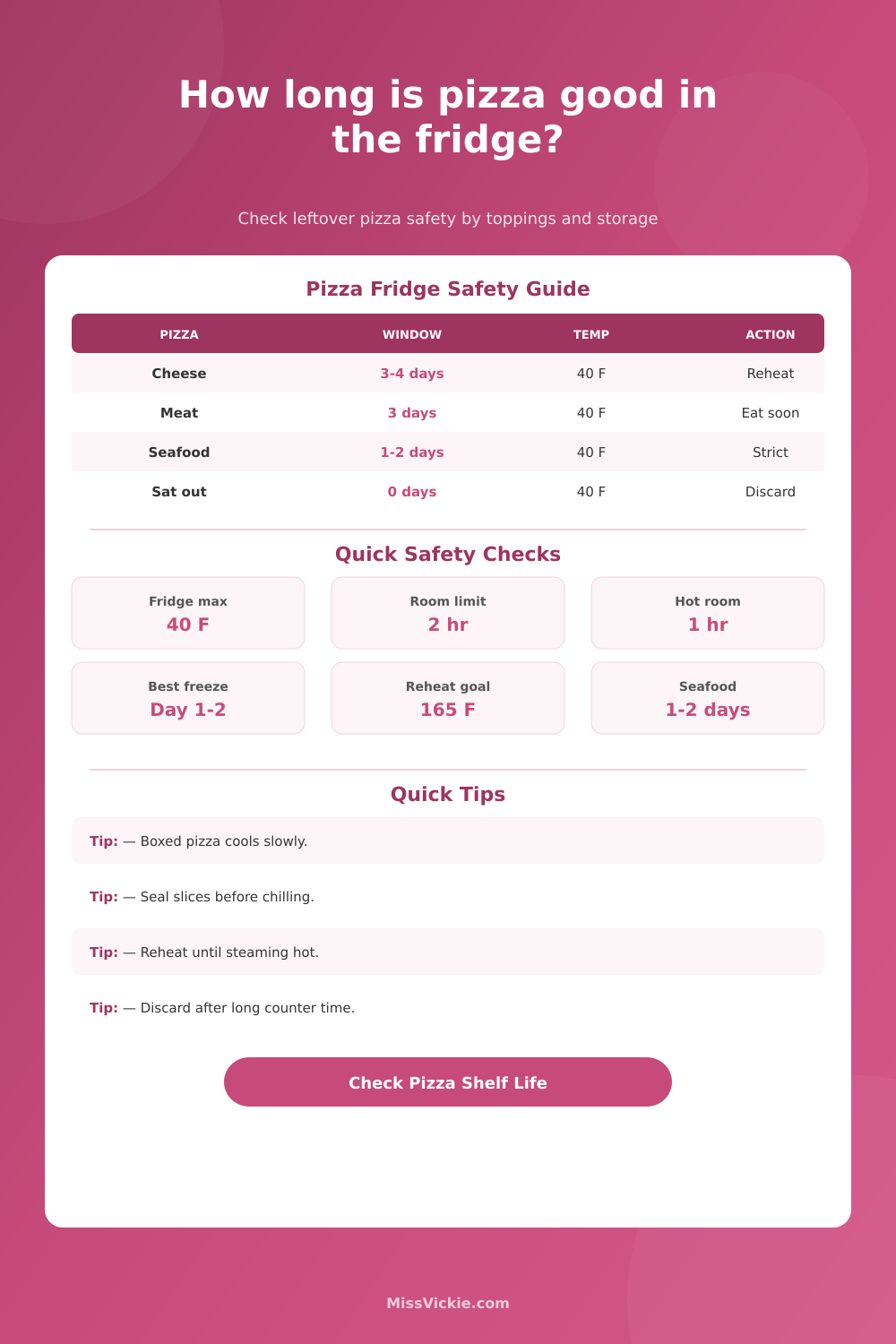
| Pizza Type | Base Fridge Window | Risk Tier | Why It Changes |
|---|---|---|---|
| Plain cheese or margherita | 72 to 96 hours | Standard | Simple sauce and cheese fit the common cooked-leftover window when chilled promptly. |
| Pepperoni or cured sausage | 72 to 90 hours | Standard-plus | Cured meats are salty, but surface handling and grease still keep it below the plain slice ceiling. |
| Meat lovers, chicken, bacon, or sausage | 60 to 84 hours | Higher | Mixed cooked meats add protein, moisture pockets, and more topping contact points. |
| Fresh vegetable or mushroom heavy | 60 to 78 hours | Moderate | Watery toppings soften the crust and can make old slices less reliable sooner. |
| White sauce, ricotta, ranch, or extra dairy | 54 to 72 hours | Higher | Extra dairy and creamy sauce shorten the practical quality and safety window. |
| Seafood, anchovy, shrimp, or clam | 24 to 48 hours | Strict | Seafood leftovers deserve the shortest refrigerator window and careful reheating. |
| Deep dish, stuffed crust, or very thick slice | 60 to 84 hours | Cooling-sensitive | Dense slices cool slowly, especially when stacked in a box or deep container. |
| Vegan cheese or plant-based toppings | 72 to 96 hours | Varies | Use the standard window unless the toppings are very wet or the slice sat out too long. |
These estimates assume the pizza was refrigerated promptly at 40 F or colder. Discard slices with mold, sour smell, slimy toppings, or unknown storage history.
🌡 Fridge Temperature and Cooling Adjustment
| Condition | Calculator Adjustment | Safety Meaning | Best Action |
|---|---|---|---|
| Fridge at 34 to 38 F | No penalty | Cold enough for the full adjusted leftover window. | Keep covered and reheat before serving. |
| Fridge at 39 to 40 F | Small penalty | Still acceptable, but close to the upper food-safety limit. | Use earlier and avoid long door-open periods. |
| Fridge at 41 to 44 F | Major penalty | Above the recommended cold-holding range for leftovers. | Eat only if very recent and reheated hot. |
| Fridge 45 F or warmer | Discard trigger | Pizza may have spent too long above safe cold storage. | Do not rely on normal shelf-life timing. |
| Counter time under 1 hour | No penalty | Fast chilling preserves the normal fridge window. | Store in shallow sealed containers. |
| Counter time 1 to 2 hours | Moderate penalty | Still within the common two-hour rule, but the window tightens. | Use sooner and reheat thoroughly. |
| Counter time over 2 hours | Severe penalty | Past the usual room-temperature limit for perishable foods. | Discard, especially for meat, dairy, or seafood toppings. |
| Hot room or car over 1 hour | Discard trigger | Warm conditions shorten the safe room-temperature limit. | Do not save borderline slices. |
📦 Container and Slice Handling Table
| Storage Method | Window Effect | Quality Effect | Calculator Logic |
|---|---|---|---|
| Airtight shallow container | Best | Less fridge odor and drying. | No storage penalty when the slices were cooled promptly. |
| Tightly wrapped stack or bag | Good | Protects toppings, but stacked slices cool slower. | Small penalty for condensation and stacking. |
| Original pizza box | Fair | Dries edges and exposes slices to fridge air. | Moderate penalty, larger when many slices remain. |
| Loose foil or paper plate | Weak | More air contact and possible cross-contact. | Larger penalty and a lower safety score. |
| Open plate or uncovered tray | Poorest | Fast drying, odor transfer, and more contact risk. | Strict penalty; eat soon only if recent. |
🔥 Reheat Safety Logic
| Reheat Method | Best For | Safety Target | Calculator Note |
|---|---|---|---|
| Oven or toaster oven | Multiple slices and thick crusts | 165 F internal topping heat | Best balance of crisp crust and even reheating. |
| Covered skillet | One or two slices | Hot toppings and steaming cheese | Cover briefly so toppings heat before the crust burns. |
| Air fryer | Crisp thin or regular slices | 165 F internal topping heat | Fast heat, but thick slices may need lower heat and more time. |
| Microwave | Speed, soft crust, office leftovers | 165 F with no cold spots | Rotate or rest the slice because microwaves heat unevenly. |
| Eat cold | Very fresh, low-risk slices only | Keep cold until eating | Not recommended for borderline, meat-heavy, dairy-heavy, or seafood pizza. |
⚖ Keep, Freeze, Reheat, or Discard Grid
Use this when the calculator shows more than 24 hours left and storage was sealed.
Best on day 1 or day 2, before toppings dry out and before the window narrows.
Use when less than 24 hours remain, especially for meat, dairy, or thick slices.
Use for long counter time, warm fridge storage, mold, sour odor, or unknown timing.
💡 Pizza Storage Tips
You have three slices of pepperoni pizza in a box on your counter at 10 PM on a Tuesday. If you account for how long it took you to track down your apartment, it’s been an hour or an hour-and-a-half since the delivery guy left. You’d prefer to scarf them all down right this second… but you’re hoping to save some for lunch the next day. All-in-all, it feels like you’re gambling with food safety instead of following any sort of clear-cut rule.
Enter: the tool, which allow you to balance known risk factors against your specific storage conditions. But most folks consider the refrigerator to be the pause button of time: Anything cold can last forever. Wrong! Bacteria is pretty damn resilient within a narrow range of temperatures. So the calculator will ask you what your fridge’s average temperature is (because yours may actualy operate at a balmy forty-five degrees, not the suggested thirty-eight). If so, your leftovers’ safe window happens sooner then the standard three-day rule indicates. It sets new shelf-life based off how well the fridge stay cold. When it comes to moisture-rich doughs or perishable proteins, a few degrees are not nothing.
How to Keep Your Leftover Pizza Safe
It depends heavily on what’s on top: Different foods rot at varying speeds. That means, for example, that a plain cheese pizza stays good for the most part due to simple tomato + mozzarella combo, which doesn’t involve as many complex protein break-downs. On the other hand, fresh veggies or any other seafood toppings are whole other ballgames. Even if kept cold, the bacteria will grows and histamine levels will rise rapidly within marine proteins, so seafood slices gets a stern ranking from the calculator. And whether your fridge runs extra chilly, those anchovies or shrimp atop your pizza start ticking off the seconds sooner. It is not just about taste; it is also about preventing things from spoiling to quickly in ways that regular chilling cannot stop. It is a big surprise how something’s stored can make a huge difference.
That delivery box may be handy, but cardboard breathes and dries out the crust while allowing ambient fridge odors to permeate the cheese. Using a shallow airtight container will help slow moisture evaporation and avoid contamination from adjacent foods. Moving slices into an airtight shallow container slows down moisture loss and prevents cross-contamination from other items. Exposed to air, as on a plate or in loose foil, things start to go downhill faster. It also makes you think about what part of the fridge they’re really in, not just its overall temp.
The calculation of safety includes your reheating habit. Most people don’t think about reheating as a source of potential danger, they believe that blasting their leftovers in the microwave will kill whatever’s left on them. But unless food reaches an internal temperature of 165 degrees Fahrenheit, bacteria may not be killed. Because microwaves are inconsistent, they typically contain “cold spots” where pathogens can stay alive. Successive cycles of heating and cooling stress the foods structure and increase its risks. Therefore, the calculator factors in how many times you’ve already reheated it, as repeated cycling drastically shrinks safe window for eating. If it’s been out too long before your first reheat, you could of just cooked it again and start over.
While there are rules, they depend on the situation. For example, if you live with older folks, pregnant people, and/or small kids, the three-day rule isn’t safe enough for higher-meat-content pizza. Because certain eaters aren’t invulnerable, the tool lets you dial back its assumptions about who’s eating, and in doing so it shrink the time frame to account for a safer-than-normal margin of error. When immunity to food poisoning isn’t so strong, it’s best to toss a slice rather then risk getting anyone sick. Other one-size-fits-all advice columns frequently fail to capture that level of detail because they assumes all adults provide the same environment for bacteria to grow.
The last test is trust your eyes. No amount of math will ever convince you to eat something if it’s covered in visible mold, smells sour, or just feels slimy to the touch. The digital calculation gives you a statistical insurance policy, relying on facts instead of feelings. But nothing beats your own eyes for noticing things that the number cannot.
Use this tool to manage your week. Know precisely which days to keep frozen, defrost, heat up, and toss out your leftover pie. Finally, let your nose and eyes make the last decision. This way you’ll stay safe in the kitchen and satisfied with your snacks without having dinner turn into a science fair project.