Ground Beef Fridge Shelf Life Calculator
Estimate safe refrigerated time for raw or cooked ground beef using beef state, grind freshness, package status, fridge temperature, fat percent, warm exposure, and household risk factors.
🥩 Ground Beef Presets
Choose the closest storage situation, then adjust the time, package, temperature, fat level, and risk flags to match your actual beef.
🧊 Storage Details
Ground beef estimate
Enter storage details to see the safe window, time left, risk score, and next step.
Formula Breakdown
Entered Scenario
📌 Safety Snapshot
This calculator is a conservative home-kitchen estimator. When smell, texture, temperature history, or timing is uncertain, discard the beef instead of tasting it.
📋 Reference Tables
| Ground Beef Type | Base Fridge Window | Why It Changes | Best Next Step |
|---|---|---|---|
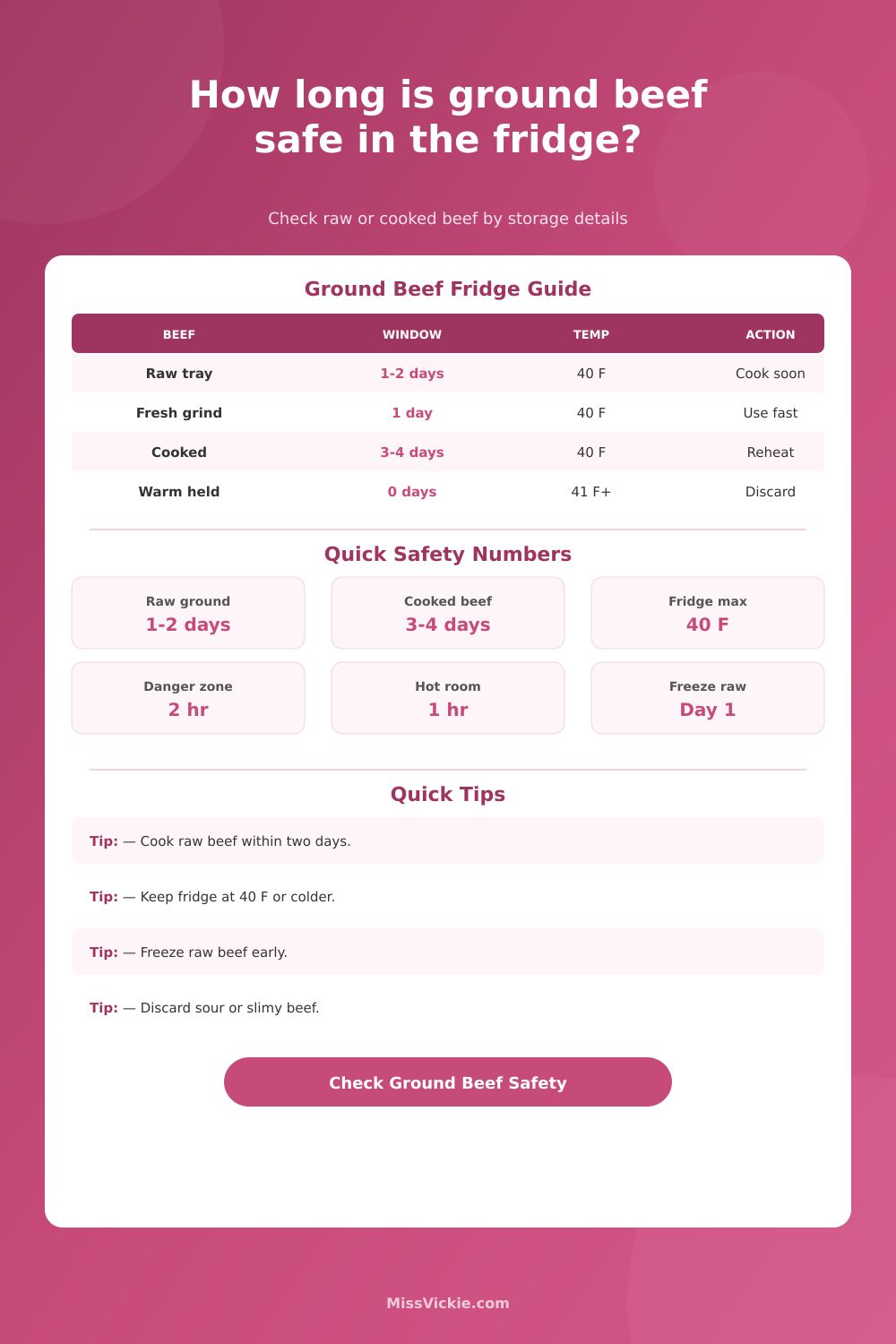
| Raw store-ground tray, chub, or butcher wrap | 24 to 48 hours after purchase | Ground surface area carries more handling exposure than whole cuts | Cook or freeze within the first 1 to 2 days |
| Fresh butcher or home grind | About 24 to 36 hours | Fresh grind quality is high, but the new cut surfaces age fast | Cook same day when possible |
| Raw thawed ground beef | About 24 hours after fridge thaw | The original raw clock resumes after thawing | Cook promptly or discard if warm-thawed |
| Cooked crumbles, patties, or meat sauce | 72 to 96 hours after cooking | Cooking resets the meal clock only if cooling was prompt | Use within 3 to 4 days and reheat well |
| Fridge Reading | Safety Meaning | Calculator Adjustment | Kitchen Action |
|---|---|---|---|
| 34 to 37°F / 1 to 3°C | Very cold home refrigerator range | Small quality cushion only | Keep sealed and use normal window |
| 38 to 40°F / 3 to 4°C | Target safe refrigerator range | No penalty | Follow raw or cooked day guidance |
| 41 to 43°F / 5 to 6°C | Marginally warm for ground meat | Subtract 12 to 18 hours | Cook today or discard older beef |
| 44°F+ / 7°C+ | Unsafe storage if sustained | Major penalty or discard flag | Check thermometer and be strict |
| Package Status | Raw Beef Effect | Cooked Beef Effect | Use-By Impact |
|---|---|---|---|
| Original sealed tray, chub, or butcher wrap | Best ordinary raw storage condition | Not usually a cooked-beef setup | No penalty if kept cold |
| Opened and rewrapped tightly | Extra oxygen and hand contact | Fine for leftovers if clean | Subtract 4 to 8 hours |
| Loose wrap, vented tray, or takeout box | Surface dries and odors transfer | Leftovers lose margin faster | Subtract 10 to 16 hours |
| Open plate or uncovered bowl | Cross-contact and drying risk | Not ideal for cooked crumbles | Subtract 18 to 24 hours |
| Observation | Usually Means | When It Is Acceptable | When To Discard |
|---|---|---|---|
| Brown or gray interior | Low oxygen color change | Normal smell, cold history, within window | Paired with sour odor or slime |
| Bright red exterior | Oxygen exposure or package gas | Still within the raw date window | If package is swollen or warm |
| Sticky surface or excess purge | Quality declining or old handling | Only if very fresh and no odor | If tacky, slimy, sour, or doubtful |
| Sour smell, slime, mold, strong doubt | Failed quality and safety screen | Never taste-test to decide | Discard immediately |
⚖ Storage Scenario Comparison
Store tray or chub, bought cold, unopened, fridge at 40 F or lower, no odor or slime.
Butcher or home grind should be cooked quickly because fresh cut surfaces age fast.
Cooked crumbles or patties last longer only when cooled promptly and sealed well.
Warm exposure, fridge above 44 F, sour odor, slime, mold, or high uncertainty wins over the clock.
💡 Ground Beef Storage Tips
So you open the fridge, grab a pack of ground beef, and everything seem okay. Human memory’s fuzzy; something doesn’t feel quite right in your head. That beef? Well, it was placed in the fridge Tuesday. Tonight’s Thursday evening. Do you risk cooking that beef or not?
Eyes are terrible judges of bacterial load, so people resort to a calculator for advice. It weigh both raw and cooked states, taking into account how fresh the ground meat is. It also accounts for actual fridge temperature (not just what the package label says) and whether or not the packaging has been damaged.
Why Ground Beef Goes Bad Fast
People often store ground beef like they would a slab of steak, but that are wrong. Because whole cuts have bacteria that is safe to sit on their surfaces, grinding spreads the bacteria inside the whole burger or crumble. The extra surface area causes it to spoil faster then you would expect from a chunk of meat. Freshly-ground meats recieve lower shelf-life estimates than vacuum-sealed packages because the former are at greater risk of being handled and exposed to air, two factors that degrade quality quickly.
Ground beef’s spoilage time depend on more than just its look: the calculator estimates when it’ll go bad based off things like temperature and packaging, while visual cues act as flags for spoilage that has already happened. Other variables that folks overlook include temperature. The standard recommendation is to keep a fridge at about forty degrees Fahrenheit, but most household refrigerators operates much warmer. If it’s crowded or close to the door, even more so. Bacteria reproduces rapidly even a few degree above 40°F. Your true fridge setting adjust the calculator to match, and punishes those in the low forties (since being warmer shrinks the safety margin). A warm refrigerator is equivalent to an active countdown clock ticking away food safety.
The length of time that beef remains edible depend heavily on packaging. When you open the package, it expose it to oxygen (not good) as well as any contamination on your counter or hands. That moves the clock right then and there. Storing the meat in an air-tight container will slow down the loss of flavors as well as limit oxidation which preserves quality. It doesn’t adjust the “safety” countdown though for raw product. The app can tell whether the item was removed from its original packaging or just wrapped loosely. How exposed it is determine the rate at which flavor degrades and moisture is lost. That’s what keeps it edible.
Most folks don’t think about it much, but the fat content of ground meat affect shelf life. More fat means there is more material for oxidation to consume. That makes it go rancid sooner even without dangerous bacteria getting involved. While lean ground beef may not develop a bad smell as quickly, it’s just as capable of holding harmful bacteria if allowed to sit too long. Because the percentage of lean affects how long it will last, the calculator accounts for this so you get an accurate estimate. An 80/20 blend act differently than a 96/4 lean blend. You’re packing around some fat that has the potential to become rancid on its own regardless of bacteria.
The confusion happens with visual indicators such as browning. When your meat browns and/or turns gray within its packaging, that’s typically just a result of the loss of oxygen. It’s a chemical reaction, not decomposition. You know you’ve lost the window if there’s a sour odor, or even more so if there’s a slime on top of the color shift. These sensory indicators also has their own flags in the calculator. Of course, nothing beats your nose for overtly spoiled meat. If it stinks, toss the beef, no matter the reading from any calculator.
Meat. Cooked beef (cooled quickly) can be stored in the fridge for up to 3, 4 days, provided you don’t leave it at room temp for long. This is why speed is important here. If cooked meat are left out beyond 2 hours, bacteria will multiply rapidly. There’s no fixing that by reheating it again. To use the app, the post-cook time needs to be recorded as well. It reset the timer based on when the heat was applied after cooking so you’ll get reminders of how long you have before it goes bad. It is a system to track leftover food without needing to remember.
Ground beef is a fickle beast and should of been treated as such when storing it. A combination of correct temperature and timing ensure that you will have meals ready to go without risking safety. You should rely on your nose too; honest sensory checks is required. When memory fails, trust the math. When the numbers become ambiguous? Always trust your nose.