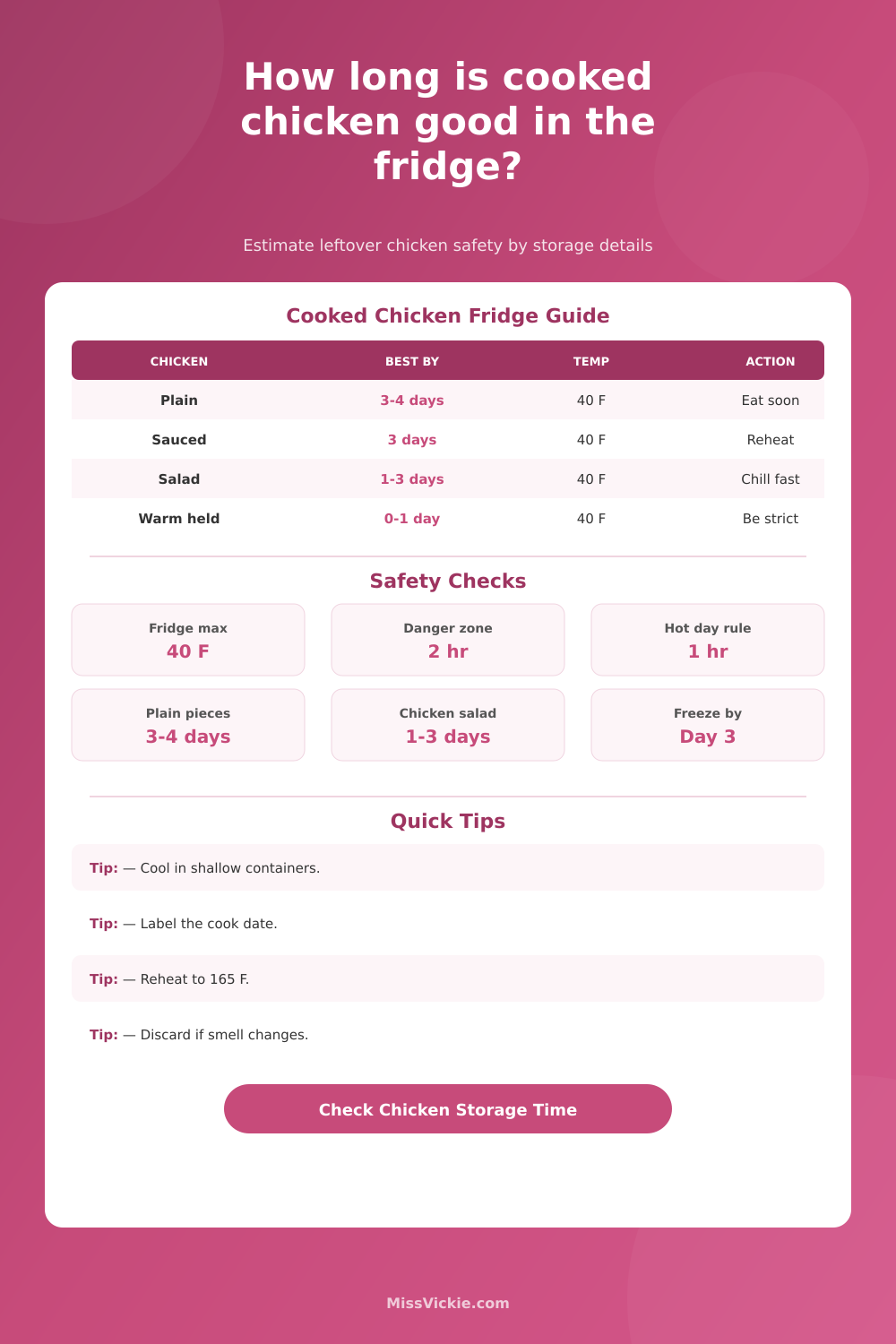
Cooked Chicken Fridge Shelf Life Calculator
Estimate how much safe refrigerated time is left for cooked chicken using the cook age, fridge temperature, cooling delay, storage seal, exposure, and chicken style.
🍛 Leftover Chicken Presets
Choose a real storage situation, then fine-tune the time, temperature, container, and exposure details for your batch.
🧊 Storage Details
Chicken Storage Result
Enter your storage details to estimate the practical eat-by window.
Storage Calculation
Use Plan
📊 Quick Storage Benchmarks
The calculator uses conservative food-safety planning logic for home leftovers. When storage history is uncertain, use the stricter result.
📋 Cooked Chicken Reference Tables
| Chicken Style | Base Fridge Window | Why It Changes | Calculator Data Used |
|---|---|---|---|
| Plain roasted, grilled, or baked pieces | 3 to 4 days | Lower moisture and fewer mixed ingredients give the standard cooked-poultry window. | 96 base hours, medium surface factor |
| Rotisserie chicken after opening | 3 days | Purchase time, carving, and store handling make a slightly stricter deadline useful. | 72 base hours, handling factor added |
| Shredded or diced meal-prep chicken | 3 days | Small pieces expose more surface area than whole breasts or thighs. | 72 base hours, high surface factor |
| Chicken in gravy, curry, broth, or sauce | 3 days | Moist mixtures are practical to use sooner, especially after repeated reheating. | 72 base hours, moisture factor added |
| Chicken salad or mayo-based chicken | 1 to 3 days | Cold service, chopping, and mixed ingredients call for the strictest window. | 48 base hours, cold-use factor added |
| Vacuum-sealed cooked chicken | 3 to 4 days | A tight seal protects quality, but home refrigeration still follows cooked-chicken timing. | 90 base hours, quality bonus capped |
| Fridge Reading | Calculator Adjustment | Practical Meaning | Suggested Response |
|---|---|---|---|
| 34 to 37 F or 1 to 3 C | Adds a small quality buffer | Cold storage is strong, but the normal date still matters. | Use by the calculated deadline. |
| 38 to 40 F or 3 to 4 C | Uses the normal window | This is the target refrigerator range for leftovers. | Label, seal, and eat within 3 to 4 days. |
| 41 to 43 F or 5 to 6 C | Subtracts 12 to 24 hours | Marginal cooling shortens the useful leftover window. | Eat sooner or discard if age is high. |
| 44 F or 7 C and above | Triggers a high-risk flag | The refrigerator is not cold enough for confident storage. | Be strict; discard if history is unclear. |
| Storage Habit | Window Effect | Quality Effect | Calculator Penalty |
|---|---|---|---|
| Shallow airtight container | Protects the normal window | Less drying and fewer fridge odors | 0 hours |
| Loose wrap or takeout box | Shortens practical use time | Dry edges and more odor transfer | Subtract 8 to 14 hours |
| Opened repeatedly for portions | Shortens practical use time | More handling and temperature swings | Subtract 8 to 18 hours |
| Buffet, party, or travel leftovers | Can make the batch discard-only | Unknown warm time becomes the deciding factor | Subtract 18 to 48 hours |
| Current Age | Plain Pieces | Shredded or Sauced | Chicken Salad |
|---|---|---|---|
| Under 24 hours | Usually fine if chilled quickly | Usually fine if sealed | Use within 1 to 2 days |
| 24 to 48 hours | Good use window remains | Plan to eat soon | Eat soon, keep very cold |
| 48 to 72 hours | Eat soon or freeze | Use today if normal | Strict check or discard |
| Over 96 hours | Discard for safety | Discard for safety | Discard for safety |
🧾 Storage Scenario Comparison
Plain chicken cooled fast, divided shallow, sealed airtight, fridge at 40 F or lower.
Shredded, sauced, opened often, or stored in a loose takeout container.
Chicken salad, cold sandwiches, or leftovers for children, older adults, or pregnancy.
Sour smell, slimy texture, mold, fridge above 44 F, or more than 2 hours left warm.
💡 Storage Tips
Midnight: You’re standing in front of an open fridge doubting yourself. Light hits your feet and then lands on Tuesday’s leftover meal. Does that look good? Smell okay? Is there any chance it sat too long on the plate? Was the kitchen warm when you put it in? Should I eat this or get sick? Hunger versus risk, which is greater?
Intuition isn’t helping because bacteria don’t give two hoots about how confident you are in yourself. They only need one thing: Time + Temperature. So the calculator does all of heavy lifting, translating what happened inside your fridge into a safety window. It accounts for factors like cool-down speed, seal tightness, etc., and converts them into clear guidance.
How the Calculator Keeps Your Food Safe
After you cook something, how do you keep it from getting too hot? That’s the first variable. You’re told to put it back in the fridge only after it cools down, and that advice has a limit. Bacteria can grows quickly at room temperature (a.k.a. Bacteria can grow quickly at room temperature, also known as the danger zone, if even warm chicken sit out for several hours. How long was yours exposed before being stored cold?
Cool it promptly, in shallow dishes, and you’ll save more days on the shelf. Put it in a hot takeout container or a big pot and let it sit for an hour or two and then the countdown begins sooner than you probably realize. That time reduction cuts into your safe days.
Preparation also affects things, texture too. A chunk of plain roasted chicken will behave different than shredded chicken in curry sauce or tossed with mayonnaise. Wet conditions are bad, moisture helps microbe growth. That’s why dry pieces last longer; a sauce dish has a limited shelf life compared to something without any sauce.
That’s where that “sauce” button comes into play: the app recalibrates its baseline days depending on if you’ve left over plain food, sauced food, or mixed food. (You’d think they’re all four days, right? Nope.)
It is more about fridge temp than most of us think. Home refrigerators often runs warmer then they should. (The target is forty degrees Fahrenheit and lower.) A refrigerator that runs at forty-four degrees actually ages leftover food faster than conventional charts indicate. You plug in your own thermometer reading into the tool. Such a minor detail can shave hours off of your estimated safe window; forcing you to eat sooner or toss out something you thought was still good. This forces you to face a reality that generic charts don’t take into account.
Lastly, ask yourself: Who’s eating it? Young kids, older adults and people whose immune systems is compromised will be less tolerant of risk than healthy adults. The calculator takes that into account. If you’re feeding a toddler, your safety margin goes down quite a bit. When the stakes are high, err on the side of throwing out questionable food.
Your eyes and nose are much better than any algorithm. When in doubt about the smell, taste, or appearance of food, throw it out right away. For example, if chicken is slimy, sour, or makes you cringe, do not wait for confirmation. When the smell/look of your leftovers is unclear, following this process takes out the guessing game.
You’re now using real data to make decisions rather than hopeful thinking. Next time you open up the fridge, you’ll know exactly what to do. No more sinking feeling. Your actualy luxuruis meals should of been safer if you used the app. It helps avoid many moddern mistakes.