Egg Freshness Calculator
Estimate freshness from egg age, storage temperature, room-temperature exposure, shell condition, float-test behavior, and planned use before you poach, fry, bake, or boil.
🥚Freshness presets
Choose the closest carton situation, then fine-tune the inputs. The calculator treats room-temperature time, warm fridges, cracked shells, and float-test results as separate freshness penalties.
📝Egg freshness inputs
Freshness estimate
Enter your carton details to see the freshness score, estimated fridge-equivalent age, and best cooking use.
Calculation breakdown
📊Freshness score guide
🔬Float test and visual checks
| Test result | Freshness meaning | Best kitchen use | Calculator penalty |
|---|---|---|---|
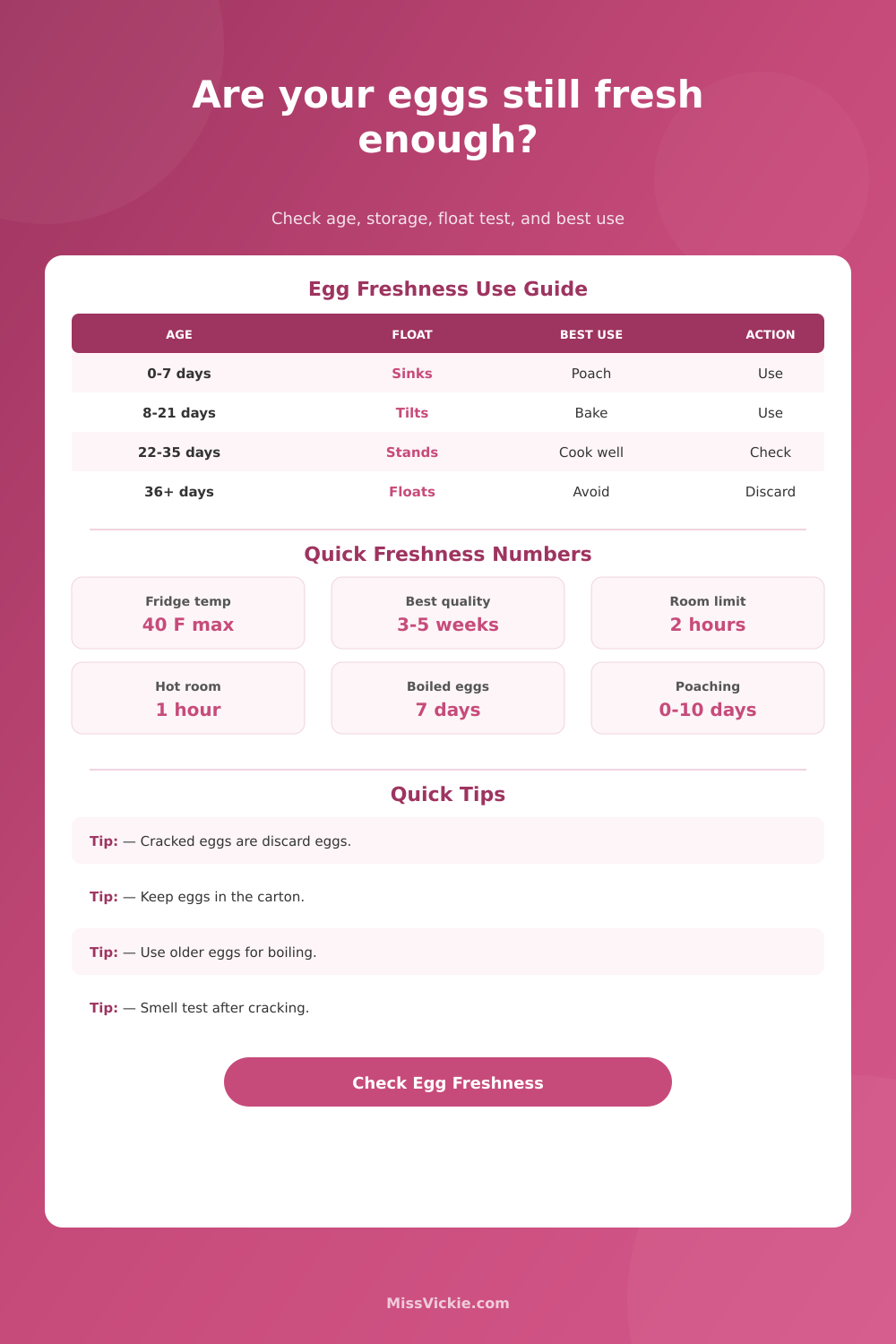
| Sinks and lies flat | Small air cell, dense white, usually very fresh | Poaching, sunny-side frying, soft scrambling | 0 days |
| Sinks but tilts upward | Moderate air cell; good general-purpose egg | Baking, scrambling, omelets, casseroles | 6 days |
| Stands upright on bottom | Older egg with larger air cell | Hard-boiling or fully cooked recipes after odor check | 14 days |
| Floats to the top | Very large air cell; may be too old for eating | Discard, especially if odor, crack, or warm storage exists | 35 days |
🌡Storage age multipliers
| Storage condition | Freshness effect | Why it matters | Calculator value |
|---|---|---|---|
| 35-40°F / 2-4°C, carton, back shelf | Baseline best storage | Cold, steady temperature slows quality loss | 1.00x age |
| 41-45°F / 5-7°C | Noticeably faster quality loss | Above the usual refrigerator target | 1.25x age |
| Fridge door rack | More temperature swings | Opening the door warms eggs repeatedly | +4 days |
| Room-temperature exposure | Rapid safety and quality penalty | Cold eggs can sweat and warm quickly | +3 days/hour |
🍳Best use by adjusted egg age
| Adjusted age | White and yolk behavior | Best use | Kitchen note |
|---|---|---|---|
| 0-7 days | Thick white, high yolk, tight shape | Poached eggs, sunny-side eggs, garnish eggs | May be harder to peel after boiling |
| 8-21 days | Good white structure with easier handling | Frying, scrambling, cakes, quick breads | Most versatile window for everyday cooking |
| 22-35 days | Thinner white and larger air cell | Hard-boiled eggs, fully cooked bakes | Crack into a small bowl and smell first |
| 36+ days | Weak white, large air cell, higher discard risk | Only if score is acceptable and no flags appear | Discard any floater, odor, crack, or odd color |
📅Common carton scenarios
| Scenario | Typical inputs | Expected score range | Recommended use |
|---|---|---|---|
| Fresh grocery carton | 0-7 days from purchase, 38°F, carton shelf | 88-100 | Any use, including poached eggs |
| Mid-fridge baking carton | 14-21 days, carton, normal smell | 72-88 | Baking, scrambling, pancakes, casseroles |
| Egg stands in water | 25+ days or warm storage, upright float test | 45-70 | Fully cooked only after crack-and-smell check |
| Cracked, leaking, bad odor, or odd color | Any age with a safety flag | 0 | Discard |
⚖Comparison grid
Freshest eggs hold a neat oval and have the best thick whites.
Fresh to moderately fresh eggs keep a rounded yolk and clean edges.
Older but sound eggs work well when fully cooked into batter.
Slightly older eggs usually peel more easily after chilling.
💡Freshness tips
It’s time to make eggs, so you grab one from the carton. But then you can’t remember when you purchased it. Now writing on the carton looks faded. Is it still good? Will it hold together in a pot of boiling water, or has it passed the point of no return? A few seemingly unimportant days can be what separates a perfect poached egg from a watery disaster.
Over time, air passes through an eggshell, changing its properties from the moment of laying. This increase the size of the air cell within the egg, impacting cooking and floating ability.
How to Know if Your Eggs Are Still Good
The calculator above takes into account what few people do. It looks at factors like how long you kept those eggs in the fridge and if you left the door open too often. It also considers how long they was sitting outside while you unloaded the grocery bags. By factoring in all this stuff together with both float test results, storage conditions, and age, the calculator use some basic math to find a realistic freshness score (not just a “best guess”).
How hot it is also make a difference. An egg kept at 38 degrees in a fridge will age slower then one at 45 degrees. To compensate for this, the tool multiplies by a factor based on how hot or cold the environment is, because higher temperatures speeds up the chemical reactions that lower the quality. And even leaving eggs out on the counter for a couple of hours can cause them to age as if they were a day or two older than what’s written on their shell. Now we have to track our room temperature exposure in order to keep honest estimates.
Calendars aren’t everything. One of the handiest and quickest checks at home is the float test. Eggs that are fresh will lay flat on their side in water, where older ones will tilt (or stand up) due to larger air cell. A floating egg is typically no longer safe for eating since the inside of the egg has broken down enough. By using physical cues like this, the calculator converts those to numbers for you, to show you just how far off your freshness score is from a standing egg. It creates a clear decision point out of what might of otherwise been a vague hunch.
Where they live also matters more than many home cooks know. When stored in the refrigerator door, eggs are exposed to temperature fluctuations with each fridge opening, speeding up their decline in quality. Ideally, they should be kept on the back shelf, where it is cooler and more stable. Because eggshells are porous, they act like sponges and will absorbs odors and lose moisture when left out of their box. They’ll retain both taste and texture far longer when kept in their cartons for weeks longer than you’d think.
But how fresh does an egg need to be? Some dishes call for super-fresh ones; poached-egg whites is thick and clingy, a quality that comes only from really young eggs. On the other hand, if they’re too fresh, their thin whites will spread out rapidly when dropped into a pot of simmering liquid, leaving an unsightly mess.
For hard-boiled eggs, on the other hand, a little age is good. As an egg gets older, its inner membrane detaches from the shell more easily, making it easier to peel. Knowing these tradeoffs will help you determine the correct egg for each job while reducing waste. Not every dish needs perfectly fresh.
But if you’re still not sure, there’s one last thing: smell. If it stinks (rotten or even just very smelly) when cracked open, toss it now and forget it; all else fails. Also be wary of odd colors in eggs or watery whites, which is visual clues to trouble that no number-crunching device will convince you is safe. Safety first; trust your nose when it doesn’t agree with the math.
Time is something bought by keeping your eggs cool and in their boxes; but saving the meal requires knowledge of what to do next. Before cracking open, check the date, test the float and listen to the smell. Confidence is the objective; perfection isn’t required.