Hot Dog Air Fryer Time Calculator
Estimate hot dog air-fryer time by frank type, diameter, starting temperature, count, basket load, fryer style, slit pattern, finish level, and bun timing.
🌭 Air Fryer Hot Dog Presets
Choose a real scenario, then fine-tune the inputs for your brand, basket size, and preferred snap or char.
⚖ Hot Dog Cooking Details
Regular hot dog air-fryer plan
Set the air fryer, cook the hot dogs, check early, then toast buns separately if needed.
Timing Breakdown
Batch And Bun Plan
Step Timing
- Preheat 2 to 3 minutes.
- Cook hot dogs in one layer.
- Toast buns after the hot dogs.
📌 Quick Air Fryer Benchmarks
📋 Hot Dog Type Timing Table
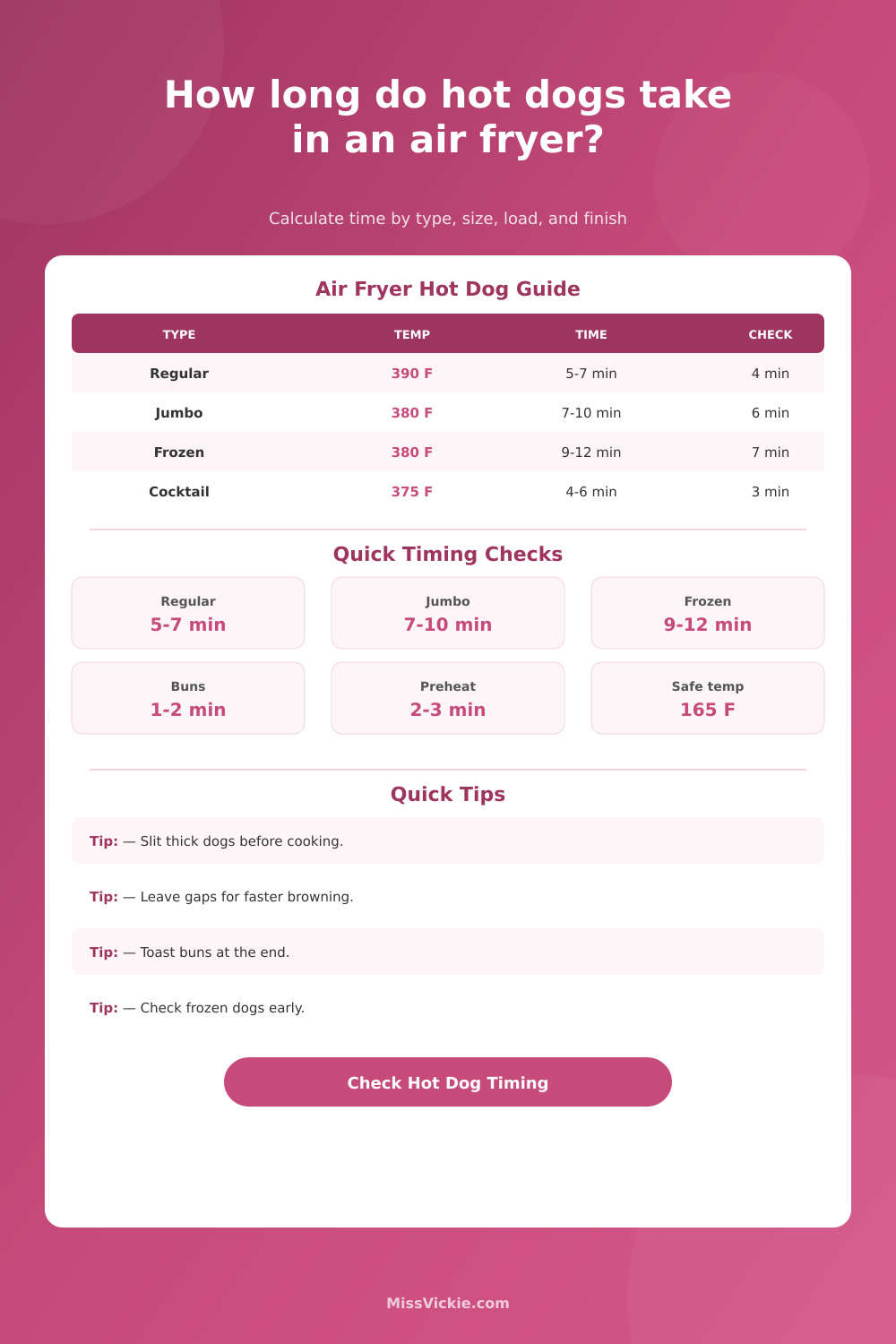
| Hot Dog Type | Typical Diameter | Air Fryer Temp | Base Time | Best Finish Cue |
|---|---|---|---|---|
| Regular beef or pork frank | 0.70 to 0.85 in | 390°F / 199°C | 5 to 7 min | Plump, hot center, browned spots, casing just starting to wrinkle. |
| Jumbo or bun-length beef frank | 0.90 to 1.15 in | 380°F / 193°C | 7 to 10 min | Split lines open slightly and the center is steaming hot. |
| Chicken or turkey hot dog | 0.65 to 0.85 in | 380°F / 193°C | 6 to 8 min | Light browning; avoid extended charring because lean franks dry faster. |
| Plant-based hot dog | 0.70 to 0.95 in | 375°F / 191°C | 5 to 8 min | Surface browned with a flexible center, not shriveled. |
| Frozen hot dog | 0.70 to 0.95 in | 380°F / 193°C | 9 to 12 min | Separate after the first few minutes, then finish until hot throughout. |
| Smoked sausage link | 0.95 to 1.25 in | 375°F / 191°C | 8 to 12 min | Juices bubble at the slit and the skin is browned but not burst open. |
| Pre-cooked bratwurst | 1.00 to 1.35 in | 375°F / 191°C | 9 to 13 min | Browned casing, hot center, and a short rest before serving. |
| Cocktail franks or mini dogs | 0.45 to 0.65 in | 375°F / 191°C | 4 to 6 min | Glossy, browned tips, and hot centers; shake once for even edges. |
🌡 Adjustment Reference Table
| Factor | Calculator Options | Time Adjustment | Temperature Adjustment | Cooking Note |
|---|---|---|---|---|
| Starting temperature | Room, refrigerated, very cold, frozen, thawed | Room: -6%; very cold: +8%; frozen: +35% | Frozen usually stays 5°F lower than charred fresh hot dogs. | Frozen packs may need a shake once the franks separate. |
| Diameter | Thin mini dogs to thick brats | About 5% to 8% per 0.1 inch away from baseline | Thicker links benefit from moderate heat instead of max heat. | Measure the widest part if the ends taper. |
| Slit pattern | None, shallow slits, spiral, butterfly, crosshatch | Butterfly: -12%; spiral: -6%; no slit: +5% | More exposed surface can brown at slightly lower heat. | Deep cuts increase browning but can dry out lean franks. |
| Basket load | Spaced, touching, crowded, tray, stacked | Touching: +8%; crowded: +18%; stacked: split batches | Stacked loads should stay moderate to avoid scorched edges. | Best texture comes from gaps between hot dogs. |
| Finish level | Gentle, standard, charred, kids, reheat | Kids: -8%; charred: +14%; reheat: -18% | Charred finish adds 5 to 10°F when the type allows it. | Check early for lean poultry or plant-based franks. |
🧺 Count And Batch Table
| Air Fryer Style | Practical Capacity | 4 Hot Dogs | 12 Hot Dogs | 20 Hot Dogs |
|---|---|---|---|---|
| Compact basket under 3 qt | 3 to 4 regular hot dogs | 1 batch, spaced carefully | 3 to 4 batches | 5 to 7 batches; keep cooked dogs warm separately. |
| Medium basket 3 to 5 qt | 5 to 6 regular hot dogs | 1 batch with gaps | 2 batches | 4 batches for even browning. |
| Large basket 5 to 7 qt | 7 to 8 regular hot dogs | 1 roomy batch | 2 batches | 3 batches if each layer stays flat. |
| Air fryer oven or rack tray | 8 to 10 regular hot dogs | 1 batch | 2 racks or 2 batches | 2 to 3 batches; rotate trays midway. |
| Wide or dual basket | 8 to 12 regular hot dogs | 1 batch | 1 to 2 batches | 2 batches, divided by drawer or zone. |
🍞 Bun Timing And Finish Table
| Bun Plan | When To Add | Added Time | Best For | Watch Point |
|---|---|---|---|---|
| No buns in air fryer | None | 0 min | Lettuce wraps, plain franks, or separate toasted rolls | No change to hot dog timing. |
| Toast separately after hot dogs | After removing hot dogs | 1 to 2 min | Most soft buns and reliable browning | Open the buns slightly so the cut face warms. |
| Add buns for final minute | Last 60 to 90 seconds | 0 to 1 min | Small lunches where space remains in the basket | Buns can block airflow if they cover the hot dogs. |
| Buttered buns after hot dogs | After hot dogs rest | 1.5 to 2.5 min | Split-top or sturdy buns | Butter browns quickly, especially near the fan. |
| Toast buns in batches | After all hot dog batches | 2 to 6 min total | Parties and trays | Toast last so buns stay crisp and warm. |
Hot dogs sold fully cooked still need to be heated thoroughly. For leftovers, poultry franks, or any uncertain storage history, use 165°F / 74°C as the safest reheating target.
🔥 Finish Comparison Grid
Best for kids, poultry franks, and leaner hot dogs that dry quickly.
The default for regular beef or pork franks with browned spots.
Use for thick beef franks when you want deeper browning and split marks.
Toast after cooking or during the last minute only if the basket has room.
💡 Air Fryer Hot Dog Notes
Okay, so you’ve been there: Friday night, it’s time to put something on the table (and do it now; your brain turned off for the work day hours ago). Hot dogs! They’re quick, inexpensive and, let’s face it, pretty good most of the time. But here comes the trap: boil ’em and they’re pale and sad; throw ’em on the grill and they’ll be charred rubber if you don’t keep your eye on them. Enter the air fryer. It promises steamy middles and a nice crisp on the outside with none of the mess. More often than not, it delivers … as long as you actualy get how the thing works, rather then guess at the timing.
Plug in the load on your basket, the starting temperature, the diameter, and type of frankfurter and the calculator do the rest (above). No more burnt delicate turkey sausages or undercooked frozen jumbo. Most folks treats all hot dogs alike. All equal cylindrical tubes of protein; but they’re not. Some have thicker casings and lower fat content than others; some is made with plants instead of meat. It’s a very different animal (sorry). And this is where the tool shines: It factors those physical variations into its calculation automatically, changing the baseline time and temp accordingly. Select the frank type, and it’ll shift the target heat to accommodate moisture retention and density of each sausage.
How to Cook Hot Dogs Perfectly in an Air Fryer
This is where most home cook get tripped up. I just put six frozen hot dogs in the basket, press 40 minutes and leave.” But convection require air flow. This is why a basket of air fried hot dog turns out with a cold center, burnt ends, and shriveled, dried-up sticks. You want air to blow around every hot dog, which isn’t going to happen if you overload your basket; the tool manages this by adjusting for both airflow and the baseline temperature and thermal inertia of the meat. So the device consider fryer type and basket load to tell you how many times through it needs to be done. For example, a compact fryer may only hold four regular sized hot dogs comfortabley spaced out in their basket without crowding; if you overfill it, you are no longer frying, just steaming. That’s where per-dog time is less important than the batch calculation based off of it.
The second variable is starting temperature, which messes with the novice timekeeper. If you pull a cold hot dog directly from freezer, it will take much longer to hit its core then if it had been thawed out for 20 minutes at room temperature. To account for this heat retention, the calculator factors in a few additional minutes if your start is frozen or fridge-cold. You don’t want all of the heat to go into scorching the outer surface; you want it to work its way inward until the interior warm up sufficiently to avoid blowing out the casing.
Now, if you slit or score the hot dog that’s a different story altogether. If you make a series of shallow diagonal cuts, steam vents will be released while more surface area are exposed for browning. Because these openings create gaps in the heat barrier, the tool use this to actually shorten cooking times a bit. But don’t go overboard here; too much cross-hatching can quickly lead to dried-out goodness when working with leaner franks. In general, a couple of shallow slits will get you all the snap you need without making your lunch resemble jerky.
One area that’s frequently an afterthought is bun time; you throw a beautifully browned dog on a limp, moist bun and realize too late. Because dogs take longer to cook than buns do to toast, the calculator treat them as two different times. It recommends toasting buns in the last minute or running them separately. This way, they gets crispy and warm. It also allows air to flow around your sausages during most of the cooking process.
Consistency is key here. The hot dogs should be plump and evenly browned all the way through. On the page there’s a chart of reference tables that describe what gentle warming look like and where you should of been aiming for burnt edges. Once you know how airflow, temperature, and diameter play off one another, it’s not guesswork anymore. It’s intentional cooking. The franks are no longer sad and pale. You will get crisp, hot, properly cooked snacks every single time.