Frozen Chicken Breast Air Fryer Time Calculator
Estimate air fryer time, temperature, flip timing, rest time, and doneness checks for frozen boneless chicken breast by weight, thickness, coating, basket load, and fryer style.
🍗 Frozen Chicken Presets
Start with a real frozen chicken breast scenario, then fine-tune the piece size, shape, basket load, crust goal, and thermometer target.
⚖ Chicken and Fryer Details
Frozen Chicken Breast Timing
Use a thermometer before serving; frozen chicken timing varies by exact thickness and fryer airflow.
Calculation Breakdown
Cooking Schedule
- 0 min: Load frozen chicken
- 12 min: Flip pieces
- 22 min: Start checking
- 165 F: Rest before slicing
📊 Timing Snapshot
📋 Frozen Chicken Breast Time Reference
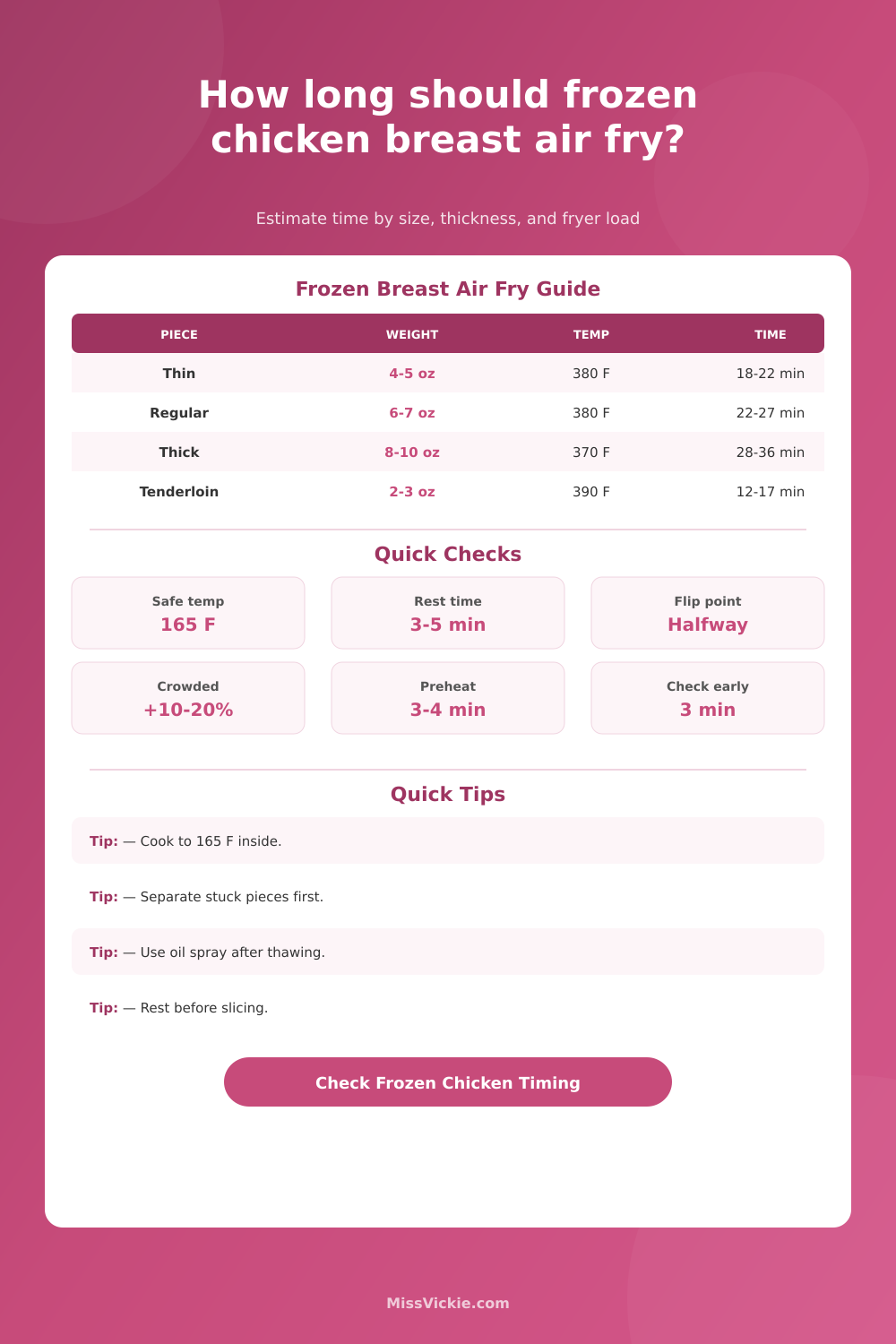
| Frozen Piece | Typical Weight | Thickness | Temperature | Estimated Time |
|---|---|---|---|---|
| Thin-sliced breast | 4 to 5 oz / 113 to 142 g | 0.6 to 0.8 in / 1.5 to 2 cm | 380 to 390 F / 193 to 199 C | 16 to 22 minutes |
| Standard boneless breast | 6 to 8 oz / 170 to 227 g | 0.9 to 1.25 in / 2.3 to 3.2 cm | 375 to 380 F / 190 to 193 C | 22 to 29 minutes |
| Large thick breast | 9 to 12 oz / 255 to 340 g | 1.3 to 1.8 in / 3.3 to 4.6 cm | 365 to 375 F / 185 to 190 C | 29 to 40 minutes |
| Chicken tenderloins | 2 to 3 oz / 57 to 85 g | 0.5 to 0.8 in / 1.3 to 2 cm | 385 to 390 F / 196 to 199 C | 12 to 18 minutes |
| Breaded frozen fillet | 5 to 7 oz / 142 to 198 g | 0.7 to 1.1 in / 1.8 to 2.8 cm | 380 to 390 F / 193 to 199 C | 18 to 26 minutes |
| Stuffed frozen breast | 8 to 10 oz / 227 to 284 g | 1.4 to 2 in / 3.6 to 5.1 cm | 350 to 365 F / 177 to 185 C | 34 to 48 minutes |
These ranges are planning estimates. Always verify the thickest center with an instant-read thermometer before serving chicken.
🌡 Adjustment Table
| Condition | Timing Effect | Temperature Effect | Action |
|---|---|---|---|
| Pieces stuck together | Add 12 to 18 percent | Start 10 F lower | Separate when thawed enough, then continue |
| Heavy ice glaze | Add 6 to 10 percent | No change | Pat dry at the first flip if surface moisture pools |
| Crowded single layer | Add 10 to 16 percent | No change | Flip and rotate outside pieces inward |
| Oven-style air fryer | Add 8 to 14 percent | Often needs 5 F higher | Use the middle rack and rotate tray once |
| Stuffed chicken breast | Add 18 to 28 percent | Use gentler heat | Check filling and chicken center for doneness |
🍴 Serving and Batch Reference
| Plan | Pieces | Total Raw Weight | Likely Batches | Cooked Yield |
|---|---|---|---|---|
| Quick lunch | 1 standard breast | 6 to 8 oz / 170 to 227 g | 1 batch | 4.5 to 6 oz cooked |
| Dinner for two | 2 standard breasts | 12 to 16 oz / 340 to 454 g | 1 batch in 5 qt | 9 to 12 oz cooked |
| Family dinner | 4 medium breasts | 1.5 to 2 lb / 680 to 907 g | 1 to 2 batches | 1.1 to 1.5 lb cooked |
| Meal prep | 6 medium breasts | 2.2 to 3 lb / 1 to 1.4 kg | 2 to 3 batches | 1.6 to 2.3 lb cooked |
| Salad topping | Tenderloins | 1 lb / 454 g | 1 batch | 12 oz cooked |
🧪 Fryer Style Comparison
Good for one or two pieces, but crowding raises timing quickly.
Best match for standard frozen breasts in a true single layer.
Needs tray rotation and often a longer check window.
Works well when both drawers hold similar piece sizes.
📚 Temperature and Doneness Guide
| Checkpoint | What to Measure | Target | Why It Matters |
|---|---|---|---|
| First flip | Surface thaw and browning | Halfway point | Frozen pieces cook more evenly after the flat side releases |
| Early check | Thickest center | 3 to 5 min before estimate | Prevents dry edges on thinner pieces |
| Safe finish | Internal temperature | 165 F / 74 C | Chicken breast should reach the safe minimum center temperature |
| Rest | Carryover and juices | 3 to 5 minutes | Resting helps the center settle before slicing |
💡 Practical Timing Tips
The freezer drawer has its own set of cooking hurdles, though it’s still very much associated with fast dinners. “I reach into the freezer drawer for some hard chicken breasts, throw them in the air fryer basket, go online and look up what temperature and how long they need to cook for,” you think, then set your timer. Twenty minutes later, when you open the air fryer basket, there are rubbery edges and a center that is still cold. It is not a lack of talent. It is a lack of understanding of heat transfer.
Weight doesn’t matter; it’s more about thickness. Home cooks tend to see only the package weight. Two eight-ounce breast are equivalent, no matter their shape, and they’ll take the same amount of time to cook. What if one is a thick breast, with more volume inside for heat to reach before registering as “done”? By entering the dimensions of your pieces, the calculator performs the math so you don’t have to guess based off feel. It will make you think in terms of geometry, not just weight.
Why Frozen Chicken Gets Cooked Wrong
Then there are the physics of your machine. A big oven style have different characteristics than a small four-quart basket. Airflow turbulence and how compact the unit is will cause it to overcook the outside while leaving the middle cold at higher temperatures, and vice versa. The tool adjusts for the structure as it goes. It knows that stuffing many items into a basket makes each item less efficient in terms of absorbs heat. Overlapping or touching chicken parts creates a sort of thermal insulation. To prevent burning the outside before the center gets hot enough, you require additional time.
Few people thinks about how the flipping happens at the right time. You don’t want to gently pull apart ice crystals and let steam out from underneath until the outside has sealed itself shut (which happens if you flip it too soon). If you leave it on one side for too long, the first layer becomes leathery while the rest remains frozen solid. Flipping it at just the right time ensures an even heat distribution all around the surface. That’s why it says exactly when to flip them. It is a little mechanical trick that makes a big impact on texture.
But no one want to wait! They just want to dig in and skip this step, which defeats the whole purpose of carefully timing everything. If you put your hot chicken right down on the cutting board, the juices will run everywhere, not inside the meat where they belong. The result is a wet plate and dry pieces of meat. If you let it rest for three or five minutes, those proteins relax, this allows them to soak back up that juice and transform an otherwise good piece of chicken into a truly tender one.
The bottom line: safety never negotiates. An instant-read thermometer cannot be replaced by any amount of calculation. It provides a good estimate based on assumed average heat properties, but every air fryer brand have small differences in fan power and heating elements. Always test at the thickest portion… This way, you’ll know that you’ve reached one hundred sixty-five degrees without going over into the dry zone. Two minutes too soon is always better then two minutes too late.
Cooking from frozen has a rhythm to it; once you know it, you pre-heat the basket, line the pieces in there with some space in-between, and go by the timer instead of guesswork. No longer do you wonder whether or not it will be cooked through; now you know when it’s time to check with a thermometer. This mental shift makes all the difference in how you feel about a freezer stuffed with protein.
In the end, this is all about taking out the guesswork of comfort food. I don’t want to take time making dinner, but I do want it to feel like it took time. That’s what the calculator does for me: it takes a bunch of variables (input) and gives me a reliable output (schedule). Load up the frozen blocks, press go, leave it alone. Let science work its magic. What could of been disappointing becomes a reliabel routine.