
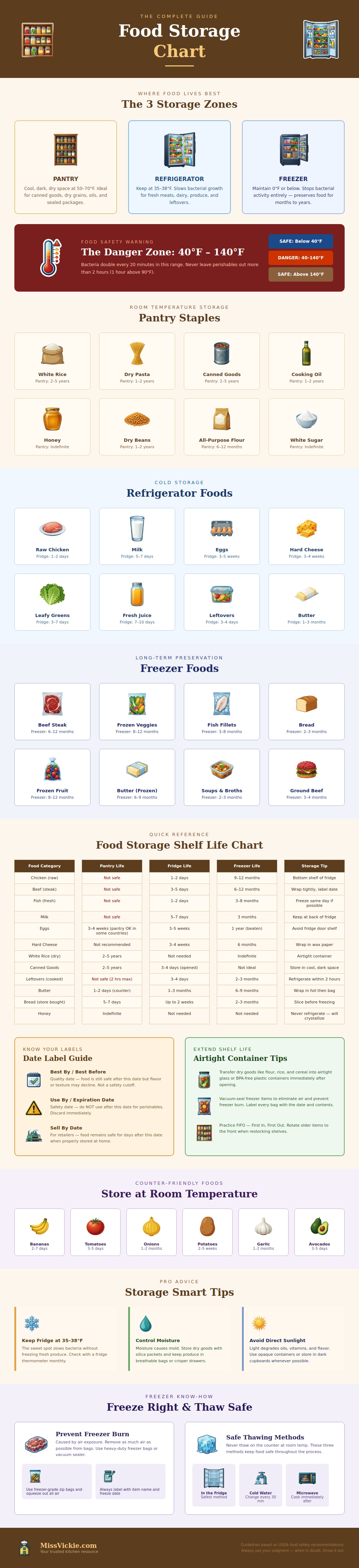
Learning about storage temperatures can help prevent food-borne illness. It’s not so much the food that gets us sick as it is improper storage conditions, time plus place equals danger. Food safety isn’t a matter of being a good cook but knowing when to turn off the heat (and which knob). Learn the fridge, freezer and pantry distinctions to save both your health and your wallet.
In the chart above I’ve broken down your kitchen items by zone. What’s each zone for? Dry goods that benefit from darkness and coolness goes in the pantry. Examples include staples like white rice, which keeps for years if stored in an airtight container. Canned goods and pasta have no moisture and, therefore, don’t spoil easy, either.
How to Store Food Correctly
Bacteria love moisture. Avoid heat and sun! They will degrade vitamin and oil content rapidly, as well as destroy flavor. Store jars in dark cupboards or in opaque containers. Avoid heat and sun! They will degrade vitamin and oil content rapidy, as well as destroy flavor. Store jars in dark cupboards or in opaque containers.
Refrigerator: Keep it running from 35 to 38 degrees F. Produce won’t freeze at this temp but will be slowed down enough to prevent bacteria growth. Running warmer increase the odds that food will spoil. At this temp, raw chicken is only good for a day or two. Other things like milk will last longer, but go sour when cold chain is broken.
Eggs: Don’t put them in the door. It’s the warmest place in the fridge, since it gets opened so often. Toss ’em in a carton on a regular old shelf. A lot of folks don’t realize that everything isn’t equally cold in there.
Food stops when it’s frozen. Bacteria just shut down completely at zero or colder. That’s why meat lasts longer in the freezer (beef steak goes from days to months). Ground beef and fish fillet are also improved by being frozen.
But do it right: Air will cause foods to dry out on surface and develop unpleasant flavors, known as freezer burn. Use a vacuum sealer or other method to remove air. Then label, with contents and the date. It will help you know what is what (like frozen berries) many months later.
Stay out of the danger zone. Between 40 and 140 degrees, bacteria grows like mad. At these temperatures, they can double within 20 minutes. Perishable items shouldn’t be left out longer than two hours. And if it’s hotter than 90 degrees outside, reduce that by half. That goes for dairy, raw meats and cooked meals. This is no gray area.
The date labels are confusing. “Best by” dates measure quality different than safety. While something might not be as good past its best by date, it’s typically still safe to consume. Use by dates are more stringent and are for items that will spoil such as milk or meat. Sell by dates help the retailer know when to rotate stock on the shelves. If stored properaly, you can often safely eat food after its sell-by date. Understanding these differences helps keep you safe and reduces waste.
The other part of storage is managing moisture: For non-perishable dry goods like beans and grains, those must be sealed or in air tight containers with silica packets so that they don’t get moldy. And for produce, which requires some breathability (too much moisture will trap in humidity), etc.
Follow first in, first out rotation. When you restock your pantry, move older items forward; make them the ones you grab for first. That way you eat what’s about to expire. This simple habit ensures you use food before it expires.
Be patient: Thawed items should of never be left on your kitchen counter where they will warm up too quickly. Transfer them to the refrigerator instead, which is slow but safe. If you intend to use the item soon, defrost it under cold running water or in the microwave. In all cases, you’re keeping the food below the danger zone and protecting both flavor and safety.
The science of storing food is simple: heat is a danger; cold delays that danger; dry equals better texture. And keeping foods in their proper zone helps prevent stomachaches and saves your grub for when you want it. No need to know all the numbers. Simply get to know the zones, and store ’em accordingly.