
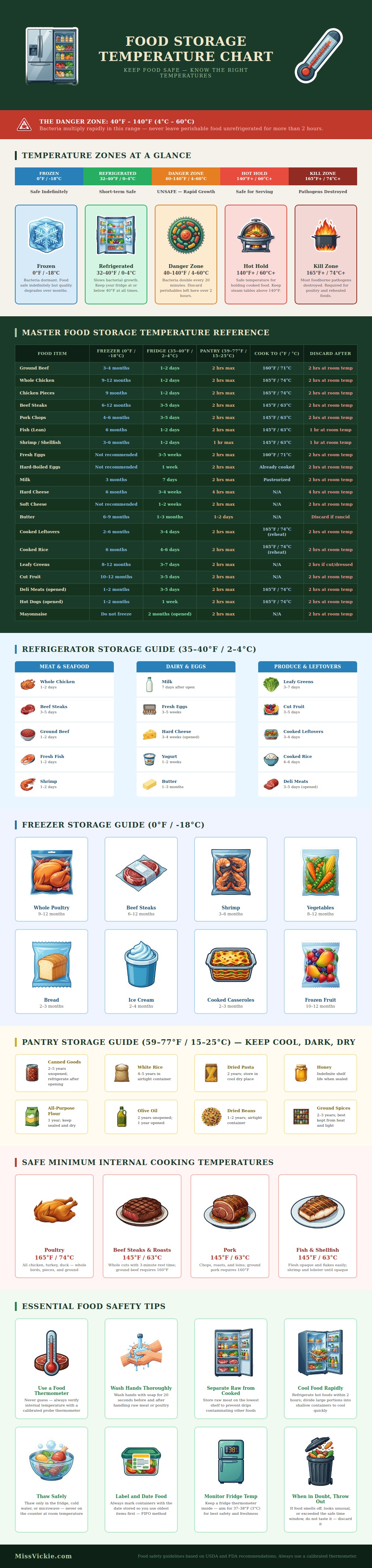
Look in your refrigerator and there it is: a mess of old vegetables and containers. Not sure what’s still edible? Much of food safety boil down to managing temperature. The numbers aren’t just random rules; they indicate when bacteria start (or cease) to multiply. Learning about these zones will help you cook, shop, and store smarter.
The Danger Zone is where things get really, really interesting. Forty to one-hundred forty degrees Fahrenheit are the danger zone. In the danger zone bacteria will double every twenty minutes. Double. And it doesn’t change the texture or the smell. Nope. Invisible. Doesn’t give a damn about what you have planned.
Simple Ways to Keep Food Safe
To keep yourself healthy, keep all of your food out of the danger zone. Below forty degrees or above one-hundred forty degrees are places where you want any perishable items to be. Between those two temperatures…you risk getting sick.
To prevent food spoilage, keep it cold. Food stay good for a couple of days inside refrigerator, which slows down biological activity. How long? Depends on what you’re keeping. Refer to the chart, but just know that raw meat go on the bottom shelf so its drippings don’t spoil other food. Ready-to-eat items and dairy sits up top. Why? Because gravity transfers bacteria easy. It is a small decision that prevents trouble.
Refrigeration isn’t the same as freezing. Zero degrees Fahrenheit do nothing more than halt bacterial growth. It doesn’t kill them. Once it’s frozen, you’re safe from bacteria indefinitely. However, texture changes and freezer burn will degrade your food quality over time. Shrimp vs. Beef has different shelf lives, as shown in the infographic. How well something freeze depends on its composition: fat content, water structure, etc. After proper freezing, it’s a battle against quality rather than safety.
The last inspection involves cooking temps. Pathogens that survived storage must reach a certain level of heat to be killed off during cooking. Because the risk in poultry is not the same as the risk in beef steaks, poultry must reach a higher temperature. Cooking without a thermometer eliminate the guessing game. Thick roasts and ground meats may look done but won’t necessarily be cooked through until you check with a thermometer.
Cold isn’t the only answer for pantry storage: Stable, low-moisture temps are a better solution. Warmth and humidity will speed up decay, so dry food (beans, pasta, rice) stays fresh longer away from heat and humidity. So are liquids (olive oil). They all keep their nutrition and taste best when kept away from heat. A cool, dark cupboard protects your shelf-stable foods from spoiling.
The two-hour rule applies strictly when you encounter leftovers. Quickly cooling hot foods is important, so that they don’t remain in the danger zone. Smaller portion sizes will cool more rapid than larger ones. Shallow containers promote quicker cooling. Better yet: safer.
Dating and labeling foods means that you consume older items first. You will have less waste. Higher quality.
You don’t have to memorize all the numbers. Just remember that handling food safely has less to do with numbers, and more to do with understanding how microorganisms act. Keep ‘em hot if you’re going to serve them; keep ‘em cold if you want them to be fresh; keep ‘em dry if you plan on keeping them awhile. That’s it.
Cook ’em well enough so they stay good on your plate. Store stuff smartly, trust the thermometer over your nose, and make sure the germs are either dead or asleep.