
A pint arrives in front of you and you pick it up, looking for a sharp smack of flavor: this one’s an amber ale, right? Well, yeah. But here’s what happens: you take a swig and…huh? What was that? Sweet? Gentle? Confused by what your tongue is telling you, you turn to the label and notice a pretty high bitterness number.
So why don’t your taste buds match what’s on the bottle? Why is this big puzzle of beer labeling tripping so many people up? The problem lies in the fact that the number on the bottle measures chemistry, not sensation; it does not describe the entire picture. It describes how much bitter substance dissolved into liquid, but says nothing of the sugar content that can completely hide that bitterness.
Why IBU Numbers Don’t Show True Taste
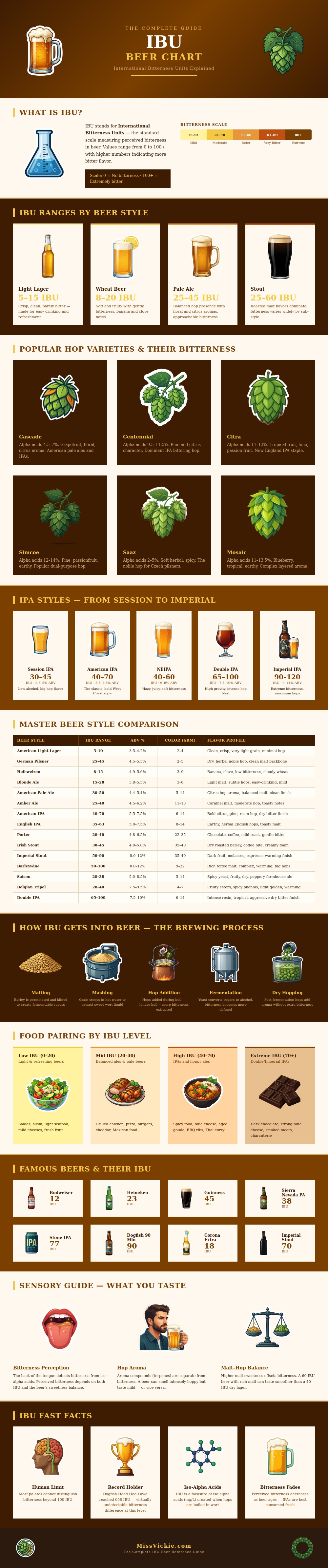
To break it down more, here’s how that translates into something you can actualy experience in your mouth: This way, you can see how chemistry maps to the actual flavor profile, rather than just looking at the number. For example, a ten-IBU light lager could be incredibly refreshing, crisp, with no hop flavors at all. Yet look over to a seventy or eighty-IBU Imperial Stout. That sounds like it’s going to completely destroy your tongue. Then recall that it’s full of those roasty malts. These adds serious chocolate and caramel flavors that overpower the bite. You’re still tasting the bitterness, it’s there, but what comes through for you is something deeper.
And there it is: the variety of hops themselves. These guys (or girls) is the engine that powers this whole thing. When browsing through more detailed information about individual hops (say, Citra or Cascade), you begin to understand how two beers could have equal amounts of IBUs but taste entirely different than each other. One may be heavy in alpha acids used solely for bittering during the boiling process, whereas the other may use late additions of lower acid hops to add fruity aromas without contributing any bitterness. That’s reflected in the infographic, too, where some of the most popular varieties are listed along with their range of alpha acids, offering a glimpse behind-the-scenes as to what brewers is dropping into the kettle.
Why is it possible to have such a soft, juicy New England style IPA when it’s got plenty of hoppiness to it? Or conversely, how can a super-resinous, piney-tasting West Coast style beer seem so bitter while only hitting double digits on the IBU scale? Variety + timing = good beer. According to the graphic’s brewing process diagram, where you put hops into the boil defines their function. Bitterness comes from hops added at the beginning of the boil, since the heat changes alpha acids into iso alpha acids (the stuff we measure) during the boiling process. Flavors and aromas comes from late additions or dry hopping post-fermentation, without adding too many bittering units to total IBU score. That’s how some of these new-fangle beers can smell like they’re full of tropical fruit, yet be surprisingly mild on the backend.
By the time the liquid touches your tongue, your nose has already been hit with the aroma. This leaves you with the impression of something super intense that the bittering units can never truly reflect. To better understand how to pair food to bitterness, however, we have to remove it from its isolation. For instance, a low IBU (bitter) beer goes well with fresh salads/sushi, it’s not going to compete for attention with more delicate tastes. Likewise, mid range (think 20-40 IBU) beer will do nicely with pizza/grilled chicken as there is enough backbone to complement the savoriness of your toppings but not so much that it clashes. Finally, things become more challenging once you enter high double digits. You would of wanted an equally strong dish, such as spicy curry or aged blue cheese, to complement the powerful hop flavor. The visual layout ties everything together. It connects the IBU intensity to the weight and spice level of the dish. This makes food pairing pretty obvious.
All that being said, however, the lesson here is really just that, for any drinker of beer, using IBU as a sort of directional compass instead of a satellite navigation system work out best in the end. You can use them to set your expectations, but remember that those numbers don’t account for the complex relationship between hop aroma, malt sweetness, and our own unique palates. At some point, most of us also lose the ability to discern differences in bitterness. So worrying about whether this beer is 80 or 90 IBUs is all very interesting in theory, but ultimately not something worth getting hung up on.
Listen to your tummy and your nose. Does it smell good? Does it taste balanced to you? It doesn’t matter a bit what the number is if the answer is yes. Follow that advice and you’ll get more out of it than any chart ever could. As you learn along the way, you’ll have a deeper appreciation for what makes that perfect pint tick.