
Do you want to make your own pasta sauce that tastes like what they serve at restaurants? You don’t need a culinary degree. No worries, your mistake probably lie in the base.
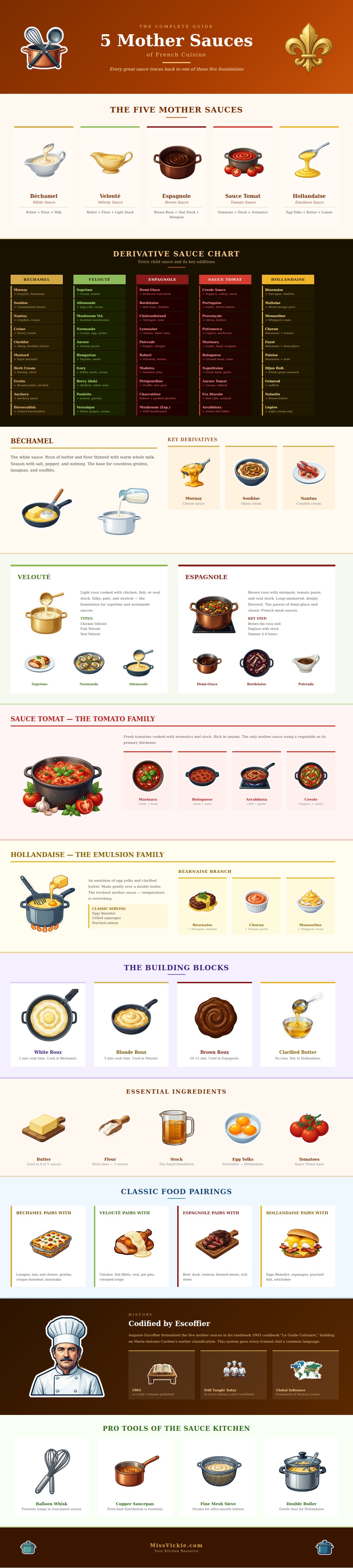
In 1903, chef Auguste Escoffier created a system for world of professional kitchens called “the mother sauces.” The idea was to create universal language based off a set of five foundational sauces. These is broken out in the chart above: five pillars from which each great sauce descends. It’s far less recipe-learning than it is structural knowledge, and once you grasp the framework, you can build whatever dish you desire.
The Five Mother Sauces
Let’s begin at the bottom with that most unassuming of sauces: white sauce, or Béchamel. White sauce is simply a roux (flour cooked in fat) made with butter and flour, and whisked until thick with milk. Add some cheese, Gruyere and Parmesan, and you have Mornay, the cheesy element of your favorite lasagna or macaroni dish. Stir in some caramelized onions, and you’ve got Soubise, ideal for a rich gratin.
Why? Versatility. With Béchamel, you prepare a single batch of sauce, and can turn out variations, all of them distinct, but none requiring you to start anew from nothing. Efficiency masked as elegance.
Same thing goes for Velouté, only with milk replaced by light stock (usually chicken, veal, or fish). The end result is a smooth, silky sauce with deeper layers of savoriness from its stock. With suprême, you take that stock and whisk in butter and cream to create a coating for roast chicken. Adding some egg yolk and lemon brightens things up with allemande. That’s part of what the infographic has in mind, grouping these sauces together; they have a similar fine quality. When you’re looking for a sauce whose flavor won’t overtake a more subtle protein, reach for Velouté.
Brown Sauce (espagnole) is made from a base of veal stock, mirepoix, and deep-cooked roux, which takes some time to cook into its dark, rich perfection. This can simmer for hours before it reaches that state. Its child is demi-glace: strong and reserved for finishing off steaks. Add shallots & red wine and you have bordelaise, the timeless companion to filet mignon.
Patience is key here. No need to rush a brown sauce. Quality shows itself through color. Darker means more cooking.
Only tomato sauce thickens up without a roux, it reduces on its own to thicken. Simmering fresh tomatoes with aromatics makes a tangy, bright sauce. Its better-known children are Bolognese and marinara, though you’ll find Creole on the list, too, featuring additional ingredients like celery and peppers to pack some heat. Tomatoes can change from season to season; they are a forgiving group of plants. The sauce will taste like the time of year it’s made. That’s okay. It counters the fat in heartier meals and offers balance.
And then finally, there is Hollandaise, which is an emulsion of butter and egg yolks. It uses no roux. Rather, it depends on carefully controlled heat to keep the fats mixed. Scrambled eggs if you don’t make it, Eggs Benedict perfection if you do. Béarnese, its cousin, replaces the lemon with a touch of shallot, tarragon and a hint of herb flavors to pair nicely with salmon or steak. Making any of these is all about temperature control. And the double boiler is your safety net.
When you get to know the families, however, the way you cook shifts. Sauces no longer appear as individual recipes but as a series of variations on a theme. And that’s where the mother sauce chart really proves its worth: it converts confusion into clarity. When you find yourself stranded in the kitchen next time, check the building blocks. The basis is butter and flour, stock, egg whites, or maybe tomatoes. Master one. Branch from there. The rest will follow naturaly.