
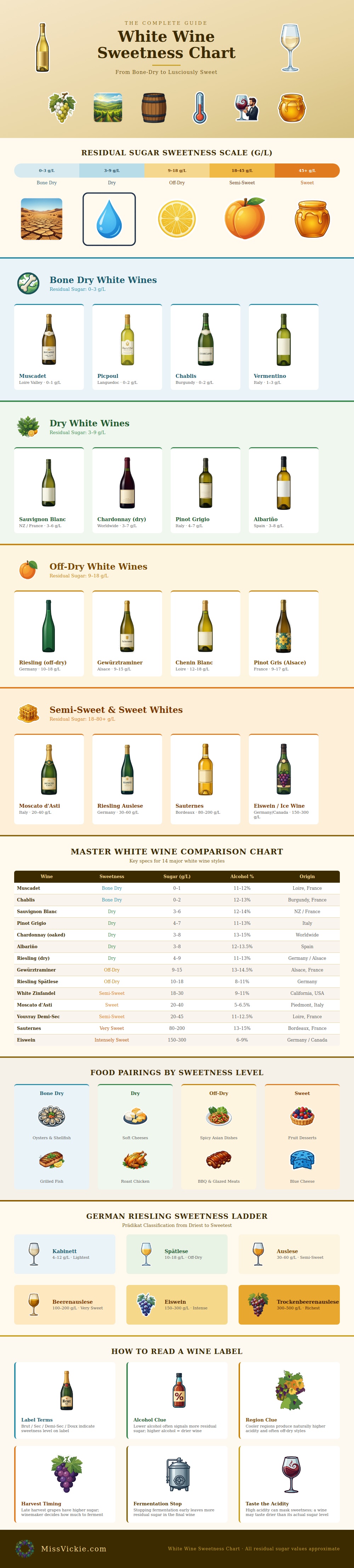
The chart uses the sugar content in wine, measured in grams per liter, to map the spectrum from sweet to dry wines and divide them into different categories based off their dryness. It’s all about real data points and less so about loosey-goosey marketing words. A Spätlese Riesling would be placed in the off-dry band; a Kabinett in the bone-dry category; an Auslese closer to rich. Knowing this lets you know what to expect before uncorking bottle: Is it going to be light, fresh and fruity? Or is it austere and crisp? That’s how it works.
Let’s begin at one end of the spectrum: Dry as a bone. Think Chablis, think Muscadet. These wines has absolutely no residual sugar. You’ll find anywhere from zero to maybe three grams of sugar per liter. These wines were created to be paired with grilled seafood or oysters. They will slide right off your tongue and cut through any salt or fat in those dishes. There’s nothing cloying in the way because there isn’t anything sweet to speak of. For those who want their wine to cleanse palate, look toward this side of chart for some help. It’s not about flavorlessness; it’s about precision.
Understanding Wine Sweetness
The next step moves a little more towards center where we have that dry to off dry zone. Here are some reliable standbys such as Albariño and Sauvignon Blanc. Typically, these wines contains between three and eighteen grams of sugar per liter. This is the territory where many casual drinker will be at ease. There’s no shortage of fruit character, yet it doesn’t overdo it on your palate. Gewürztraminer often fall into this category. It has aromatics but just a bit of sweetness to balance the naturaly spice. A moderately spicy Asian dish or softer cheese would play nicely here too. That bit of sugar will help calm down the heat from these types of dishes.
Then we have semi-sweet to sweet. Sauternes and Moscato d’Asti fall here. Here’s where residual sugar really starts to jump. Some dessert wines has over eighty grams of sugar/liter. They’re accent wines. Use them for a meal with rich blue cheeses or for special moments. And that’s shown on the German Riesling ladder in the graphic above. On it you can see how a grape can be transformed by noble rot, and harvest time. The end result is wine with hundreds of grams of sugar.
These categories help you make sense of reading labels. If they say “Brut” or “Sec,” it’s going to be dry. As you move toward “Demi-Sec” and “Doux,” it get sweeter. Also pay attention to the alcohol level, the higher alcohol tends to mean the wine is drier (since more of the sugar will have been converted to ethanol). A higher acid wine comes from cooler areas. The acid will dull your perception of sweetness. The wine might seem drier then its sugar level suggests.
There’s no such thing as “one-size-fits-all” white wine. White wine is a spectrum; there’s something on it for everyone. Knowing what you like would of saved you time and money. When you pick up a bottle, consider its balance: Do you want the honeyed depth of an Eiswein or the bright zing of a bone dry Vermentino? Sweet isn’t guilty; dry isn’t bad. Match the sugar level to the moment.