
So you’re standing in the wine aisle. You pick up a bottle of Port and a bottle of Barolo. One tastes like leather and dried flowers; the other taste like plum jam. Is the reason one is from a different region? Yes. Is it because one is made with a diffrent grape? Yes. But so much more than that.
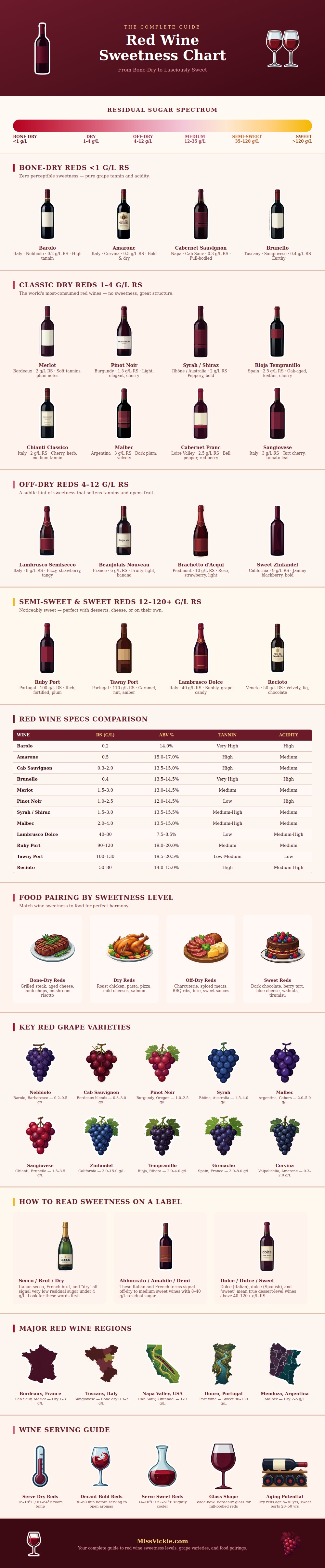
So much of the reason lie with the residual sugar. Red wine isn’t necessarily sweet or dry, but so many people believe that. What’s missing is an understanding of the spectrum between. Knowing where a bottle fits on that scale alters your enjoyment of it. It alters what you’ll want to eat alongside it. This spectrum (see chart above) is expressed in grams of sugar per liter. It sounds technical until you try it.
How Sugar Changes Red Wine Taste
Almost no residual sugar: that describes wines like Napa Cabernet Sauvignon or Barolo that are bone-dry reds. These wines often has under one gram of sugar per liter. That means all of the tannins and acidity shines through. Taste the structure first, then the wine’s elegance shines through. Because these wines lack sweetness they are able to cut through fat without clashing. A bone-dry red is made for steak and aged cheese. If you drink one too warm, the alcohol will overpower your palate and the fruit will be muted. Keep it cool (around sixty-two degrees Fahrenheit), and watch elegance come through.
Dry wines is your everyday staples. Think about Rioja Tempranillo, Pinot Noir, Merlot, they’re all in this category. These wines fall into one- to four-gram-per-liter category. Although that small amount may sound insignificant it’s a nice little buffer that takes the edge off and makes these wines easy to drink during more casual meals. Want a glass of Chianti with your pizza? No worries, the tannins won’t brawl with the tomato sauce. Instead, the wine complements rather than compete. This is sweet spot (pun intended) for most people as it provides some level of complexity without requiring full-on attention.
As you work your way from dry toward sweet though the character changes quite a bit. By adding some sugar, whether a semi-sweet Moscato or a sweet Zin, you’re muting its acidity and emphasizing its fruity side (think: blackberry and strawberry). This is where food pairings get fun. Because the sweetness mellows the burn of chili peppers, a slightly sweet red will handle spice very well while the acid will cut through any oil. Again, it’s a little thing, but it could of make all the difference when you’re attempting to pair a wine with barbecue ribs or Thai curries. As you can see on the chart, these wines provide that middle ground, connecting savory dinner plates to dessert courses.
Then there are Port and Recioto, which clock in over a hundred grams of sugar per liter. They are dessert wines in their own right. But because they have such a high alcohol content, the wines aren’t cloying. Serve them slightly cool to highlight the freshness, and match them with something intense like blue cheese or dark chocolate. The wine’s intensity meets the intensity of the food. It’s not just about flavor; it’s about harmony.
But there are ways to cut through the jargon. When you read Dry (or Sec or Secco), it’s going to be dry. Sweet (Dulce or Dolce) means sweet. Abboccato promises off-dry and a little fruit forward. Avoid getting tricked into drinking a fortified wine because you didn’t know those words.
Red wine isn’t just one thing. Red wine ranges from austere to luxurius; it’s rich to tannic, textured to balanced. Red wine ranges from austere to luscious; it’s rich to tannic, textured to balanced. If you know where a bottle falls on this spectrum, you can drink intentionally, no more guesswork and no more mismatched wine moments. And that alters everything about what you taste when you bring it to your lips.