
Ever eat a pepper, only to wish you hadn’t? If your pepper had any capsaicin in it, that’s what happened. Capsaicin are more than just a flavor note; it can be an enjoyable part of the flavor profile even as it makes things burn.
But what about all those sweet peppers, versus all those hot ones, how do we know which is which, chemically speaking? Turns out, it has everything to do with what’s going on inside the pepper. It won’t necesarily be obvious from outside appearances.
What Makes Peppers Hot?
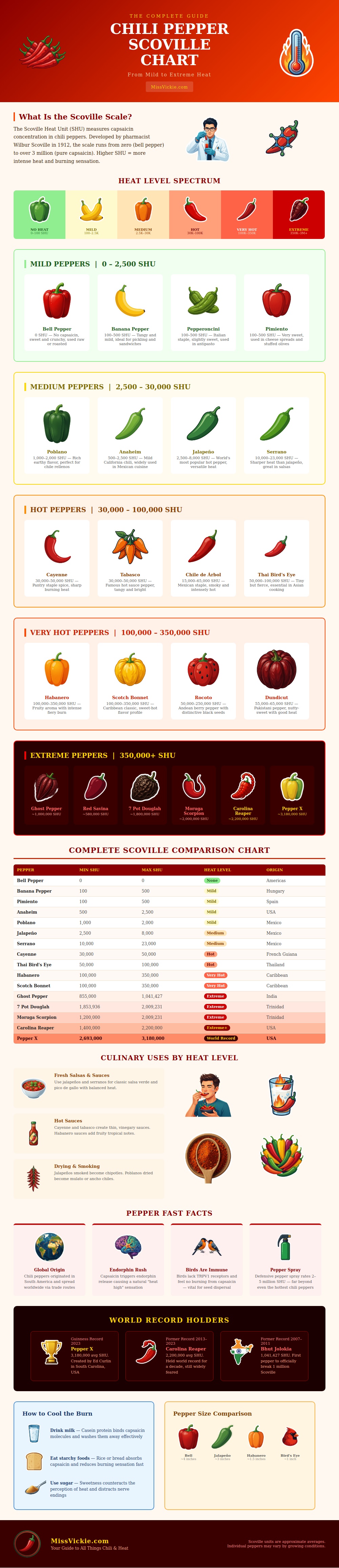
This measure of heat, called Scoville scale, simply measures how much capsaicin there is. It was created in 1912 by Wilbur Scoville who used a process where he diluted the extract of peppers with sugar water and had tasters taste them until they couldn’t detect any more heat. The hotter the pepper, the more you’d need to dilute the extract.
Pure capsaicin crystals is said to be in the millions of Scoville units while bell peppers register at zero on the scale. We use it as a shared vocabulary when talking about how hot something is, since not everyone have the same tolerance for spicy foods.
0 Scoville Heat Unit, Bell Peppers do not possess capsaicin and therefore have 0 Scoville Heat Units. Instead, they’re sweet and crunchy.
Mild Scoville Heat Units; A bit more spicy than bell peppers, these mild hot peppers includes banana peppers and pepperoncini. They provide just enough bite to give your tongue something to deal with that isn’t painful. It’s enjoyable and it helps your palate adjust to heat, it also creates trust between the person eating the dish and spice itself. This middle range is where most home chefs find their comfort zone with peppers.
In this range, you’ll see peppers such as the jalapeño and serrano. The latter are sharp and hotter (with 2,500 to 8,000 units on the Scoville scale), whereas the former is milder (jalapeño has 2,500 to 8,000). The combination of heat and flavor is a good one here. Capsaicin wakes up your senses but doesn’t completely overwhelm what else you’ve got going on. Your cilantro, onion, and tomato all come through in your salsa. It’s also supportive of cooking creativity.
Peppers are hot (and VERY hot), respect. Strong flavors with strong flavorings. Cayennes, habaneros and their close cousin the scotch bonnets packs some punch. One seed can spoil the soup with a habanero that reaches 350,000 Scoville units. As it gets smaller and more creased, the number go up fast. The hotter the pepper, the thicker its skin, and nature has filled it with more defensive compounds to ward off mammals. Birds can still feast on them for seed spreading purposes.
At the far end are the peppers like Carolina Reapers, ghost peppers, and Pepper X. With 3.18 million Scoville units on average, it’s the hottest pepper in the world. There isn’t much taste to any of them; you eat them for endurance different than taste. It’s a test of will. Your mouth just can’t handle all those pain receptors anymore. Beyond a certain point it doesn’t matter what they taste like, it tastes like fire.
Eating too much hot pepper cannot be washed down with water. The active component, capsaicin, is an oil that actualy resists water and disperses on contact (with the soda). Fat and protein can bind with capsaicin molecules and wash them off of your tongue: milk or yogurt are good; even regular ol’ bread will do. Dairy contains a compound called casein, which acts as a type of detergent against spice. Sugar (which distracts nerve endings) also assists.
Peppers are like any other ingredient: Know what you’re working with. Use the Scoville chart as both a way to measure and a guide on which pepper to select for your recipe. Roast some poblanos? Make some hot sauce? You should of prepared something. When do you want it spicy? When don’t you? Know where each type lands on the scale.
If this is all new territory for you, begin with something mild and see how you feel about moving up the scale. Have a glass of milk handy, just in case.