MissVickie air fryer fry planner
French Fry Air Fryer Time Calculator
Estimate air fryer French fry time from cut type, fresh or frozen start, potato type, basket load, temperature, oil amount, shake interval, crispness, thickness, and surface dryness.
🍟 French Fry Air Fryer Presets
Choose a common fry setup, then fine-tune the thickness, load, oil, temperature, and crispness for your own air fryer basket.
🧮 Fry Cut, Start, Load, Temperature, Oil, and Crispness Inputs
French fry timing
Enter your fry setup to calculate timing.
Timing Breakdown
Setup Summary
Fry Schedule
- Preheat, spread fries, shake, and check near the end of the calculated window.
📌 Quick Air Fryer Fry Benchmarks
Good default for regular russet fries with a light oil coating.
Most bagged fries are already par-fried and crisp well from frozen.
Enough to brown fresh potatoes without turning the basket greasy.
Short intervals help fries crisp on all sides instead of steaming in clumps.
📋 French Fry Air Fryer Timing Tables
| Cut Type | Typical Thickness | Best Temp | Fresh Time | Shake Plan |
|---|---|---|---|---|
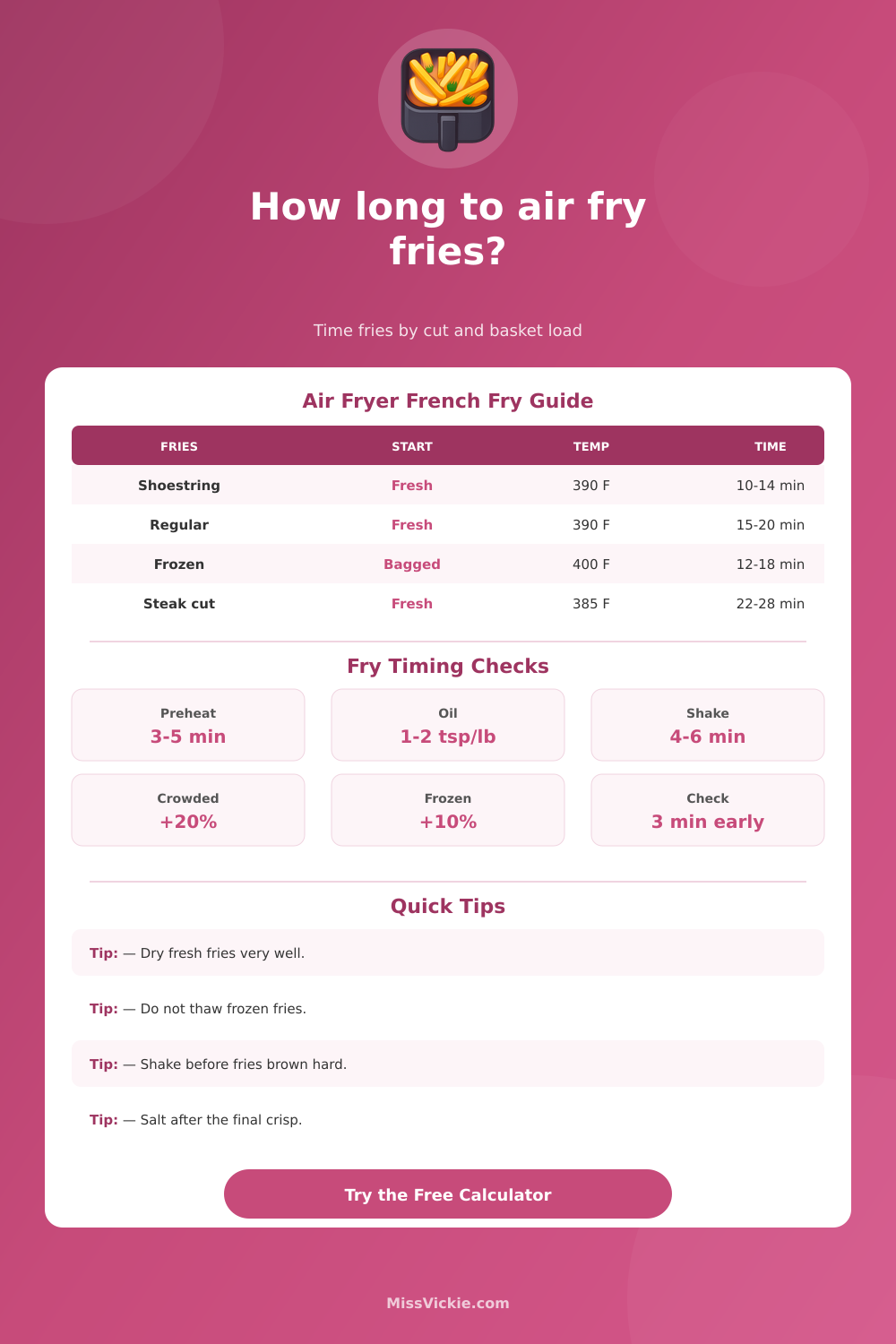
| Shoestring fries | 1/8 to 1/4 inch | 385 to 395°F | 10 to 14 min | Every 4 to 5 min |
| Regular straight-cut | 1/4 to 3/8 inch | 390°F | 15 to 20 min | Every 5 to 6 min |
| Crinkle-cut fries | 3/8 inch | 390 to 400°F | 16 to 22 min | Every 5 min |
| Steak fries | 1/2 to 3/4 inch | 380 to 390°F | 22 to 28 min | Every 6 min |
| Potato wedges | 3/4 inch center | 380 to 390°F | 24 to 30 min | Gentle turn twice |
| Starting State | What Changes | Time Adjustment | Temperature Note | Best Move |
|---|---|---|---|---|
| Fresh, very dry | Raw center plus dry surface | Baseline | 385 to 400°F | Oil lightly and shake |
| Fresh, damp | Surface must dry first | +10 to +18% | Use full preheat | Pat dry before oiling |
| Soaked and dried | Less surface starch, cleaner crisp | -2 to +4% | 390°F works well | Dry until matte |
| Parboiled first | Center cooks faster | -15 to -25% | 390 to 400°F | Rough edges crisp well |
| Frozen bagged | Usually par-fried and coated | +5 to +12% | 395 to 405°F | Cook from frozen |
| Basket Load | Airflow Result | Time Adjustment | Crispness Effect | Best Fix |
|---|---|---|---|---|
| Single layer with gaps | Air reaches most sides | Baseline | Most even | Use calculator time |
| Single layer, touching | Some trapped steam | +5 to +10% | Good if shaken | Shake halfway and spread |
| Shallow pile | Bottom fries lag | +12 to +20% | Patchy crisp | Shake every 4 to 5 min |
| Crowded pile | Steams before browning | +22 to +35% | Soft centers, pale spots | Split if crisp matters |
| Air fryer oven tray | Wide but slower recovery | +6 to +12% | Good with rotation | Rotate tray once |
| Oil and Shake Choice | Best For | Timing Effect | Texture Effect | Watch For |
|---|---|---|---|---|
| No oil | Coated frozen fries | Slightly slower browning | Drier, less glossy | Pale fresh fries |
| Light spray | Frozen fries or small batch | Neutral to faster | Good surface crisp | Uneven coverage |
| 1 tsp per lb | Fresh regular fries | Baseline | Balanced crisp | Needs tossing |
| 2 tsp per lb | Thick or pub-style fries | Faster browning | Richer edge | Greasy basket bottom |
| Shake every 4 min | Crowded or thin fries | May shorten finish | More even color | Fragile wedges |
Table times assume a preheated air fryer and fries spread as evenly as the basket allows. Appliance strength, potato age, moisture, and fry coating can shift the window.
⚖ Fresh, Frozen, and Cut Comparison Grid
High starch gives fluffy centers and crisp edges when fries are rinsed, dried, lightly oiled, and shaken often.
Bagged fries are often par-fried, so the calculator favors hotter air and shorter center-cooking time.
Sweet potato fries brown quickly but soften easily, so a slightly lower temperature and roomy load help.
Thick fries need a tender center before the final crisping stretch, especially in full baskets.
💡 Air Fryer French Fry Tips
Why do potatoes come out so wrong in an air fryer? Well: It’s not necessarily a matter of temperature, but physics. When moisture is trapped between layers of food, it doesn’t act like free-flowing water, and that behavior change everything about the final result. Four hundred degrees sounds good (you want some golden fries). But what if your overloaded basket won’t allow for any circulation? Then the fries steam, not fry.
Knowing that heat is only part of the equation, that airflow counts, will keep you from ending up with mushy. This calculator take into account load density, potato variety, cut size, and surface dryness, then calculates cook time accordingally. One key part of potato frying that applies at home as well is water content. Russets has a lot of water inside them, even when fresh off the cutting board, which needs to leave the potato before it will crisp on the outside.
How to Make Perfect Crispy Fries in an Air Fryer
When your fries go into the machine all moist they spend the first few minutes steaming, rather than cooking the starchy surface brown. That means everything else about the cooking take longer then. It’s more than a recommendation; you need to get your potatoes very dry after soaking or rinsing in order to achieve crispiness. And machine knows to lengthen the timing period if you tell it the potatoes aren’t yet bone-dry from the wash.
It all depends on how thickly it’s cut. If it’s thin; shoestring; it’ll get done quickly. There is not much middle there to shield from the heat, so it will burn before inside gets up to temperature if treated as a thick wedge. Steak-fries also take a bit because the outer edge will char while inner part softens: the geometry doesn’t work out for a “set-it-and-forget-it” time setting.
There’s no such thing as a one-time-set-that-works-for-everything timer. Adjust to the shape of the particular potato slice. Thicker = more time at first, then crisp the outside; thinner = less time/heat. Where most folks drop the ball on cooking is basket management.
Sticking your fries into a stack taller than one layer blocks airflow, which is how an air fryer works: It circulates hot air fast enough to cook quickly without much oil. Heat won’t reach all layers evenly. The top fries will char, and the bottom ones gets steamed from their own moisture. By spreading the batch out, you leave room for hot air to flow through, so each fry get cooked evenly.
When you’re feeding a crowd, splitting it up is better than trying to cram it all into the same drawer. The machine can’t breathe around the food, so efficiency decreases. This is why the calculator adds time back in to account for that crowding penalty. When we say to shake the basket, that’s not “stirring.” That’s what I call the reset button on the cooking process.
Shaking the fries mid-cook redistributes them. This exposes any pale areas directly to heat and gives any pooled oil an opportunity to move away from bottom of the basket. It ensures even texture throughout, and avoids mushy clumping. Fresh potato fries need to actually be cooked (from raw), whereas most frozen ones have been par-fried beforehand, needing only some re-crisping and heating up.
Knowing if you’re working with raw or pre-cooked fries can help you predict how quickly browning is needed, versus a full-on change. The other wrinkle: Sweet potatoes’ sweetness makes them caramelize far quicker than your typical russet. Often, by the time you check them, they’ll be brown and crispy around the edges but still solid in the center, so it’s important to watch closely (or just turn down the heat) for the last few minutes.
Once cut, it seems as if all fries will act alike, but that’s far from true. Each potato will hold its shape or fall apart when shaken, depending on how much starch it has. A mealy russet won’t cook quite like a Yukon Gold. The key to perfect fries boils down to mastering both temperature and moisture simultaneously.
Ideally, a fry should of be crisp on the exterior yet tender within, which requires understanding what your machine can handle. Water on the surface must be dried as much as possible; don’t guess at time: use a guide. If your method matches the physics, you’ll know it wasn’t luck. That’s when you hear the crunch when you take a bite. That’s proper airflow doing its work.