Chicken Tender Air Fryer Time Calculator
Estimate air fryer chicken tender timing for raw, frozen, and cooked tenders using tender size, thickness, breading, basket load, air fryer temperature, flip timing, target temperature, preheat, fryer style, and crispness.
🍗 Chicken Tender Air Fryer Presets
Choose a tender setup, then adjust the state, size, breading, load, temperature, flip plan, and crispness for your air fryer.
⚖ Tender And Air Fryer Inputs
Chicken tender timing
Set inputs, then calculate the air fryer plan.
Timing Breakdown
Cooking Schedule
📌 Tender Timing Snapshot
Probe the thickest raw tender center before serving.
Standard chilled raw tenders in a hot basket.
Frozen breaded or raw tenders need more check time.
Fully cooked tenders need heating and re-crisping.
📊 Raw, Frozen, And Cooked Tender Comparison
Timing is driven by thickness and the 165 F center, with crispness added near the end.
Start lower or check early so thawing, center cooking, and crust browning stay aligned.
Food is usually pre-cooked, but it still needs a hot center and a dry surface.
Use shorter time, open airflow, and a thermometer instead of drying the coating.
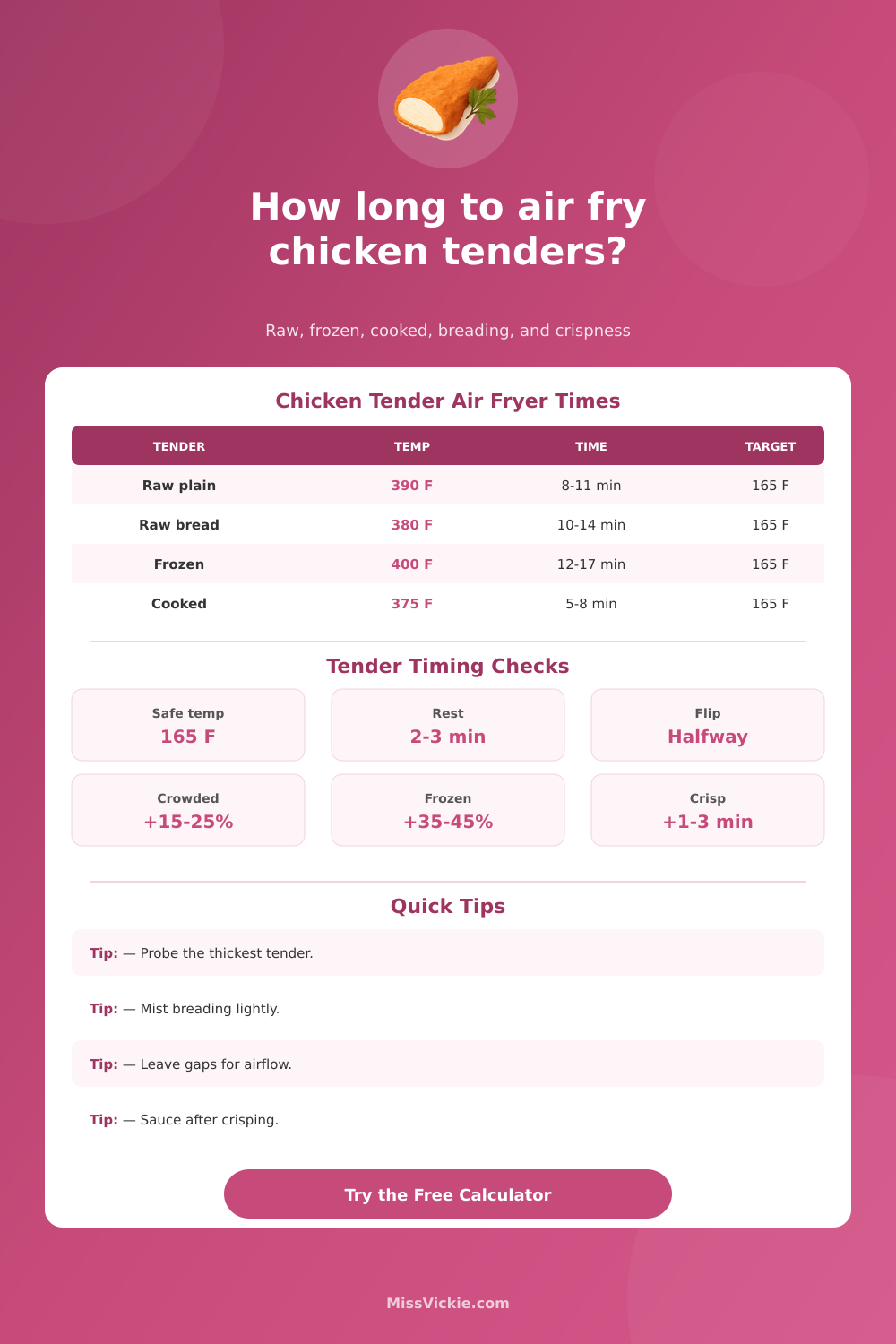
🔥 Air Fryer Chicken Tender Time Table
| Tender Setup | Typical Temp | Time Range | Flip Timing | Safety Check |
|---|---|---|---|---|
| Raw plain thin strips | 390 to 400 F | 7 to 10 minutes | Once around halfway | 165 F in the thickest strip |
| Raw standard breaded tenders | 375 to 390 F | 10 to 14 minutes | Halfway, then final check | 165 F under the breading |
| Raw jumbo tenderloins | 370 to 385 F | 13 to 18 minutes | Flip once, check twice | 165 F in the largest center |
| Frozen raw tenders | 360 to 380 F start, hotter finish | 15 to 22 minutes | Separate and flip after thawing | 165 F after rest |
| Frozen fully cooked tenders | 380 to 400 F | 10 to 16 minutes | Shake or flip halfway | 165 F reheated center |
| Cooked chilled tenders | 350 to 380 F | 5 to 9 minutes | Turn once for crisping | 165 F if reheating leftovers |
🍞 Breading And Crispness Table
| Coating | Timing Effect | Temperature Cue | Flip Advice | Texture Note |
|---|---|---|---|---|
| Plain or dry rub | Fastest center cook | 390 to 400 F | Flip once | Can dry if cooked far past 165 F. |
| Light flour or starch | Slightly longer | 385 to 400 F | Turn gently | Mist with oil to avoid pale dust. |
| Classic breadcrumbs | Moderate | 375 to 390 F | Flip halfway | Let crumbs set before saucing. |
| Panko or coarse crumbs | Adds crisp finish | 380 to 400 F | Flip twice if needed | Spray lightly for even browning. |
| Buttermilk or wet batter | Slower and softer | 360 to 380 F | Flip after surface sets | Heavy wet coating can stick. |
| Sauced or glazed finish | Add late only | Lower final heat | Sauce during last minutes | Sugar can scorch before chicken is safe. |
🛒 Basket Load And Flip Timing Table
| Basket Load | Time Adjustment | Best Flip Plan | Airflow Cue | What To Do |
|---|---|---|---|---|
| Single layer with clear gaps | Baseline | Flip once halfway | Edges dry quickly | Use the calculated time as written. |
| Edges nearly touching | Add about 6% | Flip once, rotate positions | Pale side contact spots | Move center pieces outward after turning. |
| Full basket, limited gaps | Add 15 to 25% | Shake or flip twice | Steam under breading | Check temperature before adding crisp time. |
| Overlapping at start | Add 30% or split | Separate as soon as possible | Wet patches remain | Split batches for better texture. |
| Air fryer oven tray | Add 8 to 14% | Turn and rotate tray | Top browns first | Preheat fully and rotate racks if needed. |
🌡 Target Temperature And Safety Table
| Temperature Check | Use For | Meaning | Rest Plan | Kitchen Cue |
|---|---|---|---|---|
| 160 to 162 F pull | Thin raw tenders | Can carry to 165 F | Rest 2 to 3 minutes | Only if thermometer rises during rest. |
| 165 F final | All raw chicken tenders | Safe minimum | Short rest | Probe multiple pieces in mixed sizes. |
| 170 F plus | Very thick or extra crisp | Firmer, drier texture | Rest uncovered | Use when crispness matters more than juiciness. |
| 165 F reheat | Cooked leftovers | Hot center for reheating | Rest 1 to 2 minutes | Do not overcook just to crisp the coating. |
| Frozen raw check | Frozen raw tenders | Slowest center may lag | Rest then recheck | Check after thaw phase and again at finish. |
USDA guidance uses 165 F as the safe minimum internal temperature for chicken. Appliance time varies, so the thermometer check is the final decision.
💡 Chicken Tender Air Fryer Tips
When it comes to chicken tenders, both safety and texture matter; you desire the meat to remain juicy enough to satisfy your appetite, yet the breading must be hard enough to resist cracking when bitten into. An air fryer meets that need by circulating heat quickly and evenly throughout the appliance. But there are some variables to consider beyond what you would experience with an oven, notabley how moisture can affects crispiness.
Because the main issue with air frying is moisture control, the cooking basket should never become filled with condensation caused by melting ice and/or damp batter. When this happens, the exterior of the tender will get soggy before the interior gets cooked through. That’s why knowing your initial state is far more important then blindly guessing an amount of time.
How to Get Perfect Chicken Tenders in an Air Fryer
But what if you’ve got your own rig? That’s where the calculator above comes in. Instead of figuring out the time and temperature yourself by swapping numbers in your head, let the calculator do the math for you. For example, raw tenders will conduct heat different when they come right from the fridge compared to ones you let sit outside to warm up for 15 minutes.
And then there are frozen ones which needs to be cooked in two phases: first to melt the ice and then to actualy get the food hot enough so the outside doesn’t burn. Throw those into an air fryer at high heat and the breading will get burnt but the inside will still be icy. The timer takes all this heat reality into account and adjusts the time range according to whether your chicken is frozen, defrosted, or already fully cooked.
The key is not width but thickness. Even a wide strip cooks fast if it’s very thin. A thick one will hold onto some warmth toward the center and needs more time even though the outer part might appear cooked. So now you need a thermometer. And visual clues aren’t always trustworthy: Things brown faster depending on whether your sauce or rub has any sugar in it.
Use the calculator to estimate when to take bird out and let it rest while you probe the interior. Target temps built into the calculator allow for carryover cooking as it rests.
What does changing airflow have to do with basket loads? A lot. Steam pockets form when things gets crowded. The fan can’t touch those contact spots where pieces overlap, those points will remain pale and soft. Extended times or split batches (per the page’s reference table) is needed for full baskets. Often, running two quick batches with good gaps between them is faster than running one longer session with overlapping pieces of meat.
Does your breading crisp up or steam up? That depends on airflow. The temperature ceiling depends on what is being breaded. Coarse crumbs and panko have a lower surface area so sugar doesn’t burn too fast. They can also withstand a little more heat than a finer breadcrumb or flour coating. A wetter and heavier buttermilk batter will require lower temps in order to dry out enough prior to browning. You want your fried food to be evenly colored, rather than burnt on one side and raw inside. To help with this, the calculator accounts for different coatings and flipping times as well.
Timing strategy and patience are key ingredients to saucing. Liquid (like sweet barbecue glaze or vinegar-based hot sauce) added early will cause absorption and a soggy coating. For best results: create the crisp shell first; apply the sauce in the last few minutes of cooking time by brushing or tossing. You get flavor but lose no texture. All that work spent getting it crispy? Could of been undone by saucing too soon.
Letting cooked meat rest allows the juices to return back into the fibers. If I pull chicken at 162 F, for instance, I can usually get 165 F or so in a couple of minutes under a loose tent while resting. Breast meat is still tender and not dried out.
Frying chicken tenders in an air fryer isn’t a recipe thing, it’s a moisture transfer thing. You are managing the conditions to heat the inside as slowly as possible while drying out the outside more quickly. Once you grasp that balance, the numbers stop feeling like guesses and start looking like guidelines for perfect texture every time. You see them not as guesswork but as guidelines to achieve consistantly awesome results every time.