MissVickie leftover fries planner
Fries Reheating Time Calculator
Estimate crisp reheating time for leftover fries by cut, amount, method, starting temperature, oil mist, crispness target, basket or pan load, and salt timing.
🍟 Fries Reheating Presets
Choose a real leftover fry situation, then adjust the cut, amount, method, oil mist, load, and salt timing. The calculator is for already cooked fries.
🧮 Fry Cut, Amount, Method, Crispness, and Salt Inputs
Fries reheat plan
Your reheating time will appear here.
Timing Breakdown
Setup Details
Step Cues
📊 Cut And Portion Reference
Best reheated in one loose air fryer basket layer.
Shake or flip once so center fries escape steam.
Use an oven rack, sheet pan, or two batches.
Salt after this short rest for the driest surface.
📋 Fries Reheating Tables
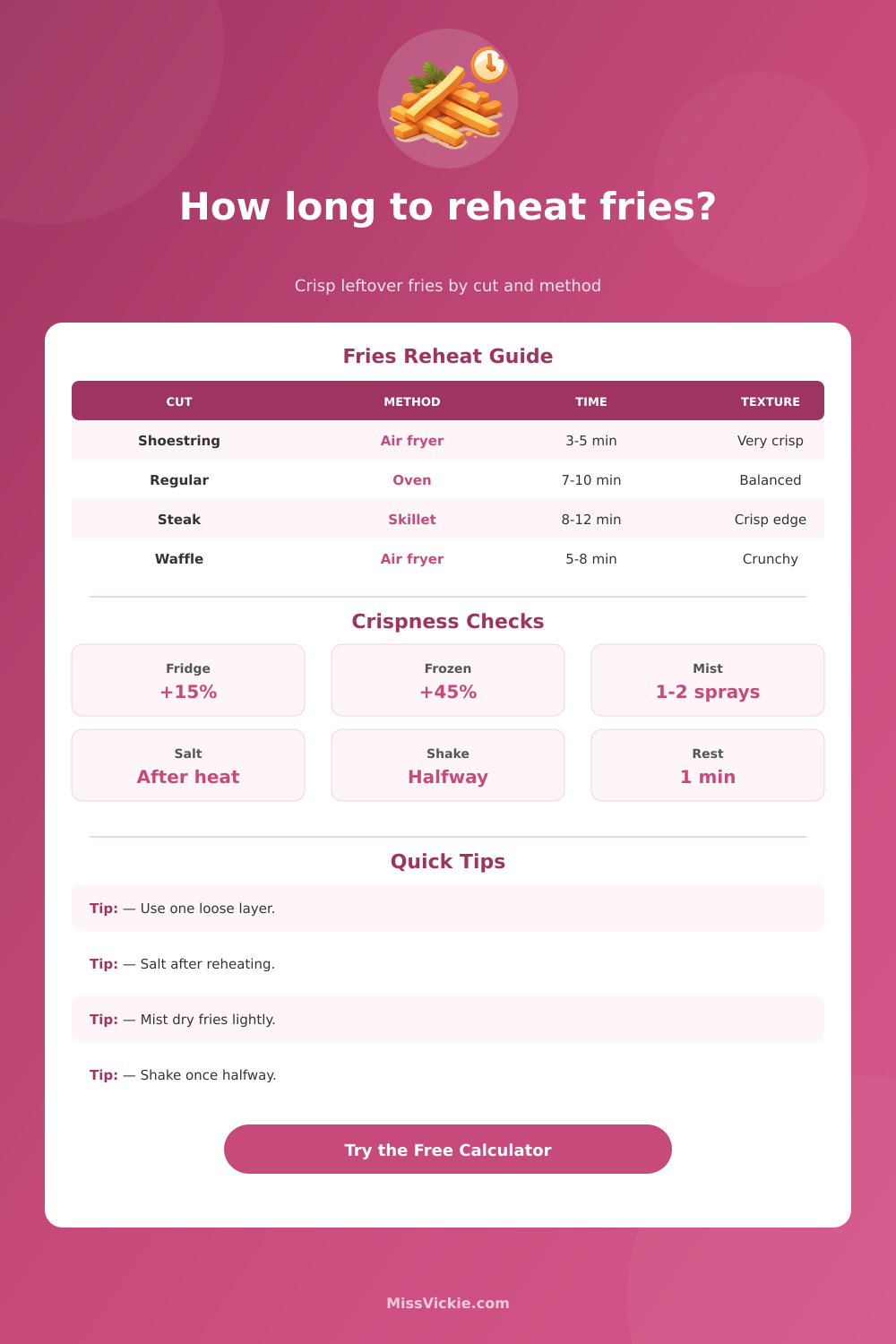
| Method | Best Heat | Typical Time | Best Use | Crisp Note |
|---|---|---|---|---|
| Air fryer | 350 to 380 F / 175 to 193 C | 3 to 8 minutes | Small to medium portions | Highest airflow, shake halfway |
| Oven or toaster oven | 375 to 425 F / 190 to 218 C | 7 to 14 minutes | Sheet pans and family batches | Use rack or preheated pan |
| Skillet or griddle | Medium to medium-high | 5 to 12 minutes | Steak fries, wedges, small piles | Toss often and keep uncovered |
| Convection oven | 350 to 400 F / 175 to 204 C | 6 to 12 minutes | Even batches with airflow | Lower heat slightly for thin cuts |
| Microwave | 60 to 80 percent power | 45 seconds to 3 minutes | Soft rescue only | Finish in skillet for crispness |
| Fry Cut | Heat Behavior | Good Method | Starting Check | Watch For |
|---|---|---|---|---|
| Shoestring | Low moisture, fast browning | Air fryer or convection | 2 to 3 minutes | Over-browning before center dries |
| Regular straight-cut | Balanced center and edge | Air fryer, oven, skillet | 4 to 6 minutes | Steam if crowded |
| Crinkle-cut | Ridges crisp well but trap oil | Air fryer or hot sheet pan | 5 to 7 minutes | Greasy ridges if over-misted |
| Waffle fries | Large surface area, airy center | Air fryer or rack | 4 to 6 minutes | Broken edges and hot spots |
| Steak fries or wedges | Thick center, slower drying | Oven or skillet | 7 to 9 minutes | Hot outside, cool center |
| Sweet potato fries | Soft starch, browns quickly | Air fryer at lower heat | 4 to 6 minutes | Sugars darken faster than potato |
| Start And Load | Time Effect | Crisp Effect | Best Adjustment | Calculator Logic |
|---|---|---|---|---|
| Room-temp fries | Shorter | Good if dry | Check early | Reduces time about 12 percent |
| Refrigerated fries | Baseline | Needs airflow | Shake once | Uses standard leftover factor |
| Frozen leftovers | Much longer | Risk of limp center | Use lower first phase | Adds time and lowers crisp score |
| Loose single layer | Fastest | Best | Do not overlap | No crowding penalty |
| Stacked pile | Slowest | Weakest | Split if possible | Adds steam and extra checks |
| Oil And Salt Choice | When To Use | Time Change | Crisp Change | Practical Cue |
|---|---|---|---|---|
| No oil | Already glossy fries | Neutral | Can be dry or patchy | Shake more often |
| Light oil mist | Most refrigerated fries | Slightly faster crisping | Best balance | One or two quick sprays |
| Heavy oil | Rarely needed | Can slow drying | Lowers crisp score | Blot first if greasy |
| Salt after heating | Best crisp finish | Neutral | Highest crisp score | Salt after the 1 minute rest |
| Salt before heating | Already salted leftovers | Slightly longer | Surface moisture penalty | Use more airflow |
These are planning estimates. Actual time changes with appliance strength, fry thickness, moisture, original fry quality, and how tightly the fries are packed.
⚖ Method Comparison Grid
Best for regular, shoestring, waffle, and crinkle fries because airflow dries every side quickly.
Best for a tray of fries when one loose layer and a preheated pan matter more than speed.
Best for wedges and steak fries because turning gives direct browning without drying the center too fast.
Best only when speed matters. Use a skillet finish if you want any real crispness afterward.
💡 Fries Reheating Tips
The fries are lurking in the rear of your fridge. They look like sad, soggy cardboard. When most of us attempt a remedy we reach for the microwave and nuke ’em for forty-five seconds. All that does is render the fries limp and warm.
But here’s the thing: Reheated potato is all about moisture control. No need to heat up the interior again. What you want to do is gently warm the middle and evaporate some moisture from the exterior so it all comes together as one, and that makes a difference when cooking leftovers.
How to Make Leftover Fries Crispy Again
After entering the appliance and number of fry types, the calculator does the math for you (above). You no longer have to guess how different variables affects each other. It accounts for factors like basket density and starting temperature and balances them against one another.
For example: All leftovers are created equal, they aren’t. Fries with a high surface-area-to-volume ratio, such as shoestrings, will cook quickly because they start losing moisture rapidly but may burn before the insides warm through. Wedges or thick steak cuts, however, is packed with moisture in their dense starch structure, creating an internal reservoir that must be given time to reach temperature while avoiding burning the outside.
Cut thickness affects the cook time, that’s accounted for. Then there’s the matter of fries from the fridge, which are cold and wet when removed or partially frozen fries, which need to be warmed slowly so they do not trap steam inside.
Crispiness is ruined by steam: As fries gets heated in the air fryer basket or on a baking sheet, they give off water. If there’s no place for this water to go it will pool around surrounding fries, thus starving them with steam from the inside out. That’s why pan-loading matters (a lot). Air needs room to move around freely; if fries are piled on top of one another humidity gets trapped. Physics doesn’t give a damn how hungry you are; the calculator will punish tightly-packed pans accordingly.
To speed things up, make multiple batches and run several smaller rounds instead of one big one. It’s worth the double-trip to the kitchen, trust me.
There’s a secondary ingredient here: oil. A slight coating; like a mist, helps grease the pan for good heat transfer, while simultaneously encouraging a nice brown. Too much oil will make for greasy fries. If there is not enough we are addressing that issue by letting you adjust how much oil you use at the end. Fries don’t want more oil. They want air. And they want to be left alone. Because adding oil to previously oily leftovers simply makes them heavy. We reward restraint in our crisp score, including your oil entry in the calculator.
There’s also another slightly fiddly detail: when you add salt. Most folks miss this one. If you salt prior to reheating, water will migrate to the surface via osmosis, leaving you with a wet environment which opposes crisping. Instead, wait until those fries are hot and dry. The salt can stick without getting in the way of the drying action. It is a small detail but it makes a big difference in texture.
Each method has its place. For example, an oven is great for bulk cooking. It heats evenly, but you need to preheat something like a rack or pan to make up for the lack of moving hot air. An air fryer is super fast because it blows hot air onto all exposed surfaces. Skillet, Good for thick-cut slices since you can turn food by hand to make sure each side directly touches the heat source. Microwave, Only really good for defrosting cold spots and finishing things elsewhere. Otherwise, you’ll end up soggy if you rely on it too much.
If you’re looking for a quick comparison of average cook times, check out the time reference table on the page.
They always have crisp edges and hot centers. How do we achieve this happy medium? Know your batchs moisture level and adjust to match: how dry do your fries look at first? How full is the pan? How cold are they? Let the machine handle the timing. You should of used your eyes to space them out. Crunch comes from patience.