MissVickie cooked chicken planner
Chicken Reheating Time Calculator
Estimate reheating time for cooked chicken by cut type, weight, method, starting temperature, sauce or moisture level, cover style, batch size, thickness, and the 165 F food-safety target.
🍗 Chicken Reheating Presets
Pick a leftover scenario, then fine-tune the exact cut, weight, moisture, cover, and batch size. The calculator is for already cooked chicken, not raw chicken.
🧮 Cut, Weight, Method, Moisture, and Batch Inputs
Chicken reheating plan
Adjust the inputs above to estimate time, moisture, cover, and thermometer checks.
Time Breakdown
Kitchen Plan
Step-by-step reheating cues
- Heat until the chicken reaches 165 F in the thickest or coolest spot.
📌 Quick Reheating Benchmarks
Use a food thermometer in at least two spots for mixed pieces.
Start from properly refrigerated leftovers whenever possible.
A short rest helps microwave and sauced dishes even out.
Single-layer chicken reheats more evenly than stacked portions.
📋 Chicken Cut Reheating Table
| Cooked Chicken | Best Methods | Typical Planning Time | Moisture Move | Temperature Check |
|---|---|---|---|---|
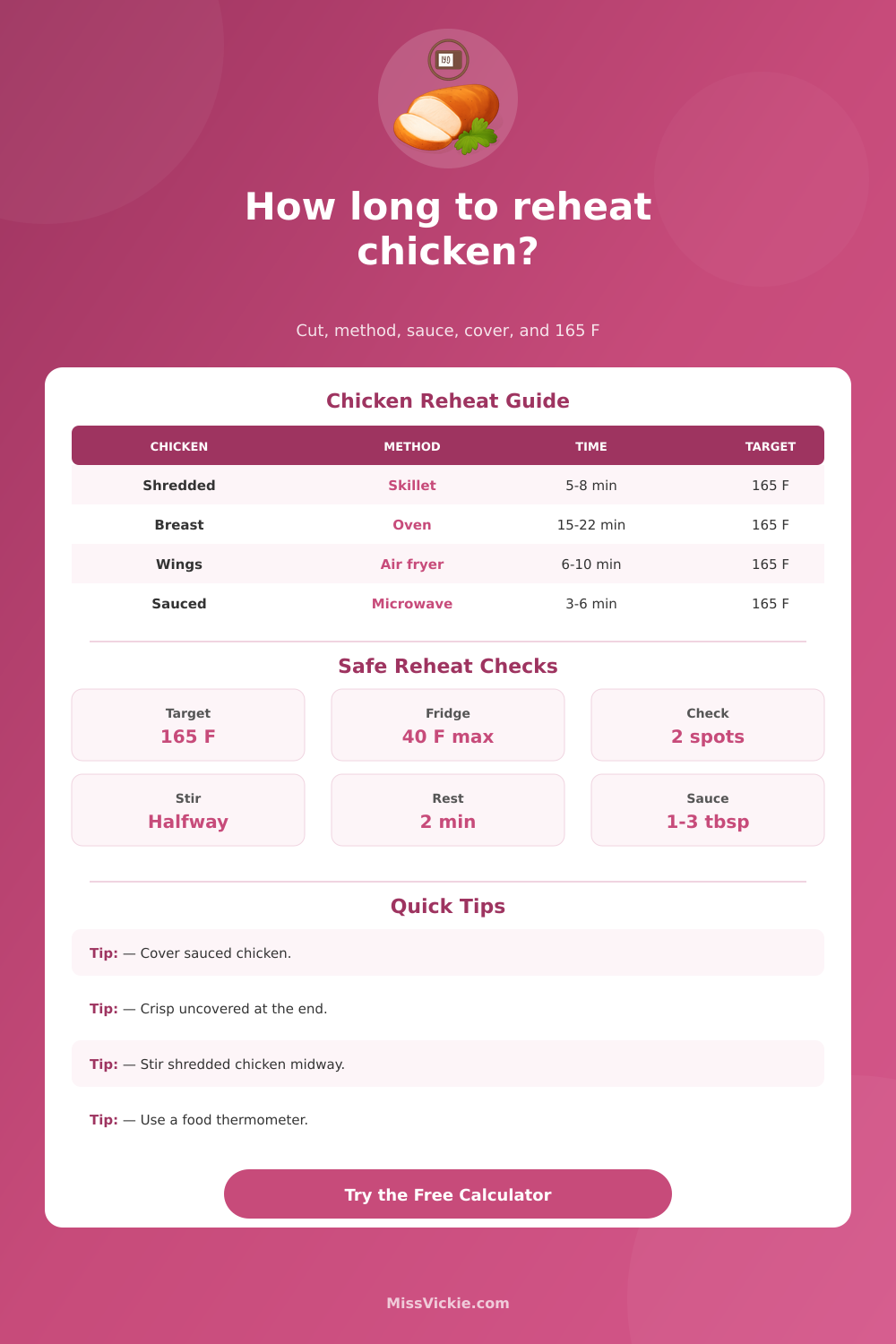
| Shredded or pulled chicken | Skillet, saucepan, microwave | 5 to 8 minutes per 1 lb | Add sauce or 1 to 3 tbsp broth | Stir, then check the center of the pile |
| Sliced breast or cutlets | Covered skillet, microwave, oven | 4 to 12 minutes depending on method | Cover with light broth or pan juices | Check the thickest slice stack |
| Whole cooked breast | Covered oven, gentle microwave | 12 to 24 minutes | Cover tightly to prevent drying | Probe the center of the breast |
| Thighs or drumsticks | Oven, air fryer finish, covered pan | 14 to 26 minutes | Cover first, uncover for skin | Probe close to the bone without touching bone |
| Wings | Air fryer, oven, toaster oven | 6 to 14 minutes | Keep dry for crisp skin, sauce after | Check the largest drumette |
| Fried or breaded chicken | Air fryer or oven | 8 to 22 minutes | Avoid steam until the final temp check | Probe meat under the coating |
| Method | Best For | Use This Setting | Cover Guidance | Halfway Action |
|---|---|---|---|---|
| Microwave | Fast lunches, sauced chicken, shredded meat | 70% power or medium-high | Microwave-safe cover, vented | Stir, rotate, spread back out |
| Oven or toaster oven | Breasts, thighs, rotisserie pieces, casseroles | 325 to 350 F | Foil or lid for moist chicken | Flip pieces or rotate the pan |
| Air fryer | Wings, fried chicken, skin-on pieces | 325 to 360 F | Usually uncovered | Shake basket or flip pieces |
| Skillet | Slices, shredded chicken, taco fillings | Medium-low with lid | Cover for steam, uncover to reduce | Stir and scrape sauce from edges |
| Covered saucepan | Curry, gravy, soup chicken, sauced leftovers | Low simmer | Lid on, stir often | Stir bottom and edges well |
| Steamer | Plain pieces, sliced breast, dim sum-style leftovers | Active steam | Covered steamer | Rearrange pieces if stacked |
| Moisture / Sauce | When To Use | Liquid Per Pound | Cover Choice | Texture Note |
|---|---|---|---|---|
| Dry leftover chicken | Plain breast, sliced roast chicken | 2 to 4 tbsp broth | Tight cover | Best for tenderness, not crisping |
| Light pan juices | Rotisserie pieces, meal prep portions | 1 to 2 tbsp broth | Vented cover | Keeps edges from drying |
| Sauced chicken | BBQ, taco, teriyaki, pasta chicken | Usually none | Cover or stir often | Sauce heats faster than dense meat |
| Gravy, curry, or casserole | Chicken in a wet dish | Thin only if needed | Tight lid or foil | Stir to remove cold pockets |
| Crispy coating | Fried chicken, breaded cutlets | None on coating | Uncovered | Use sauce after reheating |
| Safety Check | What It Means | Why It Matters | Calculator Assumption | Kitchen Action |
|---|---|---|---|---|
| Target 165 F / 74 C | Leftovers are reheated thoroughly | Temperature verifies safety better than time | All results aim for 165 F | Use a thermometer before serving |
| Check thickest spot | Dense pieces lag behind edges | Edges can steam while centers stay cool | Thickness increases the estimate | Probe whole breasts and bone-in pieces |
| Stir or rotate | Moves hot sauce and cool meat around | Microwaves and deep bowls heat unevenly | Crowding adds time and early checks | Stir shredded or sauced chicken halfway |
| Cover moist chicken | Steam carries heat into the surface | Helps prevent dry, rubbery leftovers | Covered moist reheats are faster | Vent microwave covers to avoid splatter |
| Do not rely on rest alone | Resting evens heat, but does not replace 165 F | Cold pockets can remain after standing | Rest time is guidance only | Check temperature after the rest too |
These tables are planning references. Actual time changes with appliance strength, portion shape, container depth, and how cold the leftovers are.
⚖ Method Comparison Grid
Best for small portions, sauced chicken, and lunches when you can stir halfway and check cold spots.
Best for sliced breast and shredded chicken because steam, broth, and low heat protect the texture.
Best for wings, fried chicken, and skin-on pieces, but check the meat under the crisp surface.
Best for family portions, rotisserie pieces, and casseroles when foil and a shallow pan keep heating even.
💡 Reheating Tips
Leftovers: You’ve got a container of perfectly cooked (six hours ago) chicken. Or pasta. Or a casserole. And it’s looking as if it should of be in the Smithsonian by now. It is an eternal problem: it should be hot, but not too hot; cooked, but not dry and rubbery.
If you’re reheating previously-cooked protein, there’s no exact formula, but that doesn’t mean we can’t do our best to control transfer of heat while keeping it tender. To help with this, the calculator on top will do math for you. It takes into account things most folks forget until it’s too late (dry meat!), such as weight, cut, type, starting temp, moisture level, how covered or uncovered it is, how big your batch are, how thick it is, and what temp it must reach to be “safe” (which can never go below 165 F).
How to Reheat Leftovers Correctly
Don’t treat every type of chicken as one and the same. Shredded taco meat is not the same than a bone-in whole thigh, which is not the same as a skin-on sliced breast. Because they hold more heat, dense portions takes longer to heat through and lag behind edge zones well past the point where their surfaces registers as being warm. That’s why it’s more important to consider thickness (vs. Total weight) when reheating whole cuts. You don’t want to blast a thick rotisserie breast with high heat because its outer layer will be overcooked by the time its center come up to temperature. Gentle, covered heating; coupled with steam to help even out heat spread, is the answer.
Microwaves cook quickly, but they’re cruel: They heat water molecules from the inside outward, generating hot spots and cool pockets. Without stirring or rotating halfway through, you’ll end up with a piece of chicken that is steaming on top and still fridge-cold in the middle. Rotate midway? Yeah, right. You get a hot-on-top/fridge-cold-in-the-middle hunk of chicken.
Covering your food traps steam to help heat reach any cool spots. By venting that cover, you keep pressure from building up and let extra moisture escape to avoid soggy skin. It is a small detail, but it make a big difference for the texture. When it’s time to warm something up gently but get that crunch back into the exterior, an oven and air fryer gives us the power to bring some control to the game. As long as you don’t pack the basket (you need airflow to pull moisture out of the crust) the air fryer is great at re-crisping wings or fried chicken. Layering things in the basket is like putting them in a steamer; you’re not getting any fry anymore, just steam.
These differences are spelled out neatly in this reference table found on the page. It also illustrates that final mouthfeel is decided by your method of cooking. In other words, you sacrifice speed for texture, and most times it’s worth it.
There’s another subtlety to timing: starting temperature. Reheating cold chicken fresh from refrigerator will require more time than reheating meat that has been sitting around at room temperature for 20 minutes, taking some of the chill off. It does not need to be 20 minutes on the counter but just long enough to let the chicken get a bit warmer inside so there is less of a temperature difference. Cooked chicken that was frozen is a whole other animal. It’s best to defrost it before reheating; otherwise, you’ll get uneven cooking with the outside overdone and the interior still icy.
The last thing is moisture management. To make the food moist again, add a bit of water or broth under lid (if you’re drying something). If you have sauced chicken, which has an existing liquid base, it will typicaly require less added moisture, but usually can use a stir around halfway-through reheating to distribute the heat and keep it from burning on the edges or separating.
After the reheat, let the chicken sit for two more minutes so the heat can spread evenly in the chicken. That way your chicken doesn’t dry out from cooking too long; just make sure the center stay hot. Long story short, get yourself a food thermometer. It’s your best friend. The time estimates are guidelines, but the temperature is telling it like it is. Thickest cut first, don’t go for the edges.
Reheating is as much a science as it is a game of chance once you know how heat travels in different cooking methods and cuts. Think about how your oven or microwave works. Your leftovers will thank you for taking that extra minute.