Chicken Marinating Time Calculator
Estimate chicken marinating time from cut type, thickness, acid strength, salt level, dairy or enzyme tenderizers, refrigerator temperature, flavor intensity, and the maximum safe window.
🍴 Chicken Marinade Presets
Pick a real kitchen scenario, then fine-tune the cut, thickness, marinade style, salt, fridge temperature, and cooking deadline.
⚖ Cut, Marinade, Salt, and Fridge Inputs
Marinade plan
Adjust inputs to calculate the recommended window.
Timing Breakdown
Safety and Quality Checks
Marinade Handling Plan
📌 Quick Chicken Marinade Checks
Upper refrigerated limit for raw chicken in marinade.
Use a colder refrigerator for long raw prep windows.
Fresh pineapple, papaya, and kiwi need short timing.
Use a thermometer in the thickest part of the chicken.
📊 Chicken Marinating Reference Tables
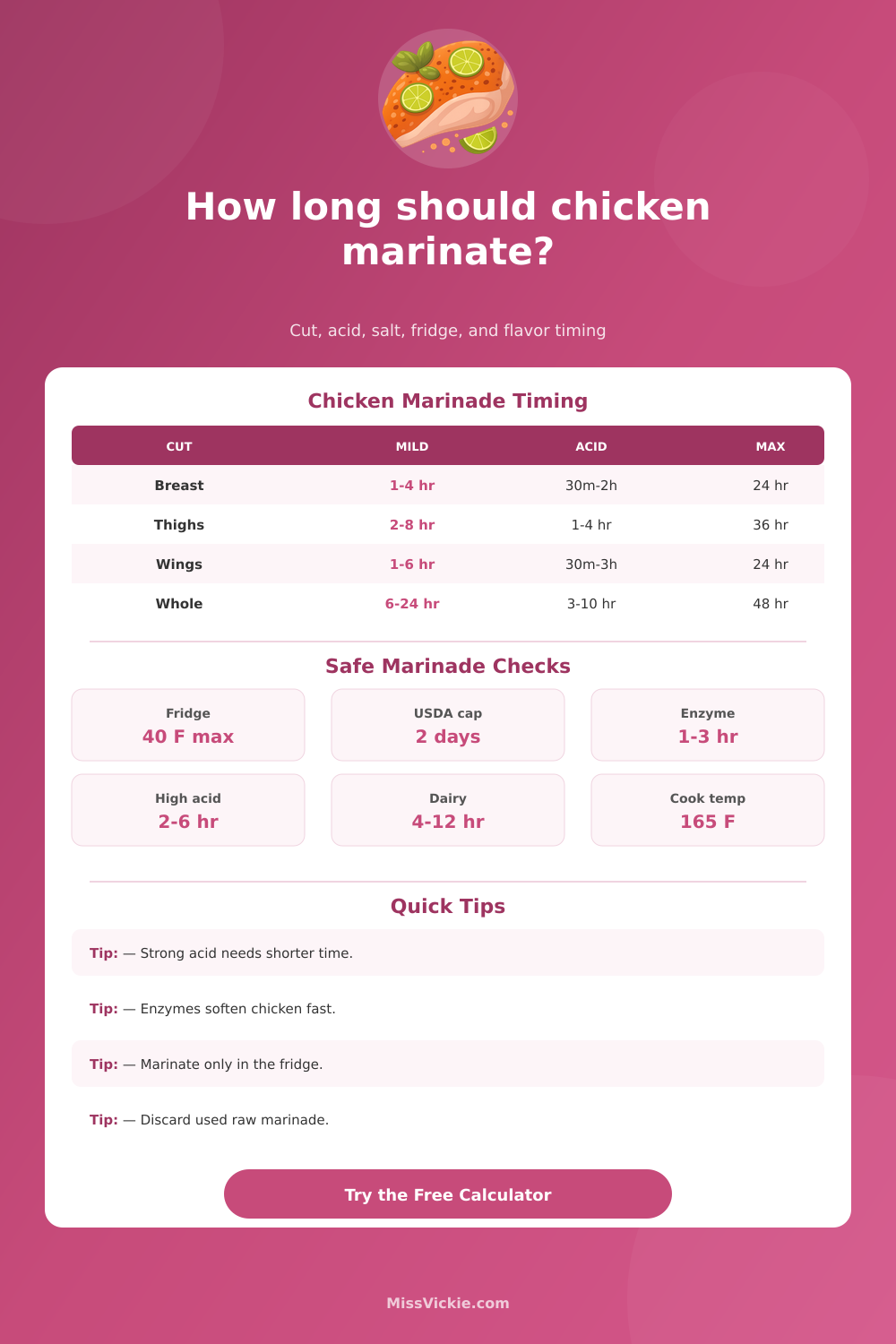
| Chicken cut | Mild marinade | Acid-balanced marinade | Strong acid or brine | Best use |
|---|---|---|---|---|
| Thin cutlets or tenders | 30 minutes to 2 hours | 20 minutes to 90 minutes | 20 minutes to 1 hour | Fast skillet, air fryer, sandwiches |
| Boneless breasts | 1 to 4 hours | 45 minutes to 2.5 hours | 30 minutes to 2 hours | Grilling, baking, meal prep |
| Boneless thighs | 2 to 8 hours | 1 to 5 hours | 45 minutes to 3 hours | Grill, skewers, curry, sheet pan |
| Bone-in thighs or drumsticks | 3 to 10 hours | 2 to 6 hours | 1 to 4 hours | Roasting, barbecue, braising |
| Wings | 1 to 6 hours | 45 minutes to 4 hours | 30 minutes to 3 hours | Grill, oven, air fryer |
| Whole or spatchcock chicken | 6 to 24 hours | 3 to 12 hours | 2 to 8 hours | Roasting, smoking, barbecue |
| Marinade style | Timing effect | Quality cap | Flavor behavior | Watch for |
|---|---|---|---|---|
| Oil, herbs, garlic, spices | Slowest flavor transfer | Longer quality window | Surface seasoning and aroma | Needs salt or time for deeper taste |
| Low acid wine or vinegar | Baseline timing | Moderate window | Balanced savory brightness | Turn pieces for even contact |
| Lemon or vinegar forward | Shortens timing | Short quality window | Sharp surface flavor | Chalky or stringy exterior |
| Buttermilk or yogurt | Gentle tenderizing | Medium window | Good coating and browning | Drain well before high heat |
| Fresh pineapple, papaya, kiwi | Very fast tenderizing | Shortest window | Softens surface quickly | Mushy texture if left too long |
| Salt level | Typical source | Calculator adjustment | Maximum quality window | Practical note |
|---|---|---|---|---|
| Light salt | Herbs, oil, aromatics | Extends flavor time slightly | Closer to cut limit | Add final salt before cooking if needed |
| Balanced salt | Salt, seasoning blend, mild soy | Normal timing | Standard cut limit | Best default for most recipes |
| Soy or bouillon base | Soy sauce, fish sauce, stock powder | Shortens upper range | Moderately reduced | Taste the marinade before extending time |
| Briny marinade | Pickle juice, olive brine, strong salted bath | Tightens timing strongly | Same-day preferred | Edges may taste cured or ham-like |
| Dry-brine first | Salt rub before wet flavor | Shortest wet soak | Wet marinade kept brief | Use wet marinade mostly for aroma |
| Fridge reading | Food safety status | Calculator cap | What to do |
|---|---|---|---|
| 34 to 36°F / 1 to 2°C | Very cold refrigerator | Quality cap still applies | Good for overnight chicken prep |
| 37 to 40°F / 3 to 4°C | Normal safe refrigerator | Up to 48 hours maximum | Use the recipe quality window |
| 41 to 42°F / 5 to 6°C | Caution zone for planning | Short same-day cap | Lower the fridge temperature |
| Above 42°F / 6°C | Too warm for long marinating | Chill first | Do not use for overnight raw chicken |
🔍 Marinade Timing Comparison Grid
Best for cutlets, tenders, skewers, wings, high-acid marinades, and weeknight cooking.
Best for breasts, thighs, drumsticks, yogurt marinades, and most grilled chicken dinners.
Best for mild marinades, bone-in chicken, whole birds, and low-acid meal prep.
USDA-style safety ceiling for refrigerated marinade; quality limits may be much shorter.
💡 Chicken Marinating Tips
This calculator is a practical timing planner for raw chicken marinade. Follow local food safety guidance, keep raw poultry refrigerated, and verify doneness with a food thermometer.
When you know that you need to get something in oven for a long time but it’s about to be dinnertime, you run into a familiar dilemma: how long does it take? The answer lies not in magic but in physics. How fast do flavor molecule diffuse into the meat vs. How quickly does bad stuff grow in there? That’s your safety margin.
The thinking is that a long marinade will always improve flavor for many home cooks. That’s not true of chicken; the muscle fiber differ from that of beef. A thicker chicken breast won’t absorb as well as thinner cutlet. A tender chicken can’t take six hours in an acid bath without becoming mushy. It doesn’t get tastier, it gets chalky from breaking down too much of the protein.
How to Marinate Chicken Safely and Well
It’s a calculator that understands the trade-offs: more time vs. Less; thinner vs. Thicker; high acidity vs. Low. It knows about the fine points, was the bag loosely or tightly closed? And it knows this: when it comes to food safety, there is no options. Leave a package of raw chicken over forty degrees Fahrenheit for long enough and bacteria will multiply like crazy. It does not matter what marinade smells like.
Kiwi, papaya, and pineapple contain enzymes that rapidly tenderize. Far faster than vinegar. Tough meat will soften within short period of soak. Too long, and it falls apart. When those fruits are included, the timer has less room to work with. That’s why the calculator cuts the window so tight. Why? Because there’s not much wiggle-room. Get how the timer gets shorter and you’ll know what it was meant for.
Acid is different than salt. Salt will help keep water inside by osmosis, but acid will break down the meat. With a lot of soy sauce in the marinade, the meat are well seasoned very quickly. But you don’t have much time before it begin to taste more like cured ham. I don’t think most people want their grilled chicken to taste like deli meat. The best marinades is balanced so that they develop flavor while still allowing the natural taste of bird to come through.
A more gentle way is using dairy products. Yogurt and buttermilk contain tenderizing enzymes and acids. Because these are mild, they don’t break down proteins too much; they’re forgiving, making it possible to soak longer. That means they work well when you want to prep ahead, say, overnight, when you have a busy day. Milk contains calcium that activates enzymes that slowly break down the collagen. No wonder buttermilk is used on fried chicken. It can be cooked at high heat without drying out meat, while still allowing time for flavor to develop.
But thickness really matter (and is something a lot of folks forget). That one-pound package of boneless breasts might look small, but when they’re an inch thick, no matter how long you marinate them, they still only get a touch of flavor in the middle. Pound them out, make them thinner and voila: more surface area, shorter distance for those flavors to travel. That’s why the calculator shows what is happening not merely on the surface but inside meat.
The final limit is food safety. Never marinate in the refrigerator for longer than 2 days, per safety guidelines. That’s the absolute max time before pathogens could of grow and cause spoilage. Any marinade that comes into contact with raw chicken must be thrown out or boiled first. Applying it as-is as a sauce is a health risk not worth the taste.
“Don’t be scared to work with what you got but make it as delicious as possible while maintaining safety and texture. Respect the boundaries of your enzymes, acid, and salt. Plan ahead and make delicious, convenient meals.”
Proper timing matters. Start with the right time for your cut. Refrigerate the meat properly. Go through the motions. You’ll see that precision matters. Good chicken becomes great chicken when it’s done right.