Dry Brine Planner
Dry Brine Turkey Time Calculator
Plan a dry-brined turkey by weight, cut, salt percentage, fridge temperature, spatchcocking, skin-drying time, seasoning target, and the maximum window before roasting.
🍽Quick Presets
Pick a real holiday or weeknight scenario, then fine-tune the dry-brine details below.
⚖Dry Brine Inputs
Your Dry Brine Plan
Salt-on time, uncovered finish, and seasoning strength will appear here.
Breakdown
- Salt evenly over skin and exposed meat.
- Rest cold so salt can draw in and season.
- Finish uncovered for drier, roast-ready skin.
🧂Current Plan Snapshot
🔍Comparison Grid
Best for balanced seasoning and dependable holiday prep without a liquid bath.
Flatter shape exposes more surface, so the calculator trims the salt-on time.
Smaller cuts season faster and need a gentler maximum window than whole birds.
Uncovered rack time is separated from wet-brine logic to focus on skin drying.
⏲Dry Brine Timing Table
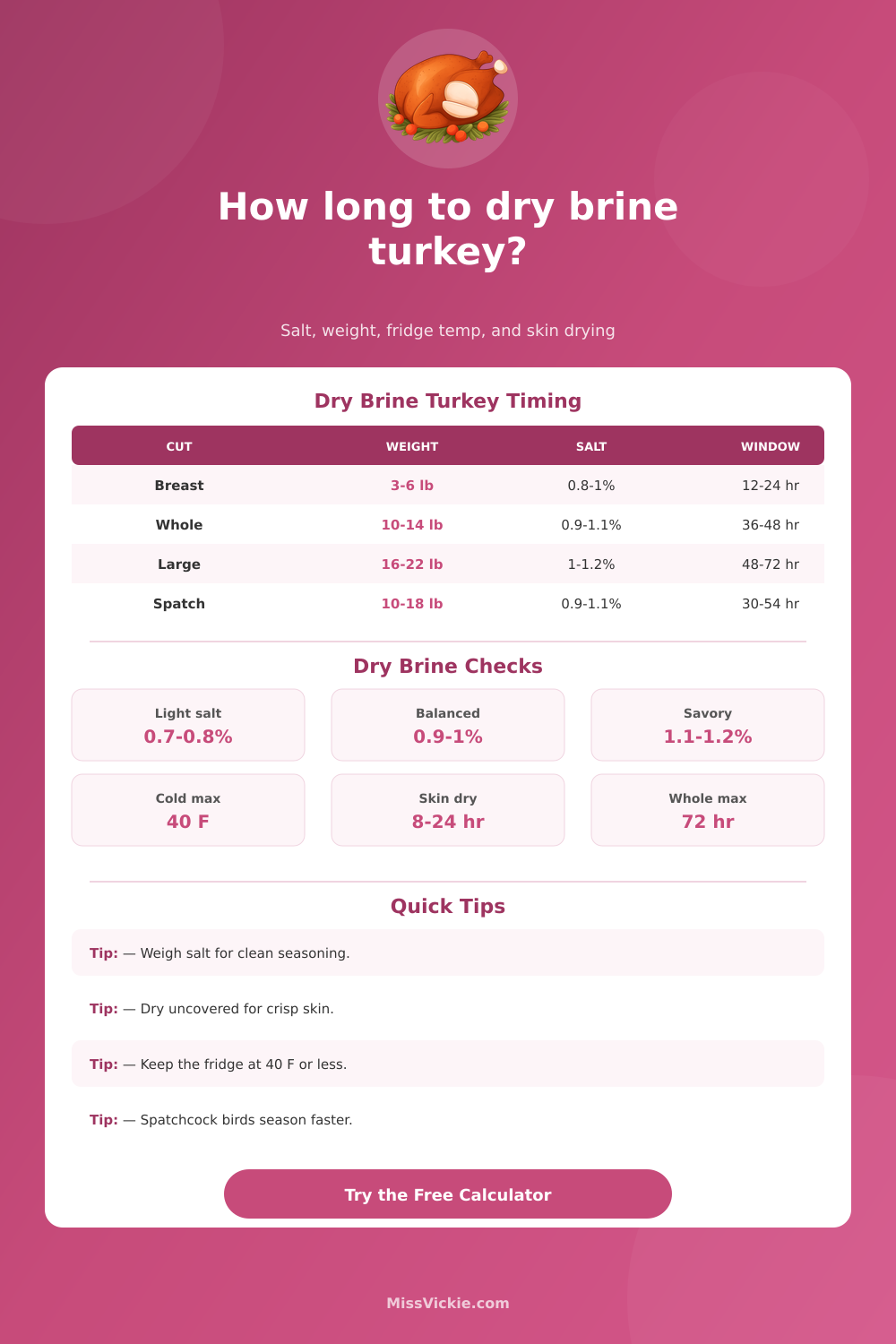
| Turkey style | Typical weight | Minimum useful time | Best dry-brine window | Practical maximum |
|---|---|---|---|---|
| Boneless turkey breast | 2 to 4 lb | 8 hours | 12 to 20 hours | 30 hours |
| Bone-in turkey breast | 4 to 8 lb | 12 hours | 18 to 30 hours | 48 hours |
| Whole turkey | 10 to 14 lb | 24 hours | 36 to 48 hours | 72 hours |
| Large whole turkey | 16 to 22 lb | 36 hours | 48 to 72 hours | 72 hours |
| Spatchcocked turkey | 10 to 18 lb | 18 hours | 30 to 54 hours | 60 hours |
📏Salt Percent Reference
| Salt target | Percent of turkey weight | Flavor result | Best use | Timing note |
|---|---|---|---|---|
| Very light | 0.6% to 0.7% | Mildly seasoned | Salt-sensitive table | Use shorter windows |
| Light | 0.75% to 0.85% | Gentle seasoning | Gravy or salty sides | Good for make-ahead |
| Balanced | 0.9% to 1.0% | Classic holiday flavor | Most whole turkeys | Most reliable range |
| Savory | 1.05% to 1.2% | Deeper seasoning | Larger whole birds | Avoid long overrun |
| Upper edge | 1.25% to 1.5% | Assertive salt | Short windows only | Not for long holds |
❄Fridge Temperature Table
| Fridge reading | Calculator adjustment | Drying effect | Safety status | Kitchen action |
|---|---|---|---|---|
| 32 to 34°F | Adds a little time | Very cold, slower salt movement | Cold zone | Allow extra hours |
| 35 to 38°F | Standard timing | Good drying without freezing | Ideal zone | Use normal plan |
| 39 to 40°F | Slightly shorter cap | Still workable | Upper safe edge | Verify with thermometer |
| Over 40°F | Flags unsafe hold | Do not extend timing | Too warm | Chill before brining |
🧪Dry Brine vs Other Prep
| Method | Liquid used | Main calculation | Skin result | Best timing control |
|---|---|---|---|---|
| Dry brine | No added water | Salt percent by meat weight | Best drying potential | Salt-on hours plus uncovered finish |
| Wet brine | Salt water bath | Salt concentration in water | Needs extra drying later | Submerged hours and container fit |
| Seasoning rub | No liquid | Spoon measure over skin | Depends on air drying | Short rest before roasting |
| Injected turkey | Seasoned liquid inside | Injection volume per pound | Skin must dry separately | Short rest after injection |
💡Dry Brine Tips
Dry-brine timing is a planning estimate. Fridge airflow, turkey shape, injected supermarket birds, and salt grain size can change the final result.
There’s a certain sort of holiday panic that sets in when you discover you have an underseasoned, raw turkey. You want juicy meat and crispy skin, but you are just guessing how long to let it sit in salt. That’s not intuition; it’s bad math.
Thankfully there is dry brining, the process where salt draws moisture from the surface, dissolves itself, then reabsorbs deeply into muscle fibers. No more guessing. Just time. The calculator above will run the exact amount of time based off your turkey size. Plan ahead. Don’t worry.
The Math Behind Dry Brining
The main variable here is weight. But it is not how you expect. When you have a 12 lb turkey versus a 10 lb turkey, it’s not as if it’s just slightly larger; there’s far more volume for the salt to pass through. If you treats both birds identically, your small bird will end up inedible while the large one tastes like chicken soup watered down with broth.
Luckily, the tool automatically corrects for this: since salt migration obeys laws of physics, rather than hope, it takes into account the fact that you might be working with a bone-in breast vs. A whole bird vs. A spatchcocked flat. Because spatchcocking exposes much greater surface area to the salt and air, seasoning goes faster, which means you can achieve awesome results in half the time. This is what most cooks miss about the benefit of flattening the turkey; they don’t realize why their skin turned out rubbery until after it’s too late.
Because different salts has wildly varying crystal densities, the kind of salt is less important than the percentage. For example, Morton kosher salt is heavy and dense; Diamond Crystal kosher salt is light and fluffy. You’re rolling dice when you measure in volume. The calculator wants a percentage of the entire weight of the turkey, which is converted into grams. Guessing? Gone.
As a starting place, one percent is safe and typical for most families. It’s enough to notice, but doesn’t make the gravy salty later. Want it milder? Back off to point eight percent. Love bold flavor? No problem, push it up to point twelve percent. Nothing changes about the math, but that one decimal point makes all the difference in what happens at the end.
Most plans don’t work out because there isn’t enough time for salt to permeate the thickest part of the breast. That’s usually about a day (twenty four hours) for a whole bird. Less than that and what you get is skin that tastes like salt and bland meat underneath. There’s also a cap though. Leave it in for too long, particularly if your fridge temperature is warm, and it will be mushy.
The calculator accounts for this too. It checks your planned roasting duration against these parameters to warn you if you are stretching things beyond safe limits. And it takes into account the fact that you’ll want to let the bird sit uncovered for a while after roasting so that the outside can air-dry. You can’t skip this step; you want crispy skin, which requires giving the fridge some extra time to suck the moisture off the bird’s exterior.
This is where the danger of fridge temp is quiet but deadly. Running warm, over forty degrees Fahrenheit, is playing Russian roulette with bacteria. So when that tool tells you something isn’t safe, it’s not because it cares about perfect seasoning; it cares about safety. Because the colder fridge slows down the salt absorption a little bit, the calculator will tack on a few hours if your fridge’s thermometer says its thirty-two degrees. This is just enough to make sure the flavor actualy makes its way into the meat by the time you come to carve it.
But in the end, dry brining is all about control. Instead of slopping around with chaotic buckets of wet brine, you’re weighing out salt and letting it work its magic on times that you control. It comes down to knowing what your window is and what your bird weighs, then waiting. The math is done for you by the calculator up top. You get to worry about whether there should of been another pat of butter in those mashed potatoes, which is a far better Thanksgiving-morning worry than having more math to do.