Turkey brine planner
Turkey Brining Time Calculator
Estimate wet brine, dry brine, and equilibrium brine timing by turkey weight, cut, salt strength, sugar, aromatics, fridge temperature, container fit, and your maximum brining window.
Load a realistic turkey setup, then fine tune weight, salt strength, refrigerator temperature, and container fit.
Your turkey brine plan
Whole turkey wet brine estimate.
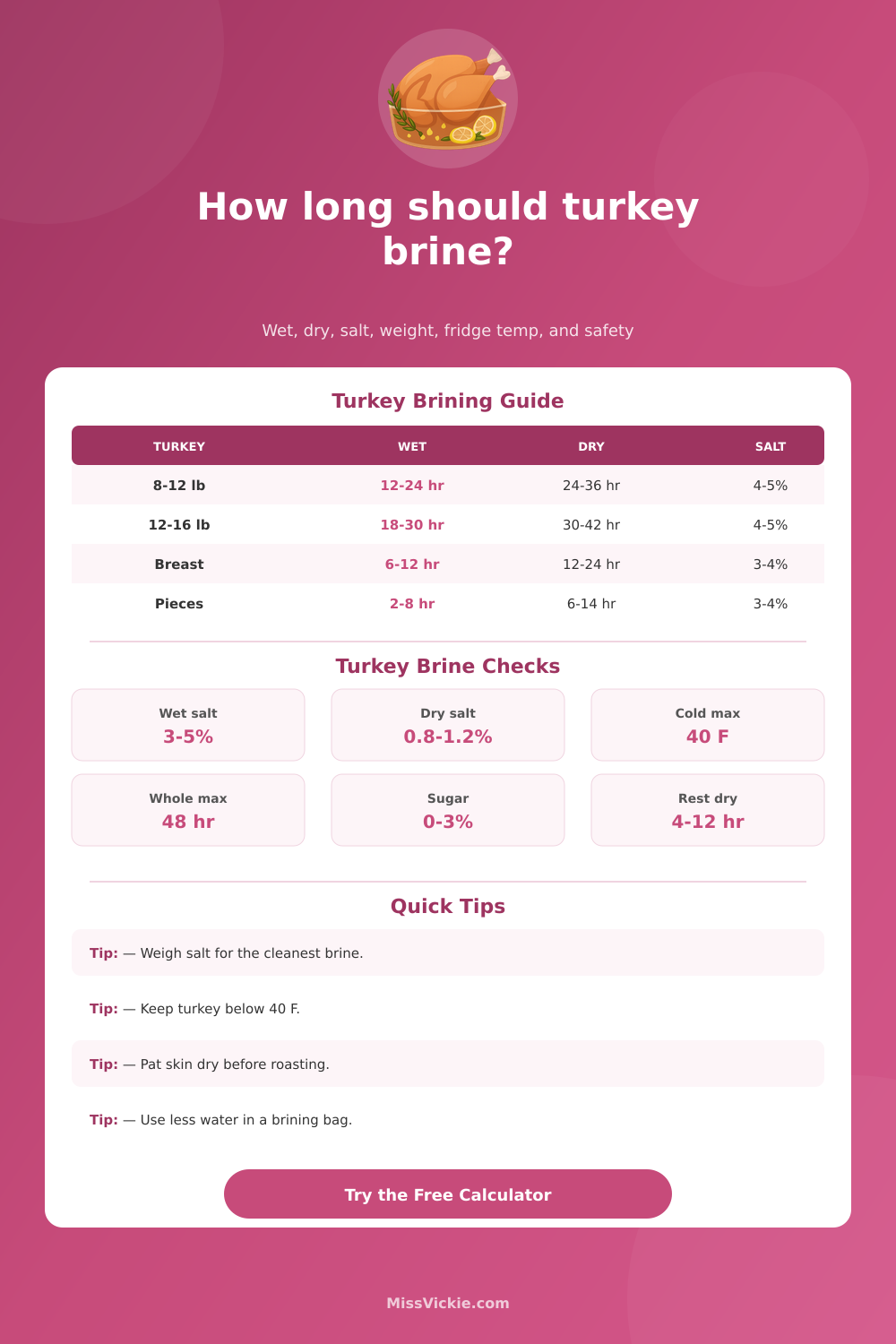
| Turkey style | Wet brine window | Dry brine window | Best salt target | Watch point |
|---|---|---|---|---|
| Whole turkey, 8 to 12 lb | 12 to 24 hours | 24 to 36 hours | 4% to 5% wet or 0.9% dry | Breast can season before thick thigh meat. |
| Whole turkey, 12 to 18 lb | 18 to 36 hours | 30 to 48 hours | 4% to 5% wet or 1.0% dry | Large birds need reliable cold space. |
| Bone-in turkey breast | 6 to 14 hours | 12 to 24 hours | 3% to 4% wet or 0.8% dry | White meat over-seasons faster than legs. |
| Boneless breast | 4 to 10 hours | 8 to 18 hours | 3% wet or 0.7% to 0.9% dry | Shorter path from surface to center. |
| Legs, thighs, mixed parts | 3 to 10 hours | 6 to 16 hours | 3.5% to 4.5% wet | Turn pieces for even contact. |
| Brine strength | Salt per quart | Salt per liter | Sugar range | Turkey use |
|---|---|---|---|---|
| 3% gentle wet brine | 28 g | 30 g | 0 to 20 g/L | Breasts, pieces, or longer soak plans. |
| 4% balanced wet brine | 38 g | 40 g | 10 to 30 g/L | Most whole turkey brine schedules. |
| 5% assertive wet brine | 47 g | 50 g | 20 to 40 g/L | Shorter whole bird windows or mild turkey. |
| 0.8% dry brine | By meat weight | 8 g/kg turkey | Optional | Breasts or lower-sodium dry brine. |
| 1.0% dry brine | By meat weight | 10 g/kg turkey | Optional | Classic dry-brined whole turkey. |
| Fridge reading | Calculator treatment | Brining action | Safety note |
|---|---|---|---|
| 32 to 34°F / 0 to 1°C | Slows salt movement | Add a little time if schedule allows | Turkey may partially stiffen near freezing. |
| 35 to 39°F / 2 to 4°C | Ideal cold brine range | Use calculated window | Keep container covered and below ready food. |
| 40°F / 4°C | Upper safe limit | Use shorter side of the window | Verify with a fridge thermometer. |
| Over 40°F / 4°C | Unsafe warning | Chill before brining | Do not hold raw poultry warm. |
| Container | Liquid need | Contact risk | Calculator adjustment |
|---|---|---|---|
| Loose stockpot | Highest | Good coverage if weighted | Uses about 0.58 qt per lb. |
| Snug brining bag | Lower | Good if sealed and turned | Uses about 0.32 qt per lb. |
| Tall bucket | Moderate | Breast or tail may float | Adds a small coverage buffer. |
| Half pan | Low | Needs turning | Adds time because contact is one-sided. |
| Dry rack | No liquid | Surface salt must be even | Uses dry-brine timing and no water. |
Around day three-ish before you’re meant to slide a raw bird into the oven, there’s a particular brand of holiday anxiety that sets in. Your kitchen counter becomes littered with plastic bags; your refrigerator suddenly seems far too small. Perhaps most of all: What if your turkey taste like rubber? Like salty solution?
Strip away tradition, and getting it right comes down to simple math. Treat it like a science experiment, however, because that’s what it is. Brining is a vaguely understood idea for home cooks, something that just involves salt and water. It’s precision that makes the difference between dinner disaster and a juicy feast.
How to Brine Your Turkey Perfectly
Water cooks out of meat, and salt rearranges its protein to help keep some of that moisture locked in. Now we just has to figure out how long to let these proteins hang out with the solution before they dissolve into mush. In general, a typical full-sized turkey need roughly eighteen to thirty hours for the salt to reach deep into the dense breast meat. Cuts, like cutlets, require far less time; giant roasters can withstand much longer soakings (if you have the refrigerator room).
With the above calculator, you’ll be able to take the guesswork out of the equation: enter your bird’s weight, along with whether you’re doing a dry- or wet-brine method, and let machine do the math for you. Traditionally, wet brines require the whole bird to soak in a salt water mixture, good for moistening the meat itself, but requiring significant amounts of liquid and a container large enough to keep the bird submerged and cold. The risk here is uneven seasoning if there’s too little brine for the turkey; it’ll float! You want to avoid weird textures at the table.
Dry brining is applying salt straight to the skin, allowing it to pull some moisture from meat, then having those seasoned juices reabsorb into flesh. Popular today among moddern cooks, this method produce crispier skin while avoiding all that salty-water business in a stockpot. Even better: it requires less fridge real estate, a huge plus as your refrigerator fills with other side-dishes.
So what about the salt? That matters more then how much, or at least how dense it is. Because each brand of kosher salt has such widely varying flake sizes, a cup may hold double the sodium compared to another brand’s. (The pro move: weigh your salt instead of using volume measures.) Why is that important? Well, if your salt crystals are finer than expected, this tool takes into account various types of salts, ensuring you don’t accidentally oversalt your main course. It also factors in sugar (which doesn’t impact the preservation but contributes balance and browning to the overall flavor). Just a hint of sweetness will help caramelize skin, while too much might cause the turkey to burn before it fully cooks through.
The second rule is to control the temperature. Temperatures must be maintained below 40°F to keep bacterial growth at bay while the salt does its work. Shorten the brining period if your fridge is running hot, or freeze some water and toss it into the brine. This all sounds so tedious, but why wouldn’t you want a cheap insurance policy against food-borne illness? A thermometer in the fridge makes sense. And here’s the reference table from the page, explaining just how much time you have before safety margins begin dropping with increasing temperature. Take this step lightly and you’re risking transforming a great dinner into a health risk.
Rinse well: After the brining time passes, it’s important to be sure there isn’t any excess salt left on surface; otherwise it’ll be unpleasantly salty when you eat it. A brief cold-water rinse removes any residue. Even more crucial: Wet skin doesn’t crisp. To achieve good browned skin during roasting, remove the turkey from the brine and allow it to dry uncovered in the refrigerator for a few hours at least, preferably overnight. Because of timing constraints, this last-minute step is often skipped… But the texture reward makes it worthwhile. To plan this final step properly, you should of used the drying plan option in the calculator.
The brine converts turkey from a lean and possibly dry meat into something that’s both juicy and flavorful, provided you’re mindful of these variables. Penetration is based off weight; saltiness depends on concentration; and safety depends on temperature. Don’t worry about precise minute-by-minute figures, or any complicated math: Plug in the numbers, let the calculator work out the proportions for you, then concentrate on everything else involved in this holiday meal.
The payoff? The payoff is a bird whose flavor shows more care than chemistry, and proof that a little prep goes a long way toward a perfect dinner.