Standing Rib Roast Time Calculator
Estimate the oven time, pull temperature, rest, carryover heat, carving buffer, and servings for a standing rib roast by rib count, bone structure, roast weight, oven path, start temperature, and target doneness.
📌 Standing Rib Roast Presets
Choose a roast setup, then adjust the rib count, chine bone, oven temperature, rest, and serving style to match your actual roast.
⚖ Roast Inputs
Standing rib roast results
Reverse sear plan for a 3-rib roast.
Timing breakdown
Roast breakdown
📏 Standing Rib Planning Grid
🍖 Rib Count And Weight Guide
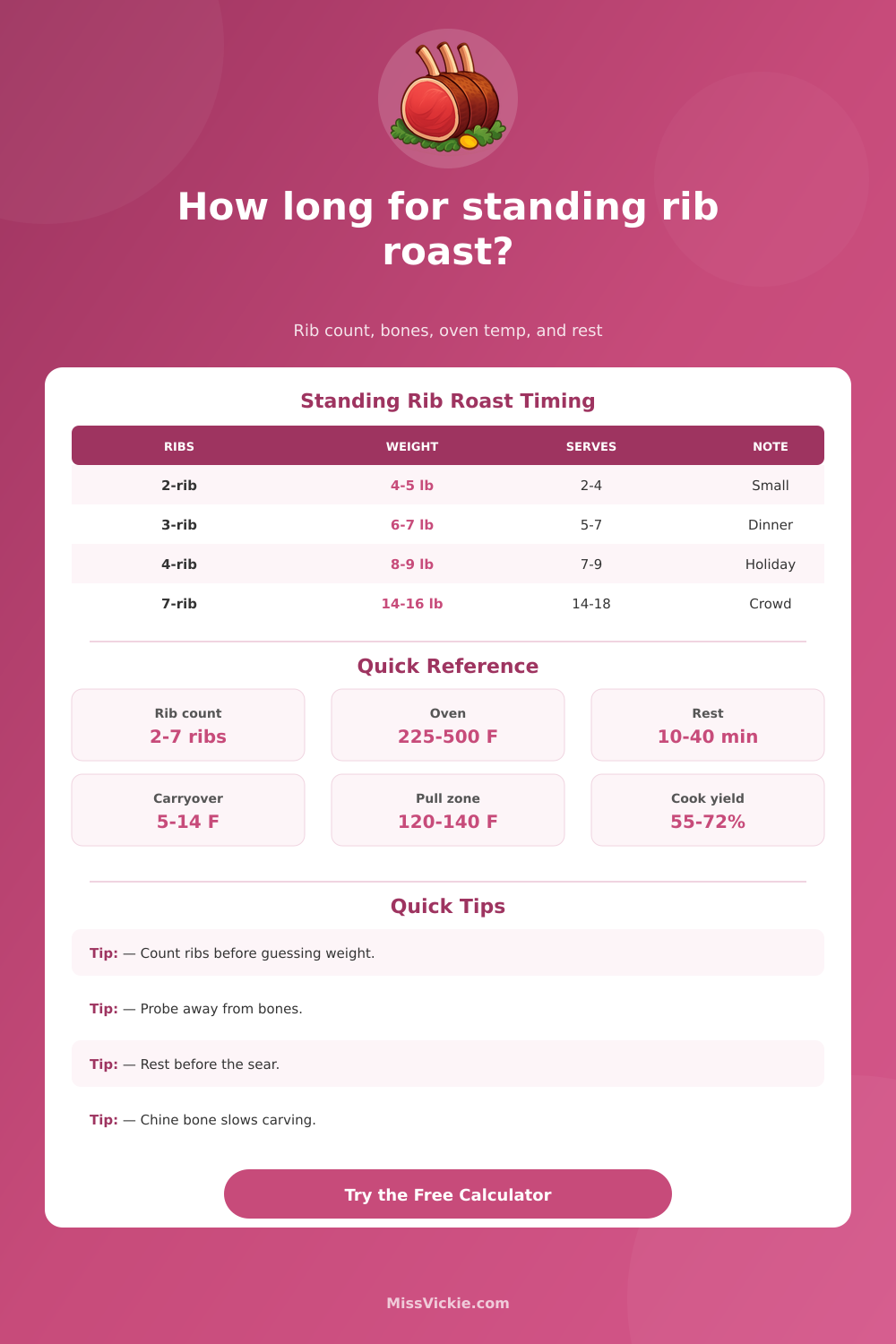
| Rib Count | Typical Raw Weight | Dinner Servings | Timing Note |
|---|---|---|---|
| 2 ribs | 4 to 5 lb / 1.8 to 2.3 kg | 2 to 4 | Small but thick enough for a roast; watch carryover closely. |
| 3 ribs | 6 to 7.5 lb / 2.7 to 3.4 kg | 5 to 7 | Classic family size with predictable center heating. |
| 4 ribs | 8 to 10 lb / 3.6 to 4.5 kg | 7 to 10 | Needs a longer rest and steadier probing near the middle ribs. |
| 5 to 6 ribs | 10 to 14 lb / 4.5 to 6.4 kg | 10 to 15 | Large holiday roast; oven recovery and starting temperature matter. |
| 7 ribs | 14 to 18 lb / 6.4 to 8.2 kg | 14 to 20 | Full standing roast; expect more carving buffer and edge variation. |
🔥 Method And Temperature Table
| Method | Usual Oven | How Time Behaves | Best Use |
|---|---|---|---|
| Reverse sear | 225 to 275°F / 107 to 135°C | Slower oven time, lower carryover, even pink center. | Medium-rare holiday roasts and precise slicing. |
| Traditional steady roast | 300 to 350°F / 149 to 177°C | Moderate minutes per pound with more edge doneness. | Simple oven plan with reliable browning. |
| High-start roast | 450°F start, then 300 to 325°F | Shorter total oven time but stronger carryover. | Well-browned outside without a separate final sear. |
| Low and slow | 200 to 235°F / 93 to 113°C | Longest cook, smallest carryover, gentle edge-to-center gradient. | Large roasts that need a long service window. |
| Convection roast | 275 to 325°F / 135 to 163°C | Faster surface drying and slightly shorter time. | Even browning when your oven fan is gentle. |
🌡 Doneness And Pull Temperature Guide
| Doneness | Final Center Target | Typical Pull Zone | Slice Character |
|---|---|---|---|
| Rare | 125°F / 52°C | 116 to 120°F / 47 to 49°C | Deep red center, very soft texture. |
| Medium-rare | 132°F / 56°C | 122 to 127°F / 50 to 53°C | Warm rosy center, classic standing rib finish. |
| Medium | 140°F / 60°C | 130 to 135°F / 54 to 57°C | Pink but more set, firmer fat cap. |
| Medium-well | 148°F / 64°C | 138 to 143°F / 59 to 62°C | Light pink to tan, more moisture loss. |
Pull zones vary with roast size, oven temperature, bone structure, and rest length; the calculator adjusts those variables directly.
⚙ Bone Structure Comparison
Most traditional presentation, but the chine bone adds carving time and a slight timing cushion.
Ribs protect the roast while the butcher cut makes carving easier after the rest.
The bones season and shield the meat but can be removed quickly for clean slices.
More even carving and higher edible yield, but less bone-side insulation during roasting.
📋 Common Standing Rib Scenarios
| Scenario | Ribs And Weight | Method | Planning Range |
|---|---|---|---|
| Small dinner | 2 ribs, 4.5 lb | Reverse sear at 250°F | About 2 hours oven plus rest and sear. |
| Family holiday | 3 to 4 ribs, 7 to 9 lb | Reverse or traditional roast | About 2.5 to 3.75 hours depending on oven temp. |
| Chine attached roast | 4 ribs, 9 lb | Traditional at 325°F | Add carving buffer and verify center with a probe. |
| Large crowd roast | 6 to 7 ribs, 14 to 16 lb | Low and slow or reverse sear | Plan a long rest; ends may cover different doneness preferences. |
💡 Standing Rib Roast Tips
But there’s a particular variety of holiday stress, experienced by the cook who’s got the bird (or, in this case, the roast). At some point, probably about 4 p.m. On Christmas Eve, you’ll notice that someone added three more relatives to the dinner plan, and your meat in the oven looks deceptively raw. On Christmas Eve, you’ll notice that someone added three more relatives to the dinner plan, and your roasted meat remain pink inside. Minutes per pound doesn’t account for the temperature it started at or how dense its bones is.
Here’s where a recipe planner enters the equation. Enter your cooking style and number of ribs into the calculator above, and it will do the math for you. It eliminates guesswork from what is actualy an exercise in thermal engineering.
Tips for Cooking a Perfect Roast
The problem most home cooks have is that they treat heat transfer as linear, but it isn’t. If there are ribs on the outside they’re getting blasted directly with heat; if there’s a layer of bone inside, it act as an insulator. If you just poke the outside, you don’t know what’s going on in the middle. That’s why the tool lets you choose your bone-in structure. Did the butcher cut and tie your ribs? Was the chine left connected? These factors affects how fast heat gets inside.
An uncut roast, held together with bones, will cook up steadily and slow. One that’s been retied will cook like a slab of steak. If you want your roast cooked evenly throughout, rather then gray at the ends and rare near the middle, that makes a difference.
You have a larger window to screw up with lower-temperature methods like reverse searing (at two hundred fifty degrees). With this technique, there’s hardly any rise in carryover heat. Take it out just shy of being cooked through and leave the rest to residual heat. It gives you a wider margin for error so you don’t overcook the middle!
With high-temp roasting (as opposed to reverse-searing), things is trickier. Because the outside cooks faster than the center, you’ll need to be on top of it. That’s a long streak of well-done meat, right around the edge, which tends to go unappreciated by diners.
Do you want precision or simplicity? Choose your poison, then use this gadget to calibrate the clock.
Weight is guessed at, so people don’t realize it’s an inaccurate guess based off rib number. Trim matters: a three-rib roast might weigh about two pounds more or less, depending on breed and trimming. Put in the real deal, after it has been trimmed.
And then there is start temp, which most recipes gloss over. If you start with a roast that has been sitting out on the counter for a while (tempering it), it will go into the oven already closer to equilibrium than if it’s just come from the refrigerator. This changes amount of time spent cooking before the outside browning begins, affecting how evenly heat spread through the roast.
But then it’s time for the rest. This needs to happen, but it often happens too fast. If you slice right away, all that juice flows out; instead of back in. Twenty minutes later, those muscle fibers has relaxed again and re-absorbed some moisture. They also let the inside of the meat rise a few more degrees. This helps you reach your goal when the roast comes off the heat. Skipping this step just means ending up with something overdone instead of the perfect medium rare.
The last challenge is carving. For a whole seven-rib roast, removing it cleanly from the chine bone (which connects all ribs) takes time. Use the planning grid on the page as a visual guide to how much trimmed waste you should plan for with each serving size. When roasting, also keep in mind that moisture loss reduces cooked weight, so most cooks is surprised when their roast weighs less once cooked. Expecting only an 80 percent yield instead of a one-to-one ratio avoids the embarrassment of not having enough left for the tardy guests.
Understanding the variables lets you have confidence. There’s a physics to this protein. There’s time. There’s heat. There are also things like probes. Why do they go away from the bone? Why don’t I just put them in the middle? Anxiety dissapears when you know why the oven isn’t on while you’re resting.
How will the roast cook itself? Just leave it alone. Sit down with your company, set up the clock and wait. Know that center is going to be cooked exactly how you want it.