Prime Rib Roasting Time Calculator
Estimate prime rib roasting time from bone-in or boneless style, roast weight, oven method, sear plan, starting temperature, target doneness, carryover heat, rest time, and sliced yield.
📌Prime Rib Presets
Choose a real prime rib setup, then adjust the weight, oven, sear, doneness, carryover, and rest for your roast.
⚖Roasting Inputs
Prime rib roasting plan
Adjust the inputs to estimate your roast window.
Timing Breakdown
Temperature Breakdown
📏Prime Rib Serving Grid
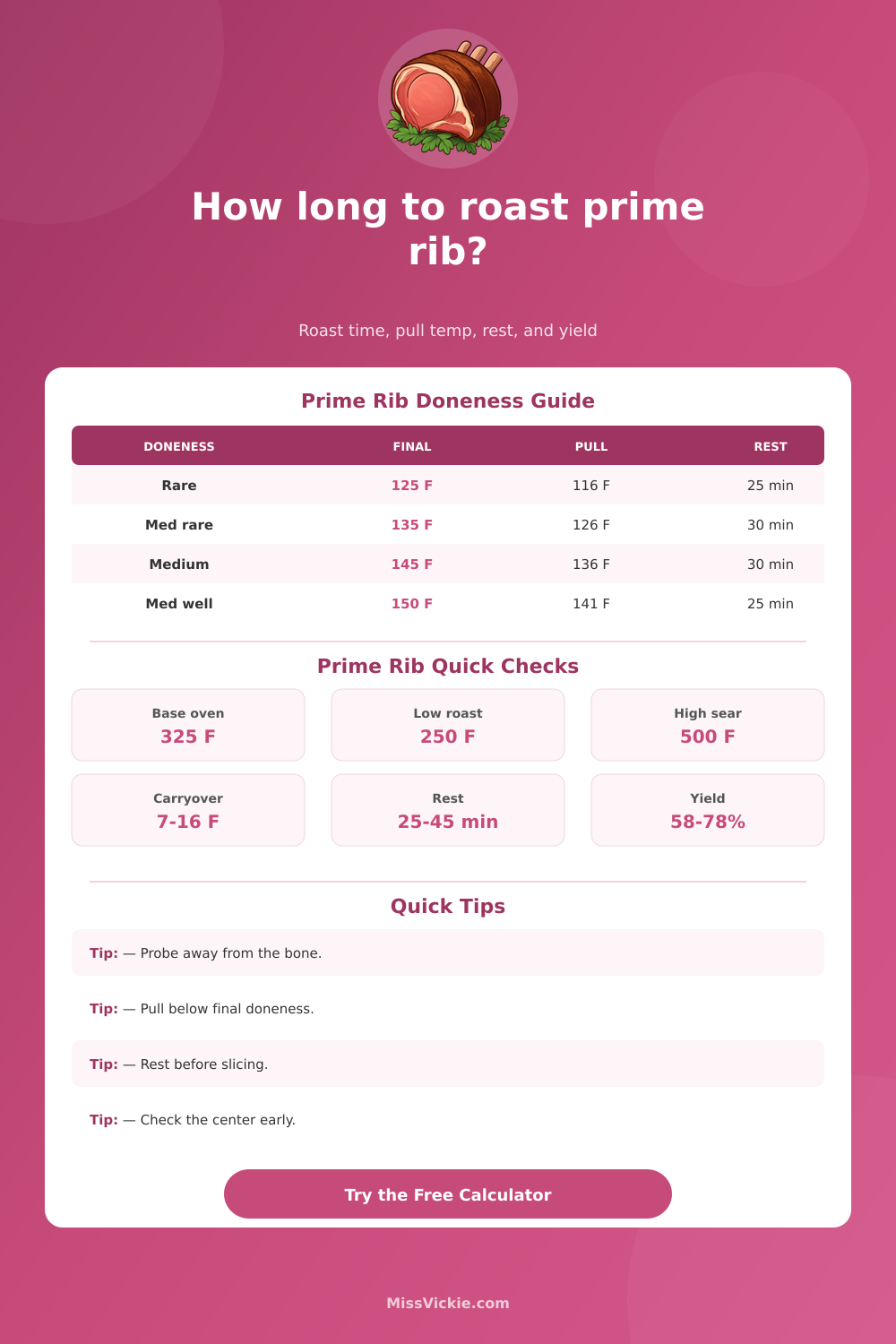
🌡Prime Rib Doneness Table
| Doneness | Final Temperature | Typical Pull Range | Center Cue |
|---|---|---|---|
| Rare | 125°F / 52°C | 112-119°F | Cool red to warm red center |
| Medium-rare | 135°F / 57°C | 122-129°F | Warm red center with rosy edge |
| Medium | 145°F / 63°C | 132-139°F | Pink center and firmer slices |
| Medium-well | 150°F / 66°C | 138-144°F | Thin pink band |
| Well done | 160°F / 71°C | 148-154°F | Little pink, firmer texture |
🔥Carryover And Rest Table
| Roast Setup | Expected Carryover | Rest Range | Planning Note |
|---|---|---|---|
| 3-5 lb boneless | 5-8°F | 15-25 min | Smaller roast cools faster |
| 5-8 lb bone-in | 8-12°F | 25-35 min | Classic holiday range |
| 8-12 lb standing rib | 10-16°F | 35-45 min | More thermal mass after pull |
| Reverse sear roast | 5-9°F | 20-35 min | Gentle oven creates less overshoot |
| High sear start | 11-18°F | 30-45 min | Hot surface drives more carryover |
🍴Yield And Carving Table
| Prime Rib Style | Cooked Yield | Raw Per Guest | Carving Note |
|---|---|---|---|
| Bone-in standing rib | 58-66% | 10-12 oz | Bone weight lowers sliced yield |
| Bones tied back on | 60-68% | 10-12 oz | Easy carving after removing bones |
| Boneless ribeye roast | 70-78% | 8-10 oz | Most consistent slice count |
| Rolled and tied roast | 68-76% | 9-10 oz | Round shape can cook a little slower |
| Cap-on rib roast | 62-70% | 10-12 oz | Rich cap shrinks and renders |
⏲Oven Method Comparison
| Method | Main Oven | Timing Behavior | Best For |
|---|---|---|---|
| Steady roast | 325°F | Balanced time and browning | Classic holiday prime rib |
| Low roast | 225-275°F | Longer but more even | Rosy edge-to-edge slices |
| Reverse sear | 225-275°F plus 500°F | Long roast, short finish | Crisp crust after resting |
| High sear start | 450-500°F then 300-325°F | Fast browning, more carryover | Traditional crust |
| Convection | 300-325°F | Often 8-12% faster | Even oven airflow |
🧭Prime Rib Comparison Grid
Bone shields part of the roast, adds flavor at the edges, and reduces carved yield.
More predictable slice count and slightly faster heat path through the center.
Best for a wide rosy center because the roast coasts less after leaving the oven.
Builds early browning, but the hotter surface usually means a larger carryover allowance.
💡Prime Rib Roasting Tips
This calculator estimates prime rib timing for planning. For safety-sensitive service, follow current food safety guidance and verify the thickest center with a calibrated thermometer.
Before we carve up our prime rib, we tend to get a little panicky. We look at clock in the oven, grab for thermometer, and wonder whether center is still ice or already gray. Then we turn to the old rules-of-thumb that don’t really work very well. This calculator does away with all of that.
It’s not about guess-work; it’s about math. It calculate how long to roast and when to stop. It also figures out how much your meat will continue to cook (carry-over), how long to let it rest, and finally how much weight you’ll end up with.
Why You Should Use This Calculator
How do you know how long? Answer: What kind of meat is it? You have to know what you’re cooking before you know how long it’ll take. A second source of error is the initial state of your roast. Most recipes assume you are taking a bone-in standing rib out of a cool refrigerator (thirty-eight degrees) and putting it immediately into hot oven (three hundred twenty-five). But maybe your roast has been out on counter for an hour while you tempered it, or maybe you remembered to late to take it out early and it’s still cold. The tool accounts for that kind of heat delay. Because the center of the roast will still be cooler, it take longer before it hits the cooking range… Delaying browning and lengthening the window.
The oven can’t read your watch; it only respond to heat transfer. But it’s not just about weight. Bone also counts; a boneless cut like a center-cut ribeye will cook different than a bone-in one like a roast. In certain parts of the dish, the bone is a heat conductor, and in other places it’s an insulator. This geometric difference mean the calculator shifts its times accordingly, accounting for how meat is shaped.
It also accounts for whether you’re using the reverse sear technique (slow-roasting at a lower temp first, then finishing with high heat). That technique yields more evenly pink band across the piece, but it take time. That technique has different tradeoffs, which the tool spells out explicitly: exactly how much extra time it’ll take if you want to go gently instead of roasting steadily at all temperatures.
Another consideration is carryover cooking. “When you take something out of the oven, it keeps cooking for a few minutes. So our tool will tell you how long to cook depending on the method and size, then will say ‘stop now,’ so when you rest it, you’ll achieve the right doneness.” For instance, taking out a roast at one hundred thirty-five degrees may look like pulling a perfectly medium-rare piece of meat, but without factoring in the nine-degrees-rise over the half-hour rest time, it will actualy be cooked to medium. That’s why folks make mistakes: They’re taking the roast out when they feel like eating rather than when it’s done.
These are shopping-list effects. Because you’ll trim away some of those rib bones when carving a roast, a bone-in cut will leave you with less actual meat on the plate. A boneless roast will retain roughly three-quarters of its raw weight (as opposed to about 60 percent for a bone-in one), as the charts show. That’s relevant to determining how many ounces of meat to purchase per person. You want to feed each guest either eight ounces of sliced, boneless meat, or ten ounces of the uncooked bone-in kind? Your shopping list depends on knowing that. The calculator crunches the figures for you.
It spares you from having to guess in real time while the clock ticks down. Cooking prime rib has nothing to do with recipes, but everything to do with controlling heat flow. You want to move the thermal energy from the outside in while trying to preserve the moisture inside. So you’ve got some tricky physics going on: resting, temperature difference, shape … and the tool controls all these factors. It provides you with a plan that respects the meat. Then it’s up to you just to trust the thermometer, remove the roast at the right moment based off the math, and then allow it to rest (without cutting into it prematurely). That confidence is far more valuable then a shortcut.
You should of used this sooner.