Pot Roast Cooking Time Calculator
Estimate pot roast timing for chuck roast, round, brisket, arm roast, and short ribs by weight, Dutch oven, slow cooker, pressure cooker, liquid, vegetables, sear, oven temperature, and tenderness target.
📌Pot roast presets
Choose a common pot roast setup, then tune the cut, weight, liquid, vegetables, sear, heat, and tenderness. Pot roast timing is a tenderness estimate; probe feel matters more than the clock.
⚙Cooking time inputs
Your Pot Roast Plan
Cook time, schedule, liquid check, and tenderness cue update as you change the inputs.
Timing breakdown
Cooking cues
📊Cut timing guide
Rich marbling and collagen make it the classic pot roast cut.
Best sliceable or gently fork-tender; it can dry if pushed too far.
Needs steady moist heat and a longer rest for cleaner slices.
High collagen pieces turn plush with less total weight in the pot.
⏱Method timing table
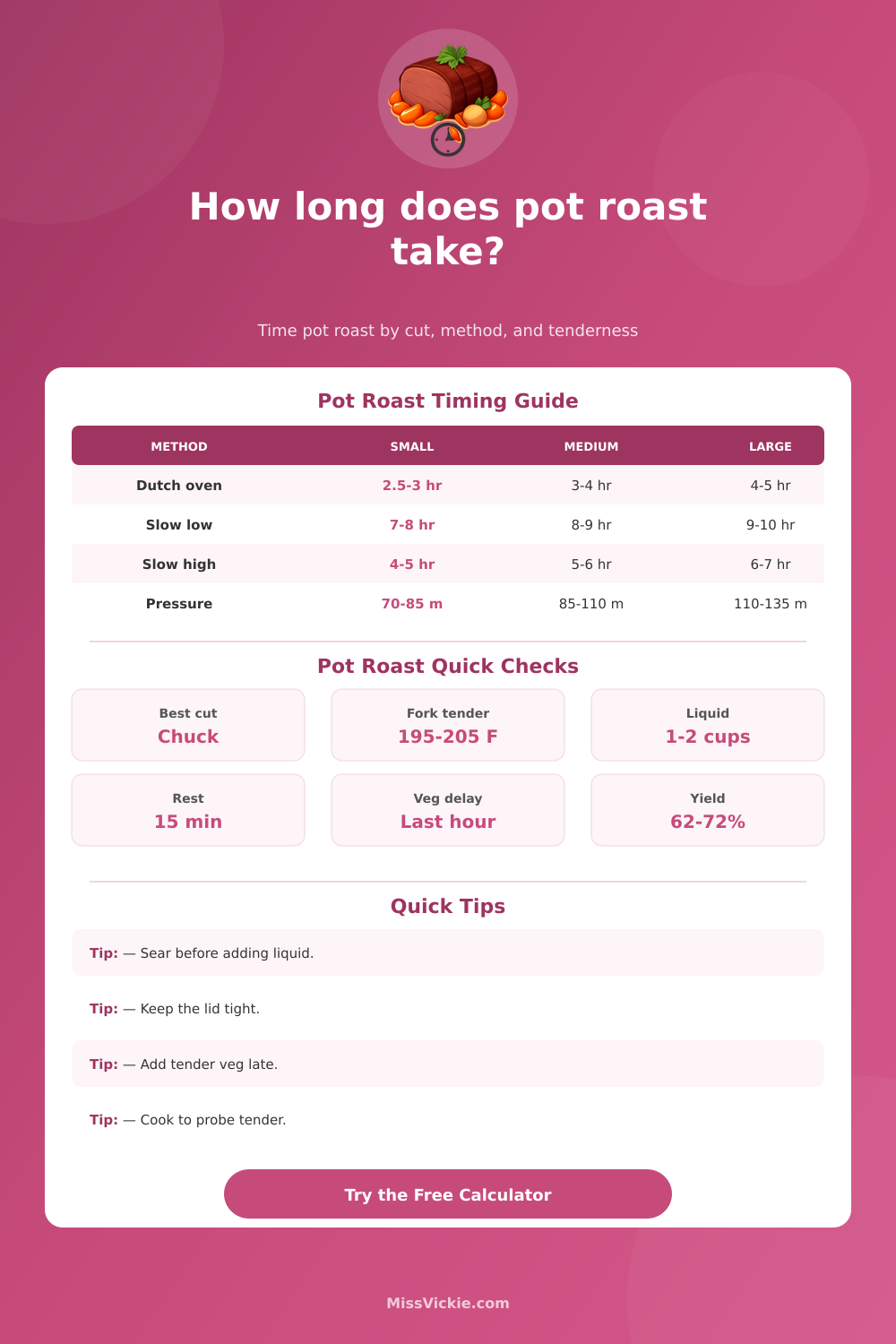
| Method | Best For | Typical 3 to 4 lb Time | Liquid Need | Timing Note |
|---|---|---|---|---|
| Dutch oven at 325 F | Classic chuck roast | 3 to 4 hours | 1 to 2 cups | Best browning, sauce reduction, and oven control. |
| Slow cooker low | Hands-off family dinner | 8 to 9 hours | 3/4 to 1 1/2 cups | Runs gently; large vegetables can go in early. |
| Slow cooker high | Same-day shortcut | 5 to 6 hours | 3/4 to 1 1/2 cups | Faster, but lean cuts may feel tighter. |
| Pressure cooker | Weeknight tender roast | 85 to 110 minutes | 1 to 1 1/2 cups | Includes pressure time and natural release in the calculator. |
| Covered stovetop | Small roasts and tight monitoring | 3 to 4 hours | 1 1/2 to 2 cups | Keep at a lazy simmer, not a rolling boil. |
🥕Vegetable and liquid table
| Pot Add-In | Add At Start | Add Late | Effect On Time | Best Move |
|---|---|---|---|---|
| Onions, celery, garlic | Yes | Optional | Small change | Use as a bed under the roast. |
| Carrots in large chunks | Yes for slow cooker | Last 60 to 90 min for Dutch oven | Adds a little mass | Keep pieces large for long cooks. |
| Potatoes | Slow cooker only | Last 60 to 75 min | Can slow center heat | Add late for cleaner texture. |
| Too little liquid | Below 1/2 cup | Not ideal | Edges dry faster | Add enough to cover the pot bottom well. |
| Too much liquid | Over half the roast | Not needed | More stewing than braising | Reduce sauce after removing beef. |
🔪Tenderness target table
| Target | Probe Range | Texture Cue | Best Cuts | Serving Style |
|---|---|---|---|---|
| Sliceable but tender | 185 to 195 F | Probe enters with some resistance | Round, rump, brisket | Slices with gravy |
| Fork-tender chunks | 195 to 203 F | Fork twists with gentle pressure | Chuck, arm, cross rib | Classic pot roast pieces |
| Shred-ready | 202 to 208 F | Meat separates easily | Chuck, short rib, brisket | Sandwiches, bowls, meal prep |
| Extra soft for gravy | 205 to 210 F | Collagen fully relaxed | Chuck, short rib | Soft beef with mashed potatoes |
🧮Preset comparison grid
Deep sear, 325 F Dutch oven, moderate vegetables, fork-tender finish.
Longest clock time but the gentlest texture for family dinner.
Best for weeknights, with natural release counted into the schedule.
Lean pot roast works best when stopped before it becomes dry shreds.
💡Pot roast tips
These estimates are for covered, moist pot roast methods. Adjust for your cookware, actual simmer strength, altitude, roast thickness, and thermometer readings.
Roasting a big hunk of meat for several hours can be anxiety inducing. Do you cook it long enough to make sure it’s tender (falling-apart-tender) but not so long that it turns to dry sawdust? That’s where the roasting calculator comes in (above). Plug in your roast size and method, and it’ll do the rest of math for you. You won’t have to guess if it needs three hours or five.
Once you enter how tender you’d like your pot roast, along with type of cut, amount of vegetable stock/liquid/broth, and any veggie included, the roaster calculates braising time. Pot roast isn’t so much a question of when the clock ticks down as it is a question of how to manage the collagen. But what else? The type of cut of beef you choose are the first thing that will change the outcome.
How to Cook Perfect Pot Roast
A chuck roast is forgiving -it’s got plenty of connective tissue that breaks down over low heat to create gelatin. A round roast, on the other hand, is leaner and has less fat to insulate it during longer cooking times. When you choose a lean cut in the tool, notice how the estimate change slightly. That tweak is accounted for by the fact that lean meats reaches their best texture quicker; so further cooking just takes away more water with minimal added tenderness. It is a small tradeoff, but it makes for a totally different dinner.
But that chemical change happens at different rates depending on how you cook. Slow-cooking methods like slow cooker offer prolonged evenness of temperature to break down those fibers over several hours; pressure cooking speeds things up by compressing them with liquid inside a sealed vessel, but doesn’t always achieve the fond development as you’d get if you seared your beef in an open pot first; and so on. The calculator factors in different levels of thermal transfer and gives you a ballpark instead of a lock-in time.
The amount of liquid used in braising can be more complex than most home cooks are aware. Although it doesn’t have to cover the entire roast, you don’t want to run out either. Steam and moist heat from below the lid do all the work of braising, so generally a cup or two of wine or broth will do. If there’s not enough, the edges will go dry while the middle continue to cook. If too much, well, you’re making soup now.
The size of the pot and quantity of vegetables help determine how much that matters. Potatoes and other root veggies (like carrots) tend to soak up heat and prevent the middle from rising in temperature as quickly. That’s accounted for in the overall timing.
In terms of timing, people think of searing as an extra flavor factor for many dishes. But a good sear will also affect how well things holds up over long cooks. It’ll create a more crusty outside to help keep everything in place. On the flip side, if you don’t do that, plan on your dish being soft all along (no need to preheat, though! This means no prep time is saved. The calculator accounts for the initial heat shock. Because of this, your final estimate will include how hot or cold you started with.
Meat is a matter of tenderness, and that’s relative. The tool prompts you with a question: how tender do you want it? Do you want something sliceable (i.e., still intact on your dinner plate)? Or do you want it shred ready (fully broken down, perfect for meal prepping and sandwiches)? Those are very different internal temps, about one-hundred-eighty-five to well past two-hundred degrees Fahrenheit. That range might account for as much as forty-five minutes more cook time. So don’t rely only on the clock; follow your fork instead. When you poke gently and it doesn’t budge, add another twenty minutes.
Clean slicing requires resting the meat. If you cut into a warm roast, you’ll have a bunch of juice on your cutting board and dry strands of fiber in its place. When you let it rest for 15 minutes, the protein fibers relaxes and pick up a little bit of that lost liquid. The time between cutting and serving can get rushed. That’s what separates a nice dinner from a memorable one.
A good pot roast is one part easy recipe, one part patient act. Thermal consistency, liquid management and cut selection are the variables that can be controlled by you. Your senses supply the finishing touches, while the calculator supplies the framework. You’re done when the fork slips into it without resistance. It’s worth more than any digital guesswork. With a good place to start, there’s no need for panic about an overdone or underdone center piece.