Roast Cooking Time Calculator
Estimate roast cooking time for beef, pork, lamb, poultry, and large holiday cuts by meat type, cut, weight, oven temperature, bone-in status, starting temperature, doneness, rest, and carryover heat.
📌 Roast Presets
Choose a common roast setup, then adjust the meat, cut, weight, oven, doneness, and resting plan to match your kitchen.
⚖ Roast Inputs
Your Roast Schedule
Cook to temperature, not just the clock.
Timing Breakdown
Roast Details
- Preheat oven fully before timing.
- Roast until the pull temperature is reached.
- Rest on a warm board or platter.
- Carve after juices settle.
📊 Roast Planning Grid
🌡 Roast Temperature Table
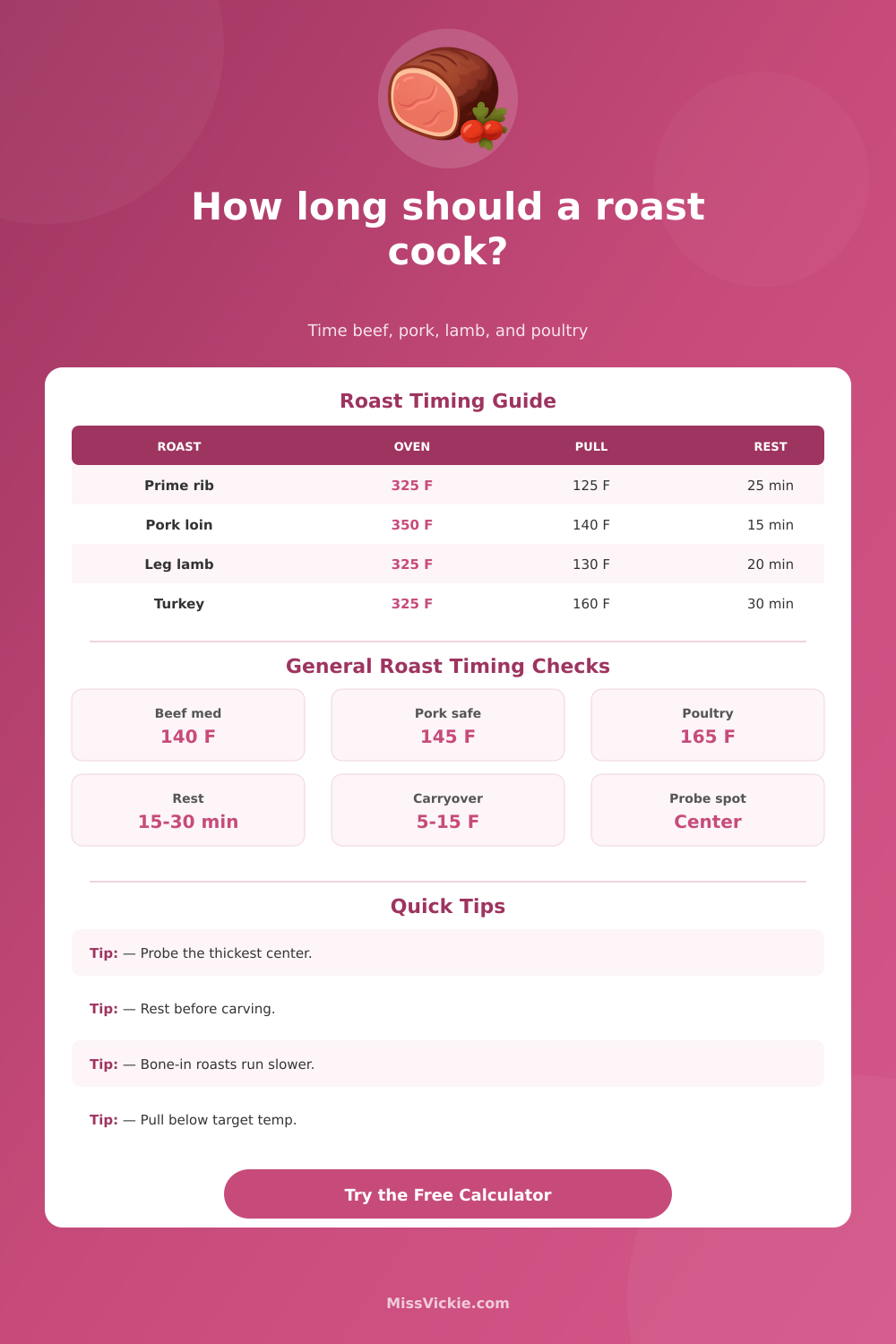
| Meat And Cut | Common Oven Temp | Pull Temp | Final Target | Rest |
|---|---|---|---|---|
| Prime rib, medium-rare | 300-325°F | 120-125°F | 130-135°F | 25-35 min |
| Beef tenderloin, medium-rare | 400-425°F | 120-125°F | 130-135°F | 10-20 min |
| Pork loin, juicy sliced | 325-375°F | 138-142°F | 145°F | 10-20 min |
| Leg of lamb, medium-rare | 325°F | 125-130°F | 130-135°F | 20-30 min |
| Whole chicken | 375-425°F | 160°F | 165°F | 10-15 min |
| Turkey breast | 325-350°F | 158-160°F | 165°F | 20-30 min |
For ground, stuffed, or previously cooked foods, follow the food-safe final temperature for that specific preparation.
⏱ Approximate Minutes Per Pound
| Roast Type | Low Oven | Moderate Oven | Hot Oven | Best Use |
|---|---|---|---|---|
| Prime rib or rib roast | 22-28 min/lb at 275°F | 16-22 min/lb at 325°F | 12-16 min/lb at 400°F | Temperature-driven finish |
| Beef tenderloin | Not ideal | 16-20 min/lb at 350°F | 9-14 min/lb at 425°F | Quick tender roast |
| Pork loin | 28-35 min/lb at 275°F | 18-25 min/lb at 350°F | 14-18 min/lb at 400°F | Juicy sliced pork |
| Pork shoulder | 70-95 min/lb at 275°F | 55-75 min/lb at 300°F | Not ideal | Fall-apart texture |
| Whole chicken | 26-32 min/lb at 325°F | 18-24 min/lb at 375°F | 14-19 min/lb at 425°F | Crisp skin poultry |
🍴 Yield And Serving Table
| Roast | Cooked Yield | Main-Course Serving | Planning Note |
|---|---|---|---|
| Bone-in prime rib | 60-70% | 10-12 oz raw per person | Bone and trimming reduce yield |
| Beef tenderloin | 78-85% | 8 oz raw per person | Little waste, rich portions |
| Pork loin | 72-78% | 7-9 oz raw per person | Rest before thin slicing |
| Pork shoulder | 55-65% | 10-12 oz raw per person | Shrinks during long cooking |
| Whole chicken | 55-65% | 1 to 1.25 lb raw per person | Includes bones and carcass |
| Turkey breast | 65-75% | 0.75 to 1 lb raw per person | Bone-in breasts yield less |
🔥 Carryover Heat Table
| Roast Size | Lean Roast | Bone-In Roast | Large Dense Roast | Rest Target |
|---|---|---|---|---|
| Under 3 lb | 3-5°F | 4-6°F | 5-7°F | 8-12 min |
| 3 to 6 lb | 5-8°F | 6-10°F | 8-12°F | 15-25 min |
| 6 to 10 lb | 7-10°F | 8-12°F | 10-15°F | 25-35 min |
| Over 10 lb | 8-12°F | 10-15°F | 12-18°F | 30-45 min |
🧮 Roast Comparison Grid
Best planned around pull temperature, carryover, and a generous rest rather than minutes alone.
Needs a lower final target and rest; overcooking quickly dries the center.
Tough connective tissue needs long time near tenderizing temperatures, not just safe doneness.
Plan around the thickest breast or thigh area and verify 165°F before serving.
💡 Roast Timing Tips
You check on that roast and realize it’s been cooking for hours because the timer was no help at all, and you panic. Meat! Physics! Geometry! Heat transfer! What do?!?
Well, you start with weight and end with calculation: Instead of trying to guess the right coefficient or conversion factor, you just plug in the oven setting and weight and let the calculator do the math. That transforms an otherwise stress-filled holiday variable into something you can fit into your schedule.
Stop Guessing and Start Calculating Roast Times
Minutes per pound is how most home cooks figure it out. But that is wrong thinking, as it fails to account for meat thickness. Two equal-weight roasts can vary greatly; one might be flat, the other lumpy, or perhaps one has bones but the other doesnt. To take that into account, tool allows you to specify whether it’s bone-in and what shape the meat is.
Since bone is an insulator, it slow down how heat moves through roast. You’re not only cooking outward, but also waiting for heat to travel inward. That’s what produces gradient between the pink within and the crisp without. Time is simply the mechanism. Temperature are the objective.
Instead of telling you your desired end-point, the calculator provides a starting point: the “pull” temperature. Carryover cooking occurs once the meat has been removed from the heat; it keeps cooking as long as it remains warm. Why? This is because the outside edges of the roast are much hotter then the interior. Once you take the roast out of the oven, all that heat moves inward as the outermost parts push their way through. On a big old prime rib, this can tack on another fifteen degrees or more.
If you wait until it hits your target temperature, you will of already overcooked it. Plan for that rise. This is one step where there’s no room for skipping resting time. While it rests, the muscle fibers relaxes and soak up any juices that were driven toward the center by the heat. Because the heat pushed them to the center. But if you slice right away, they’ll squirt out onto your cutting board and never get inside the meat.
The chart on the page shows this for various sized cut. Ten minutes or so for a small roast. Half an hour for a giant hunk. It doesn’t take long, but it makes a huge difference in mouthfeel.
Each protein has different safety concerns and doneness goals. Whole cuts of beef, for example, generally has pathogens present only on the outside, so they’re fine at medium-rare or even rarer. Ground meats and poultry should hits much hotter temperatures before you consider them safe. By varying the minimum depending on the kind of meat chosen, the calculator won’t let you request something unsafe. No rare turkey for you. If you want a juicy but safe breast, it’ll tell you when it is cooked to your liking. It will also make sure it is not overcooked. Sometimes, the difference between meat being tender and being overcooked is only five degrees.
There’s also the fact that oven itself matters. It could have convection fans, which blow air around quickly, shortening cooking time just a little bit. Pans may be covered, which keeps moisture in the meat, helping it to break down but slowing browning. The tool accounts for those differences, because if you’re operating based off a fixed assumption, you’re not actualy operating under anything at all.
It understands that your kitchen is special. Maybe your oven is running on the hot side. Or maybe your roasting pan has some insulation thanks to an inner layer of aluminum foil. All of this adds a level of change to the mix. Time should be your guide, but only your starting point. Treat the estimate as such.
Fifteen minutes before it’s done, set a timer and wait. Wait and check the thermometer. Believe the probe, not the clock. It is a combination of both temperature and time. It is the kind that gives you food worth eating. The sort where the meat, once you know its behavior during cooking, no longer scares you. You see the oven as a precise tool. This change in attitude turns the anxious host into a self-assured chef.