Pork Butt Smoking Time Calculator
Estimate pork butt smoke time by raw weight, smoker temperature, bone-in or boneless cut, wrap style, stall strategy, humidity, tenderness target, rest, warm hold, and serving time.
📌Pork butt presets
Choose a real pulled pork scenario, then adjust the weight, pit heat, wrap, stall plan, humidity, tenderness target, and hold. The clock gives a planning window; the final decision is probe tenderness.
⚙Smoking time inputs
Pork butt smoke plan
Adjust the fields to update the schedule.
Cook breakdown
Timing modifiers
📏Pork butt planning grid
🌡Smoking time by weight and pit temp
| Raw Pork Butt | 225°F No Wrap | 250°F Foil/Paper | 275°F Hot Finish | Best Use |
|---|---|---|---|---|
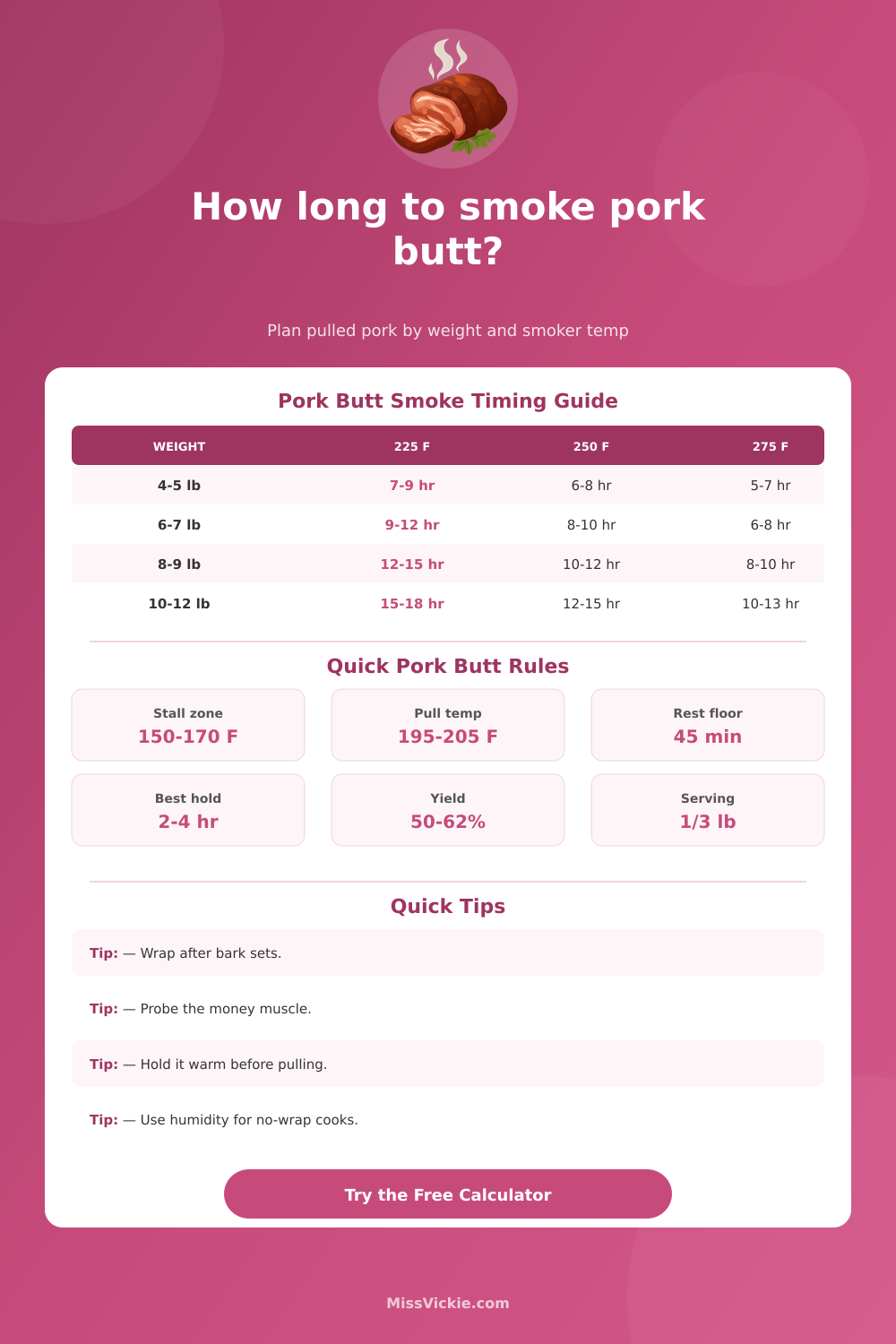
| 4 to 5 lb half butt | 7 to 9 hr | 6 to 8 hr | 5 to 7 hr | Small family dinner or test cook |
| 6 to 7 lb butt | 9 to 12 hr | 8 to 10 hr | 6 to 8 hr | Backyard pulled pork with a short rest |
| 8 to 9 lb butt | 12 to 15 hr | 10 to 12.5 hr | 8 to 10.5 hr | Classic overnight or early morning cook |
| 10 to 12 lb shoulder | 15 to 19 hr | 12 to 15.5 hr | 10 to 13 hr | Party pork or longer warm hold |
| Two 8 lb butts | 13 to 16 hr | 10.5 to 13.5 hr | 8.5 to 11 hr | Large gathering with even spacing on the grate |
Times assume steady heat, average thickness, and pork pulled when probe tender. Enter each butt's individual size when cooking multiple butts of similar weight.
📋Wrap, stall, and humidity reference
| Choice | Timing Effect | Bark Effect | Moisture Effect | When To Use |
|---|---|---|---|---|
| Foil wrap | Fastest stall push | Softest bark | Strong juice capture | Lean boneless butts or slipping schedules |
| Butcher paper | Moderate stall cut | Better bark texture | Moderate moisture hold | Balanced pulled pork texture |
| Foil pan covered | Very steady finish | Soft lower bark | Best drippings recovery | Chopped pork, catering, or sauce mixing |
| No wrap | Longest stall | Firmest bark | More evaporation | Bark-first barbecue with a wide time window |
| Water pan | Can add 3 to 6% | Softer but even bark | Protects surface | Dry cookers, windy days, or no-wrap cooks |
| Windy dry pit | Adds 8 to 16% | Can crust early | Higher drying risk | Use a buffer and avoid constant lid checks |
🍖Tenderness and yield table
| Target | Likely Finish | Probe Feel | Yield | Best Serving Style |
|---|---|---|---|---|
| Sliceable shoulder | 190 to 195°F | Some resistance | 58 to 64% | Thick slices, Cuban sandwiches, chopped edges |
| Classic pulled pork | 198 to 203°F | Loose with light push | 54 to 60% | Sandwiches, tacos, barbecue plates |
| Extra soft shred | 203 to 208°F | Very loose | 50 to 57% | Very tender pulled pork with mixed bark |
| Competition texture | 195 to 201°F | Money muscle holds shape | 55 to 61% | Slices plus pulled tubes and bark chunks |
| Long-hold friendly | 195 to 200°F | Tender but not fragile | 55 to 61% | Catering pans and delayed service |
🍽Serving yield reference
| Raw Weight | Typical Pulled Yield | Sandwich Servings | Plate Servings | Notes |
|---|---|---|---|---|
| 5 lb | 2.6 to 3.1 lb | 8 to 10 | 6 to 8 | Good for family dinner with leftovers |
| 7 lb | 3.7 to 4.3 lb | 11 to 14 | 8 to 11 | Common grocery-store pork butt size |
| 9 lb | 4.8 to 5.6 lb | 14 to 18 | 11 to 14 | Best single roast for a party tray |
| 12 lb | 6.2 to 7.4 lb | 19 to 23 | 15 to 18 | Use a long hold and a sturdy pan |
| Two 8 lb | 8.4 to 9.8 lb | 25 to 31 | 20 to 25 | Space evenly so airflow reaches both roasts |
📊Wrap style comparison
Shortens the stall most and captures juices, but bark softens during the covered finish.
Keeps bark more textured while still moving the shoulder through the stall.
Helpful for catering pans, chopped pork, or mixing rendered juices back in after pulling.
Builds the deepest crust, but needs humidity control and the widest timing window.
💡Pork butt timing tips
So don’t trust time as the only indicator of pork butt doneness. There’s no substitute for checking its tenderness with a probe. That said, there are calculators that’ll give you an idea of how long something will take, depending on both its temperature and weight. But remember: you’re breaking down collagen, which is a process that doesn’t happen at a steady rate and takes time.
The greatest hurdle you’ll have to overcome is what’s called the stall; the point between 150 and 170 degrees Fahrenheit where the inside temp won’t budge any further because moisture on the surface begins to evaporate. To combat this, some cooks begin opening the lid frequently, or turn up their heat. Doing either mess with the cooking environment. If you let the stall happen naturaly, it’ll take longer but it’ll result in better bark. If you want a quicker end result, wrap meat in paper or foil, which also means softer crust. Decide if texture is worth it to you at mealtime. If you’re making something casual, go for the crunchy exterior; if you’ve got company and people are starving, maybe get that thing finished more quicker.
Tips for Cooking Perfect Pork Butt
Thermal mass also control how fast that heat reaches center of meat, which affects cooking time by weight. An eighteen pounder will retain heat far deeper then a four pound roast long after it appear to be cooked. Your baseline hours per pound adjust according to the temperature you set in the tool. Cooking slowly at low temperatures (such as 225 degrees Fahrenheit) allows more flavor while reducing risk of burning. Cooking fast at high temperatures (over 275 degrees) will shorten cooking times but increase chance of dry edges. No one temperature are right. There are only trade-offs. Choose the time you have available or the texture you want.
Even the cut type matter. For example, bone-in butts is insulated by the bone and take a bit longer to cook but hold moisture better when held for hours. Boneless shoulder will finish faster. However, they can dry out quickly on high heat. Using two smaller cuts (two butts versus one big butt) alters airflow dynamics. You want some space between them so that heat circulates around all of it. If packed into your pit, your meat will not cook evenly and take an additional unpredictable amount of time. The calculator considers those structural differences to give you a more realistic range based off a generic rule.
Lastly, there is tenderness. Part of that’s told by temperature; the rest is told by resistance. Do you want the probe to stop at a particular degree? No. You want it to slip right in there. Some butts, at 195 degrees Fahrenheit, are tender as all get out. Others require 205. It will vary based off how old the animal was. It depends on how fatty it is and how long it rested before being smoked.
For example: If you’re going to hold your meat awhile (a few hours) in a warm oven or cooler, go with low end of that range. Mushy is what happens when pork overcooks and then holds for a long time. Tough is what undercooked pork turn into once it cools. Resting is not optional: This part allow fiber relaxation and juice redistribution. Hot meat off the puller = ½ of your flavor on the cutting board. Wrap loosely in foil or even better- a storage container designed to hold, and let stand for one hour minimum. Let it stand longer if you have a suitable holding unit. Patience here, especially with pulled pork, is frequently what separates great from good. Smoke can be rushed, but don’t rush the rest.
Plan backwards from your serve time: add in a buffer for “who knows what”, the rest time, then the cooking time. Now go brew some coffee. Set the fire up right and it’ll keep itself going. Not the clock but the meat will let you know when it’s ready. And that’s how you realy do get it right.