MissVickie brining calculator
Pork Chop Brining Time Calculator
Estimate a safe, flavorful brining window for pork chops by thickness, bone, wet or dry method, salinity, sugar, fridge temperature, chop weight, salt type, and desired seasoning strength.
Use a preset for common pork chop brining situations, then adjust the thickness, salinity, sugar, fridge temperature, and seasoning target.
Your Pork Chop Brining Plan
Calculated from chop thickness, brine method, salt strength, sugar, and fridge temperature.
Brine Breakdown
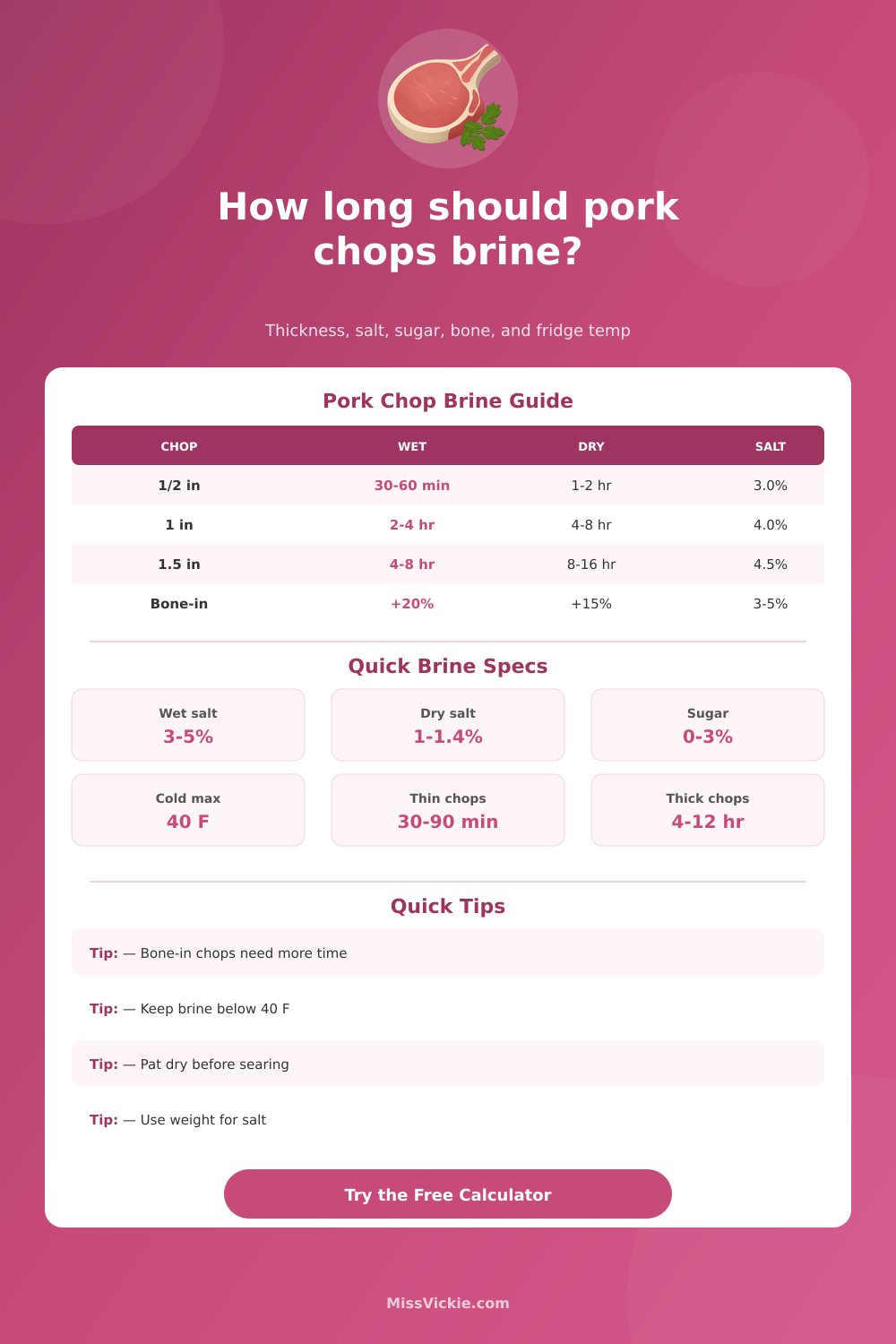
| Chop Thickness | Wet Brine Window | Dry Brine Window | Best Use |
|---|---|---|---|
| 1/2 inch / 1.3 cm | 30 to 60 minutes | 1 to 2 hours | Thin boneless chops for quick pan searing |
| 3/4 inch / 1.9 cm | 1 to 2.5 hours | 2 to 5 hours | Weeknight chops with moderate seasoning |
| 1 inch / 2.5 cm | 2 to 4 hours | 4 to 8 hours | Center-cut chops for grilling or skillet cooking |
| 1 1/4 inch / 3.2 cm | 3 to 6 hours | 6 to 12 hours | Bone-in rib or loin chops |
| 1 1/2 inch / 3.8 cm | 4 to 8 hours | 8 to 16 hours | Thick chops for reverse sear or smoking |
| 2 inch / 5 cm | 6 to 12 hours | 12 to 24 hours | Double-cut chops, especially bone-in |
| Brine Goal | Wet Brine Salt | Dry Salt Rate | Sugar Level |
|---|---|---|---|
| Light weeknight seasoning | 3.0% to 3.5% | 0.8% to 1.0% | 0% to 1% |
| Balanced pork chop brine | 3.8% to 4.5% | 1.0% to 1.25% | 1% to 2% |
| Bold grill or smoker flavor | 4.5% to 5.5% | 1.25% to 1.5% | 2% to 4% |
| Make-ahead or overnight | 3.0% to 4.0% | 0.9% to 1.1% | 0% to 2% |
| Salt Type | Approx Grams per Tbsp | Best For | Calculator Use |
|---|---|---|---|
| Table salt | 18 g | Precise brines, dissolves quickly | Smaller spoon volume for the same salt weight |
| Fine sea salt | 17 g | Wet brines and equilibrium bag brines | Close to table salt, still best weighed |
| Morton kosher | 15 g | General kitchen brining | Moderate spoon volume |
| Diamond Crystal kosher | 9 g | Dry brines and hand seasoning | Larger spoon volume for the same salt weight |
| Coarse sea salt | 13 g | Wet brines after full dissolving | Volume varies widely by crystal size |
| Fridge Temperature | Brining Effect | Time Adjustment | Safety Note |
|---|---|---|---|
| 34 to 36 F / 1 to 2 C | Slow seasoning diffusion | Add about 10% | Excellent cold holding |
| 37 to 39 F / 3 to 4 C | Normal fridge brining | No change | Ideal everyday target |
| 40 F / 4 C | Upper safe fridge target | Use shorter half of range | Check with thermometer |
| Above 40 F / 4 C | Not recommended for raw pork | Chill first | Do not extend brine time |
Good for thick chops, grill sessions, and added sugar or aromatics.
Uses less space, keeps the surface drier, and suits pan searing.
Salt is based on pork plus water in a bag, so oversalting risk is lower.
Best for 1/2 to 3/4 inch chops when dinner is close.
Unless prepared before cooking, lean pork chops is frequently a dissapearsment. They seem fine initially but when they reach safe doneness, they’re rock-hard. What’s happened? Moddern pork is very lean; there isn’t much margin for error. Cooked just until it’s safe, it’ll be dry anyway.
With brined meat however, you have water retention, which translates into difference between something tasty and something destined for the trash bin. How does brining work? It changes behavior of salt at molecular level, specifically its interactions with protein fibers. By rubbing the meat with dry salt or soaking it in a salt solution, sodium ions enters the muscle tissue and unfold certain proteins, allowing them to absorb more water then they normaly would.
How to Brine Pork Chops
As the meat cooks, heat draws moisture away from the meat. But because those unfolded proteins is able to retain it, the result is juicier meat. Brining’s a chemical shift that makes meat better-textured, yet it doesn’t involve any complicated technique.
But there’s a right time to do it… Or else diffusion won’t happen as well. Just plug in your chop thickness and desired cooking style into the calculator above and let it do the math for you. No need to guess at conversions or coefficients.
Yes, thicker chops requires longer brine times. And yes, many folks don’t realize that absorption rates varies with bone density. While salt travels through muscle fibers easy, a thick bone acts as insulated barrier that slows down the seasoning process. This means that a bone-in chop‘s thick bone becomes a seasoning wall, greatly slowing down the process different than an equally sized boneless chop. Cooking them both exactly the same will result in bland centers and overly salty exteriors.
By considering this sort of structure-based variation, the tool help you avoid under-seasoned (or over-cured) meat. Compare dry brining and wet brining. Wet brines are just what they sound like: the meat is submerged in salted water (plus other ingredients such as aromatics or sugar). Since the meat sits inside salted water, it will become more hydrated. This is ideal for something like a lean chop where you want to maintain some moisture during cooking.
The downside is that it occupies refrigerator space (and requires big container) for however long the cure needs to last. Dry brines are simply salt rubbed onto surface of the meat. It works by drawing liquid from meat at first, forming a super-concentrated layer of salt before it reabsorbs back into the meat. The result? The surface becomes drier so when your chop meets the pan it doesn’t have any extra water to boil off and prevent a good sear.
Most home cooks don’t know that different salts is not the same. Table salt has a different density and crystal structure than, say, kosher salt. By weight, one tablespoon of kosher will contain far fewer milligrams of sodium compared to one tablespoon of fine table salt. Using different salts based off volume measurements will always lead to inconsistent results.
To guarantee an accurate amount, weigh out your salt. Choose the kind of salt from the pull-down menu. The calculator then translates how much you need by weight into how much you need by volume. You won’t oversalt your food by thinking table salt is the same as kosher salt.
The key with all of this is temperature control. Raw meats are in the danger zone where bacteria can multiply. However, they’re also being kept in a brine with enough salt that it takes some time for the salt to do its job. Keeping your refrigerator at or below 40F ensures that the salt has time to work without compromising food safety. If yours runs warm, play it safe with a shorter time (the lower number on whatever time frame you see).
You should of not put pork chops on the countertop to hurry things along, the potential health risk isn’t worth the few minutes you save. When done, rinse off wet-brined chops thoroughly and wipe down any dry-brined chops. To rinse out any leftover salt, rinse the chops under water and pat them dry; if using a dry brine, simply wipe away any loose crystals on meat’s exterior.
Leave exposed in refrigerator overnight prior to cooking, which will encourage a more juicy and less spongy piece of meat, with a superior browned surface. One last touch that rewards the effort spent preparing: a well-rounded meal of thoughtfully balanced flavors and textures.