Burger Cooking Time Calculator
Estimate burger cooking time from patty thickness, weight, beef and fat blend, method, grill or pan temperature, doneness target, fresh or frozen start, smash style, rest time, and spacing.
🕒Burger Presets
Pick a common burger setup, then adjust the patty thickness, blend, heat, and doneness to match your grill, skillet, or griddle.
📏Inputs
Burger timing estimate
Set your burger inputs, then calculate.
Timing Breakdown
🌡Safe Temperature and Doneness Table
| Burger target | Internal temperature | Use case | Calculator note |
|---|---|---|---|
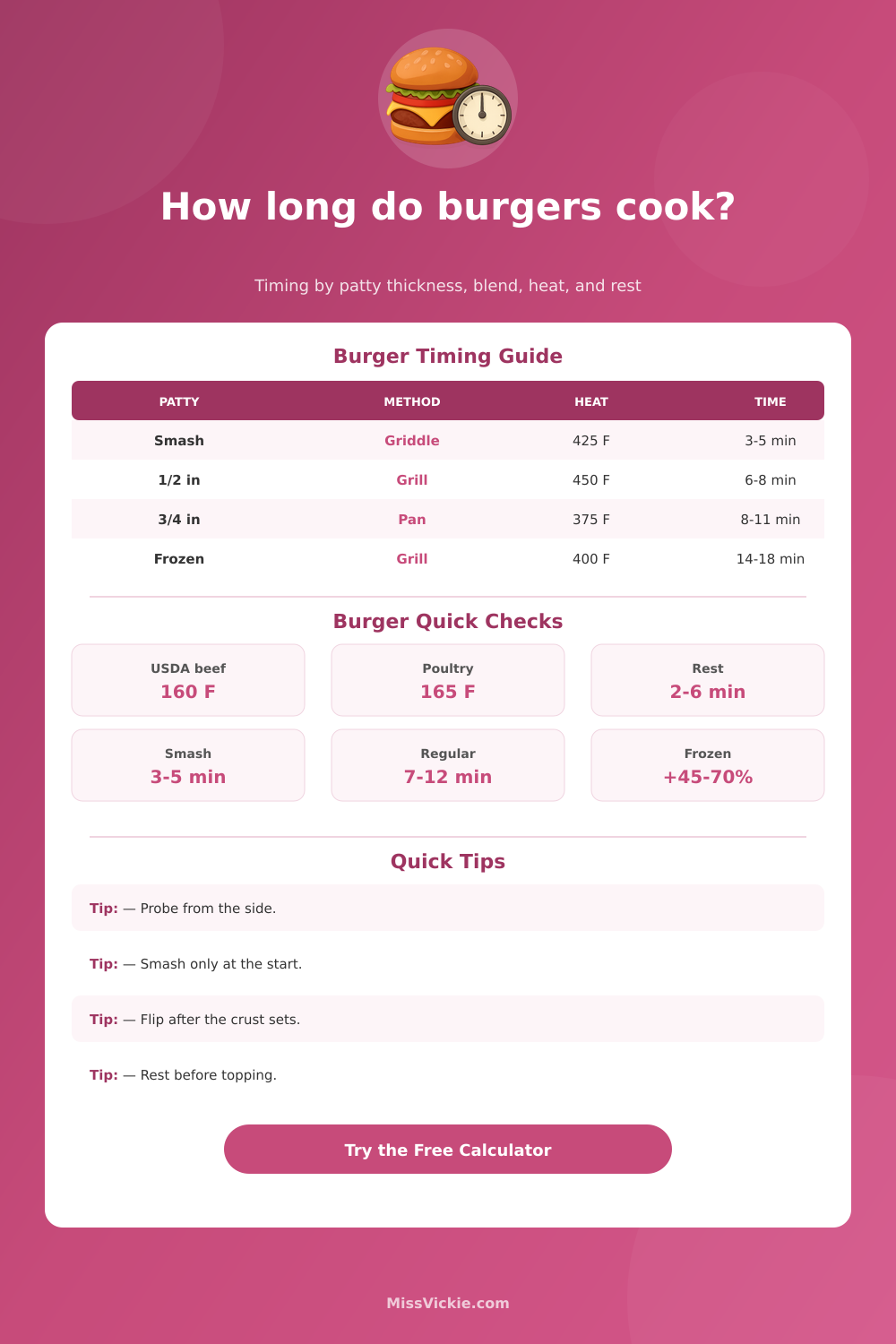
| USDA-style ground beef | 160°F / 71°C | Safest home default for beef burgers. | Ground beef color is not a reliable doneness check. |
| Ground turkey or chicken | 165°F / 74°C | Poultry patties and mixed poultry burgers. | The calculator raises the target automatically for poultry blend. |
| Medium-well beef | 150-155°F / 66-68°C | Firmer restaurant-style burger. | Below USDA consumer guidance for ground beef. |
| Medium beef | 140-145°F / 60-63°C | Pink center preference. | Use only with your own risk judgment and verified sourcing. |
| Medium-rare beef | 130-135°F / 54-57°C | Very juicy, red center preference. | Not recommended for higher-risk diners or unknown ground beef. |
Insert an instant-read thermometer through the side of the patty into the center for the cleanest burger reading.
🔥Thickness, Method, and Timing Table
| Patty type | Typical thickness | Good heat range | Approximate active time |
|---|---|---|---|
| Smash burger | 0.2-0.35 in | 425-475°F griddle | 3-5 minutes total. |
| Thin regular burger | 0.4-0.55 in | 400-475°F grill or pan | 5-8 minutes total. |
| Classic backyard burger | 0.65-0.85 in | 400-475°F grill | 8-12 minutes total. |
| Thick pub burger | 1-1.25 in | 350-425°F, often covered | 12-18 minutes total. |
| Frozen patty | 0.5-0.8 in | 350-425°F, moderate heat | 14-20 minutes total. |
🥩Beef Blend and Yield Table
| Blend | Typical cooked yield | Timing effect | Best handling note |
|---|---|---|---|
| 90/10 lean beef | 78-82 percent | Slightly faster, lower flare-up. | Avoid pressing; lean patties dry out quickly. |
| 85/15 sirloin blend | 74-78 percent | Baseline to slightly fast. | Good for regular patties and skillet cooking. |
| 80/20 chuck | 70-75 percent | Classic baseline. | Juicy with enough fat for a strong crust. |
| 75/25 brisket-chuck | 66-72 percent | Slightly slower from fat rendering. | Watch grill flare-ups and rest before serving. |
| 70/30 or wagyu-style | 62-69 percent | May need heat control. | Use room on the grill for flare-up escape. |
❄Start, Rest, and Carryover Table
| Input choice | Timing change | Carryover effect | Practical cue |
|---|---|---|---|
| Fridge-cold fresh patty | Baseline | 2-5°F after resting. | Best default for predictable burger timing. |
| Tempered 15-25 minutes | About 4-8 percent faster. | Slightly more even center. | Cook promptly after tempering. |
| Partly frozen | Adds about 25-35 percent. | Uneven center risk. | Use moderate heat and probe more than once. |
| Frozen solid | Adds about 45-70 percent. | Low early, higher late. | Start covered or indirect, then brown. |
| No rest | Needs a higher pull temp. | Little carryover. | Juices run more easily when cut or bitten. |
📊Burger Method Comparison
Best for classic 3/4-inch patties. Lid heat helps the center catch up while the grate builds smoky browning.
Strong crust and predictable contact heat. Thick patties often need a lower finish after the first sear.
Best for smash burgers and doubles. Thin patties cook quickly, so cheese and buns should be ready first.
Good backup method with top heat. Keep patties on a rack and start checking earlier than oven baking.
Convenient for small batches and frozen patties. Airflow speeds browning but can dry lean blends.
🧮Quick Burger Planning Numbers
💡Two Burger Timing Tips
At each backyard barbeque there’s a particular instant: The grilling chef stands motionless. They look down at their coals, their faces filled with terror. They are terrified of having burnt the burger, terrified of undercooking, and terrified of being wrong entirey. The problem? It’s messing up meat AND hurting your guests.
Most of us cook blindly, we wait for them to look brown on top; we flip them once they begin to smell like smoke; we use our noses as thermometers. Sometimes this method pays off, but most times it doesn’t. Heat transfer follow the laws of physics. Regardless of how hungry you are, hunger has no effect on it.
Why Using a Calculator Makes Perfect Burgers Easy
The thickness-to-area ratio determine how fast your food will cook. Heat reaches core of a half-inch smash burger quickly. It takes much longer (up to fifteen minutes or more), even when set to high. For a thick steakburger. Once you plug in your dimensions and blend, the calculator do the math for you. No need to guess whether a three-quarter inch patty requires four minutes or twelve.
Instead it factors in shape of your meat. The thickness of meat is also important; your cut of beef makes a difference. Lean muscle doesn’t conduct heat as well than fat. During grilling, the fat renders and alters the temperature surrounding the patty. Chuck blends with an eighty-twenty ratio retain their moisture and form a crust. Pushing more lean version (a ninety-ten mix) too aggressively at high temps for too long results in a dried-out disc. A lean burger behaves differently: it lose water and shrinks faster. The calculator compensates for this. If not, you end up with discs of compressed sawdust.
That’s where food safety advice and personal taste conflict: when cooking ground meats (especially ground poultry), you aim for an internal temperature of 165 degrees Fahrenheit to avoid bacteria. For beef, the USDA says to shoot for one hundred sixty just for safety purposes, but if you have confidence in your source, you could certainly take it down a little more. You can tell the calculator what temp you want to hit, and it will alert you when it’s time to remove it from the heat.
It also accounts for carryover cooking during the rest period, which you absolutely cannot skip. Cut into the burger too soon, and all of that delicious juice will end up on the plate rather than remaining within the burger. The timeline is also affected by start temperatures. If you’re cooking straight from frozen, there’s a good chance you’ll have an icy center and burnt exterior if you crank it up to high. Here’s where math comes in: frozen starts take some serious time. And they needs to be cooked gently, so the interior can thaw and reach doneness while avoiding being burned on the outside.
Tempering your meat in the fridge or letting it sit at room temperature for fifteen minutes evens out this gradient. Your final cook becomes more predictable. It is a small step but it prevents the worst outcomes.
How far apart are they spaced on the grill? That matters more than most people think. When you crowd your grates, you steam, not sear, the burgers; the ambient temperature go down. Do you have enough breathing room (the “breezy” option)? Are you packing in eight patties on a two-burner gas grill (“not breezy”)? The calculator takes that into account.
Are you squishing the burger with a spatula? You’re thinning it out. Changing its geometry, speeding up the cooking process. You save some time, you are giving up juiciness. This is a trade-off that you could of only consciously make if you understand just how much time you’re gaining or losing.
It’s not a recipe; cooking a burger is how you control the way heat moves through an object. Shape the meat, pick the fat level, then do whatever you want with that. Numbers tell you where in this range to pull them off and flip them over. Your eyes (and nose) let you know you’re home.
Stop guessing and start measuring. Stop worrying about whether you’ve screwed up the burger. You’ll just know when it’s right.