Cabbage Steaming Time Calculator
Estimate cabbage steaming time for wedges, shreds, whole leaves, compact heads, stuffed-roll prep, steam strength, batch load, altitude, pot type, density, and target tenderness.
🥬 Cabbage steaming presets
Choose a cabbage setup, then fine tune the cut thickness, head size, fresh density, basket load, steam level, altitude, and pot style.
⚖ Cabbage and steamer details
Your cabbage steaming plan
Adjust the inputs above to estimate a practical steam window.
Steam logic breakdown
Check schedule
📏 Cabbage cut timing grid
Best for warm slaw, bowls, and quick sides.
Steam until flexible enough to roll without snapping.
Rib thickness decides when the center turns tender.
Small whole heads and thick quarters need a longer window.
📋 Reference tables
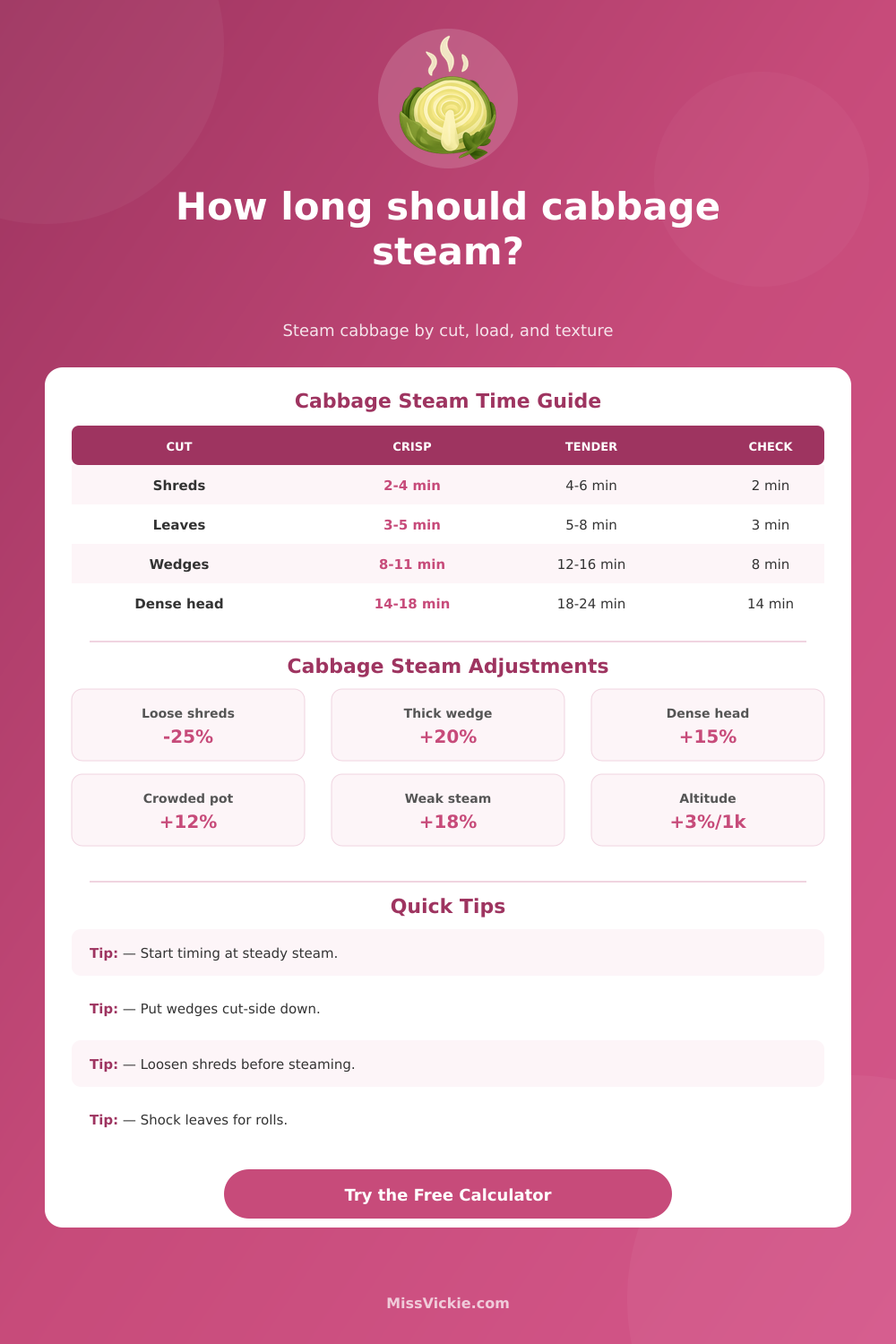
| Cut style | Typical thickness | Crisp-tender | Fork-tender | How to check |
|---|---|---|---|---|
| Loose shreds | 1/8 to 1/4 inch | 2 to 4 min | 4 to 6 min | Taste a center strand; it should bend but not collapse. |
| Whole leaves | 1 to 3 stacked leaves | 3 to 5 min | 5 to 8 min | Leaf rib should fold for rolls without tearing. |
| Small wedges | 1 to 1 1/2 inch | 7 to 10 min | 10 to 14 min | Knife should slide through the rib with light resistance. |
| Thick wedges | 2 to 3 inch | 10 to 14 min | 14 to 20 min | Center rib should be steamy and pale, not raw white. |
| Baby whole head | 3 to 4 inch head | 12 to 16 min | 16 to 22 min | Core should yield when pierced from the bottom. |
| Cabbage type | Steam behavior | Timing factor | Best doneness | Kitchen note |
|---|---|---|---|---|
| Green cabbage | Balanced leaf and rib density | Baseline | Crisp-tender to tender | Good all-purpose default for wedges and sides. |
| Red cabbage | Dense, firm leaves and ribs | Longer | Tender or soft | Add a splash of acid after steaming if serving hot. |
| Savoy cabbage | Crinkled leaves soften quickly | Shorter | Pliable or tender | Check early for rolls because leaves tear when overdone. |
| Napa cabbage | Loose watery leaves | Much shorter | Bright or tender | Drain well; it releases moisture quickly. |
| Winter storage head | Very compact layers | Longer | Fork-tender | Cut narrower wedges so steam reaches the core. |
| Steamer setup | Recovery speed | Best load | Timing adjustment | Risk to watch |
|---|---|---|---|---|
| Wide covered pot | Fast | Single layer wedges | Baseline | Water boiling dry on long whole-head cooks. |
| Narrow stockpot | Moderate | Leaves or smaller batches | Add 5 to 12% | Deep piles with raw centers. |
| Bamboo steamer | Gentle | Leaves and tender wedges | Add 6 to 10% | Steam loss around the sides. |
| Electric steamer | Slow start, steady hold | Planned batches | Add 4 to 12% | Counting time before full steam appears. |
| Microwave steamer | Fast but uneven | Shreds or leaves | Shorter, then rest | Hot spots and trapped water. |
| Batch size | Suggested raw amount | Finished yield | Pot fit | Serving note |
|---|---|---|---|---|
| 2 side servings | 1/2 to 3/4 lb | 1 1/2 to 2 cups | Small basket | Best for shreds or two wedges. |
| 4 side servings | 1 to 1 1/2 lb | 3 to 4 cups | Medium pot | Common half-head side dish. |
| 6 side servings | 2 to 2 1/2 lb | 5 to 7 cups | Wide pot | Use wedges or separated leaves. |
| 12 side servings | 4 to 5 lb | 10 to 14 cups | Large steamer | Split batches keep texture even. |
| Roll prep batch | 1 large head | 12 to 18 leaves | Deep pot | Remove leaves as they turn pliable. |
Times assume the water is already producing steady steam before timing begins. Very dense cabbage heads vary more than loose shreds.
🧪 Steam method comparison
Thin cabbage ribbons soften fast and need early checking.
Cut-side-down wedges steam steadily if the basket is not packed.
Flexible leaves matter more than a fully soft center rib.
Compact layers and core thickness need a longer covered window.
💡 Steaming tips
When you’re steaming cabbage, for instance, there’s a catch: how do you get it tender enough to consume but not so tender that it disintegrates? How do you ensure that it keeps its shape and stays bright green? How do you keep it from turning into a gooey mess? As any cook can tell you, this is sometimes as little as thirty seconds between edible and inedible; an accurate sense of how long it will take to steam can make all the difference.
Trial-and-error, or simply guessing from memory, is what most of us depend on (which explains why so many veggie are overdone and taste like wet cardboard). In effect, it lets you plug different factors into the equation, factors that affect how your food cooks, and let the calculator do all the work: It factors in the cut style: Shredded items cook fast on two sides; wedged ones need time for heat to reach inside to the rib (which is thick).
How to Steam Cabbage Perfectly
It factors in type of pot you are using and how strongly it steams: A wide pot covered with a lid will recover heat faster then a narrow stockpot crammed with ingredients. And yes, it even factors in altitude (if you live in high-elevation kitchen where water boils at a lower temperature).
Now: What does this thing spew out? It is not just one number. But what’s more honest than a range of numbers when the conditions of your kitchen can be so wildly variable from stove to stove?
Knowing what’s going on inside transforms how we think about cooking with this vegetable. Unlike other leafy greens, which go limp instantly, a head of cabbage is tightly packed layers of cellulose and moisture. If you crowd the steamer basket, you block the steam from reaching every part of the head: compressed cabbage sheds water instead of absorbing heat. The calculator adjusts for such crowded pots by accounting for the fact that compressed cabbage doesn’t absorb heat, it just sheds more water.
And it separates out types of cabbage. Green is your baseline; red is denser (and firm), meaning a longer cook until tender. Savoy has crinkly leaves and softens far sooner than the rest. Napa lets off its moisture so fast that it barely needs any time at all. The worst error home cooks make is treating them all alike.
It’s not just about serving, but about when to start checking the output. You enter your desired doneness into the tool, and it tells you when to begin. For instance, if I’m preparing cabbage rolls, I want the leaves to be flexible enough to bend rather than snap. This happens sooner then it would for cabbage wedges intended as a fork-tender side dish.
To explain: The page also includes some useful reference tables explaining how much longer thicker items take compared with thinner ones, thickness alone doubles or triples one’s cook time. A two-inch-thick wedge requires fifteen or more minutes. A quarter-inch-thin shred cooks up in minutes. These times depend on density and surface area.
The time computed will be an estimate, not a rule. Remember to begin timing once you see steady steam, not when the water boils (which makes a big difference). The calculator assumes that you’re beginning at refrigerator cold rather than room temperature. But that doesn’t mean it’s not time to check. How do things look? Have any changed color yet? Poke it with a knife or a fork and see how it feels.
When you’re steaming just the leaves for something like rolls, pull them off in stages as they tenderize. Don’t wait until the entire head softens. If you do, you’ll be way too late for what people call the middle. You might get it wrong by thinking the entire thing can be harvested all at once, like a layer.
Another factor that can screw up your dinner: altitude. If you’re over three thousand feet above sea level, you’ll have to cook longer before veggies is at the same interior temp. This is because the boiling point goes down and heat doesn’t transfer as well from steam. You just punch in where you live, and it takes it into account without you even thinking about it. It is a little thing that goes a long way toward getting consistant results.
The bottom line: Steaming cabbage is all about control. It’s a matter of breaking down some tough fiber with heat and moisture, without killing off flavor or structure. And knowing which factors; variety, cut size, pot shape… Influence that process means no more guesswork. You would of no longer walk into the kitchen on your knees saying a prayer. Now you have a plan. Your attention keeps it together, but the math helps.