Artichoke Steaming Time Calculator
Estimate artichoke steam time from globe size, diameter, trimming, whole or halved prep, steamer style, water depth, altitude, target tenderness, and basket load.
🍲 Artichoke Steaming Presets
Choose a common artichoke setup, then adjust the trim, prep shape, water level, altitude, and crowding for your pot.
⚖ Artichoke and Steamer Details
Your Artichoke Steam Plan
Timing begins when the pot is producing steady steam.
Timing Breakdown
Cooking Cues
- Bring water to full steam before starting the timer.
- Check the stem with a paring knife near the early end.
- Pull one outer leaf; it should release with gentle resistance.
- Rest covered off heat for 5 minutes if the heart is close.
📌 Key Artichoke Steam Factors
Width predicts the dense heart and stem timing better than weight.
Cut faces expose the core to steam and shorten the full window.
Each 1,000 feet adds time as steam temperature drops.
A covered rest evens the heart without turning outer leaves mushy.
📊 Artichoke Size Timing Table
| Artichoke Size | Typical Diameter | Whole Steam Time | Halved Steam Time | Best Use |
|---|---|---|---|---|
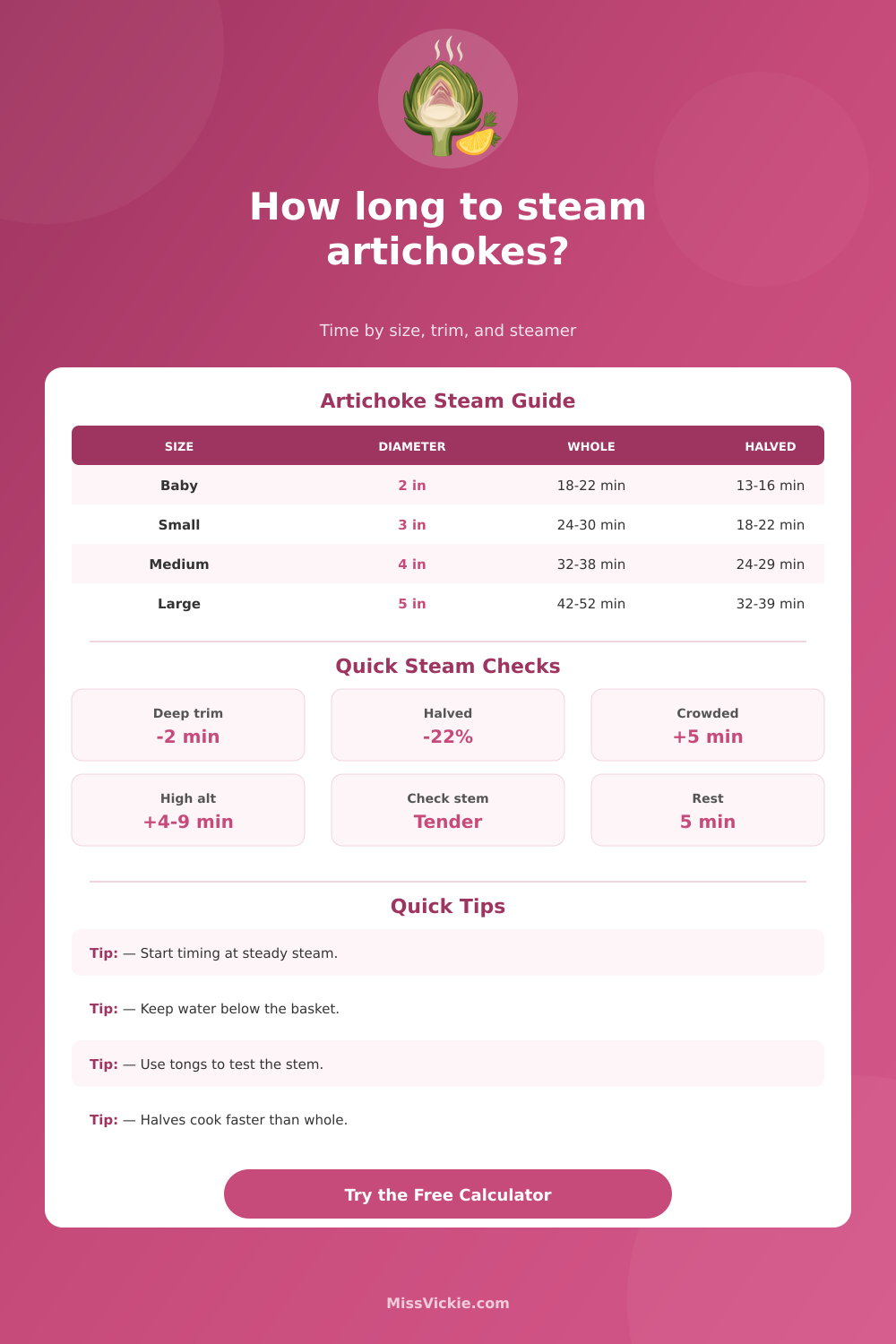
| Baby artichokes | 1.75 to 2.25 in | 18 to 22 min | 13 to 16 min | Appetizers, antipasto, quick sides |
| Small artichokes | 2.5 to 3.25 in | 24 to 30 min | 18 to 22 min | Individual sides and salad plates |
| Medium artichokes | 3.5 to 4.25 in | 32 to 38 min | 24 to 29 min | Classic dipping artichokes |
| Large artichokes | 4.5 to 5.25 in | 42 to 52 min | 32 to 39 min | Main-course vegetable plates |
| Jumbo artichokes | 5.5 in or wider | 52 to 62 min | 39 to 47 min | Stuffing, sharing, very meaty hearts |
✂ Prep and Trim Adjustment Table
| Prep Choice | Timing Effect | Texture Effect | Best Check Cue |
|---|---|---|---|
| Whole, standard trim | Baseline | Even leaves and protected heart | Outer leaf pulls with gentle tug |
| Halved lengthwise | About 22% faster | Heart cooks sooner; leaves stay a bit firmer | Knife slides through stem center |
| Quartered | About 34% faster | Fastest access to the choke and heart | Core bends easily at the base |
| Deep top trim | 2 minutes faster | Less leaf mass over the heart | Leaf and stem tests should agree |
| Long peeled stem | 3 minutes longer | More edible stem, slightly longer core cook | Test the thickest stem end |
💨 Steamer, Water, and Altitude Table
| Condition | Adjustment | Why It Matters | Kitchen Note |
|---|---|---|---|
| Metal basket, tight lid | Baseline | Fast condensation and steady steam | Keep water 1 inch below basket |
| Bamboo steamer | Add 3 min | More venting and gentle heat transfer | Use a wide pot or wok for stable steam |
| Electric steamer | Add 4 min | Slower recovery after loading | Preheat until steam is visible |
| Low water level | Add 4 min | Steam can weaken before the heart softens | Use hot water for refills |
| 5,000 ft altitude | Add 17% to 20% | Steam is cooler as boiling point drops | Check tenderness, not just the clock |
🍽 Batch Load Reference Table
| Basket Setup | Good For | Timing Add | Water Reserve |
|---|---|---|---|
| Loose single layer | 1 to 3 large artichokes | 0 to -1 min | 1.25 to 1.5 cups |
| Full single layer | 4 medium artichokes | Baseline | 1.5 to 2 cups |
| Crowded basket | 5 to 8 small artichokes | Add 5 min | 2 to 2.5 cups |
| Two-tier steamer | 8 to 12 baby artichokes | Add 7 min | 2.5 to 3 cups |
| Jumbo sharing pot | 2 to 4 jumbo artichokes | Add 3 to 6 min | 2.5 cups minimum |
🔍 Whole vs Halved Comparison Grid
Best presentation and most protected leaves. Use for dipping with intact petals.
Best when you want a shorter cook and easier choke removal after steaming.
Good for small artichokes, salads, and chilled plates where shape matters less.
Opened leaves and filling restrict steam paths, so the heart needs extra time.
💡 Artichoke Timing Tips
Use the calculated window as a starting range. Harvest age, leaf density, and stem thickness can shift a large artichoke by several minutes.
Artichokes make you nervous because they seem complicated to cook. They makes you think you are getting something fancy, so you purchase them, but then standing by a pot of bubbling liquid, you’re not sure how long to let them go. Is it 20 minutes? Is it an hour? That’s too short or maybe it’ll turn the heart into a blob?
The confusion isn’t you. It’s that most people assume that all artichokes requires equal amounts of steaming, and they don’t. Not even close. What happens with a small California-grown globe versus a big Spanish one? And what about whether you trimmed the stems? Altitude matter, too. Letting the computer calculate the time takes the guess out of it. It adjusts for factors no human eye can judge well.
How to Cook Artichokes Perfectly
The biggest variable is size (diameter, not weight). If the leaves are loose, even though it’s heavy, the inside could be packed with air pockets. On the other hand, if it’s light, its dense interior need to soften up before coming apart. Once trimmed, enter the true width into the calculator. After chopping off those thorny tips, take your measuring tape to the widest point of what remains.
Why? Because it’s precise, and remember, steam comes in from the outer perimeter inward. If the stem connects the outermost leaves to the inner heart through an inch or two of meaty substance, it will take longer for heat to travel all the way to the middle. Guess wrong on the diameter and you’ll end up with chewy leaf that resist easy separation.
How does prep style affect the process? A whole steamed artichoke keeps delicate interior leaves out of contact with water. This maintains both their shape and texture but also traps cold air inside the crown. Keeping that cold air in the artichoke increases the cooking time.
If cut in half, the heart and choke will be exposed directly to the stream. This decreases its mass, requiring about twenty percent less time for heat to reach the center. Because the tool is designed to adjust automatically for this change, cutting an artichoke in half should of been done when time is limited and you need a quicker side dish.
Leave them whole if presentation is more important than speed, but be prepared to wait longer. One unexpected factor here is trimming. A lot of folks simply slice it off flat at the bottom, but if you peel away that stringy exterior part (you can eat that, too), you increase your edible part without increasing your cooking time. And deeper trimming also reduces those layers of leaves as well as the distance food has to steam. When making several batches, shaving two minutes apiece makes a big difference.
To account for such subtleties, the calculator doesn’t give one number… But instead a window during which you check for doneness. Why? Because an artichoke from dry ground will require slightly longer cooking time than one that is plumper and becomes tender sooner.
If you are above sea level, then you know that cooking changes with altitude. The boiling point of water is lower. This makes steaming cooler and less aggressive. Everything cooks slower in high-altitude cities such as Denver. The tool handles this fact of physics by adding minutes. If it doesn’t adjust for altitude, your artichokes will be firmer different than tender. People who live in the mountains should not skip the altitude input.
I also found out that water level is important. More so than many realize. You should put the bottoms in boiling water and the tops in steam. If the water reaches up into the artichokes, they cook oddly. The bottom part ends up being too mushy, and the top part remain uncooked. Keep the water under the basket.
The amount of reserve needed depends on the size of your batch, which is why there are reserves suggested by the batch-size calculator. The bigger the batch, the longer it takes to cook so the bigger the water volume must be to sustain steam pressure throughout. Otherwise, the food will dry out/burn before cooking through as the water evaporates and the temperature spikes.
To tell when they’re done: Go by feel. Insert a paring knife at the base of each stem. Knife should slide right in; there will be some resistance though it shouldn’t be hard. If you hit wood, wait longer. Tear back one of the outermost leaves. Does it come away easily (with a little pull), exposing softer interior flesh?
Let the artichokes rest off the heat for several minutes so that any remaining steam can redistribute itself throughout the heart without cooking the outside leaves too much. It’s not rocket science; it’s all about managing conditions, rather than any exact timing, when steaming artichokes. Maintain even heat, keep things moist, and be patient. Let the steam hiss and the leaves soften (and let the calculator worry about the nitty-gritty). Go by what you see and hear, rely on your knife test, not the clock.
After you no longer see each artichoke as exactly alike but instead begin to appreciate its unique internal arrangement, it’s that easy. And then making perfect artichokes becomes a no-fuss habit rather than a source of stress.