Green Bean Steaming Time Calculator
Estimate green bean steaming time from bean thickness, whole or trimmed prep, batch size, steamer type, fresh or frozen state, doneness, lid tightness, steam strength, and altitude.
🍲 Green Bean Steaming Presets
Choose a common green bean setup, then fine tune the thickness, batch load, lid fit, frozen state, steamer recovery, and target texture.
⚖ Beans and Steamer Details
Your Green Bean Steam Plan
Run the calculator to estimate steam time, first check time, serving yield, and texture window.
Timing Breakdown
Steaming Schedule
🫘 Bean Size Reference
Thin haricots verts cook quickly and overcook quickly.
Good for bright, crisp side dishes and cold salads.
Most supermarket green beans fall near this range.
Older or large beans need more time to become tender.
⏱ Fresh Green Bean Timing Table
| Bean Thickness | Bright Crisp | Tender-Crisp | Tender | Soft |
|---|---|---|---|---|
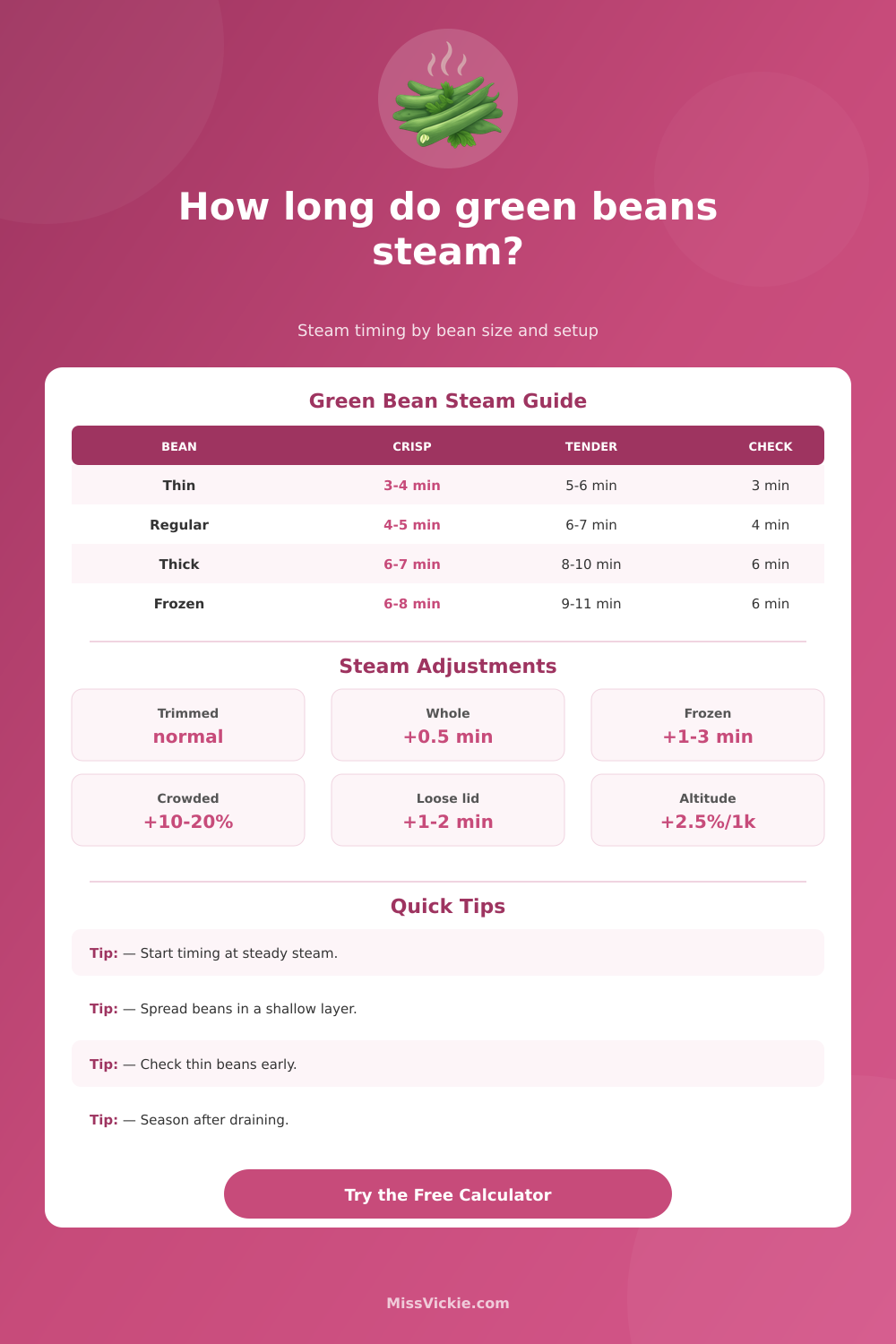
| French or very thin, 0.10 to 0.15 in | 2.5 to 3.5 min | 3.5 to 4.5 min | 5 to 6 min | 6.5 to 8 min |
| Slender beans, 0.16 to 0.22 in | 3 to 4 min | 4 to 5.5 min | 5.5 to 7 min | 7 to 9 min |
| Regular beans, 0.23 to 0.29 in | 4 to 5 min | 5 to 6.5 min | 6.5 to 8 min | 8 to 10 min |
| Thick mature beans, 0.30 to 0.40 in | 5.5 to 7 min | 7 to 8.5 min | 8.5 to 10.5 min | 10.5 to 13 min |
Times assume steady steam, a covered pot, and beans spread in a single layer. Taste one bean before draining the full basket.
🔥 Steamer and Batch Adjustment Table
| Setup | Time Effect | Why It Changes | Best Use |
|---|---|---|---|
| Stovetop basket | Baseline | Fast steam recovery when water is already boiling. | Most weeknight batches |
| Bamboo steamer | Add 5 to 10% | Bamboo absorbs heat and vents lightly. | Gentle, even texture |
| Electric steamer | Add 10 to 15% | Many units cycle steam and recover slowly after loading. | Hands-off batches |
| Multi-tier stack | Add 15 to 25% | Upper tiers get softer steam and lower tiers are crowded. | Large family sides |
| Microwave steamer | Subtract 5 to 10% | Contained steam heats a small batch quickly. | Small portions |
| Crowded mound | Add 10 to 20% | Center beans are shielded from direct steam flow. | Toss once midway |
❄ Fresh, Frozen, and Prep Table
| Bean State or Prep | Multiplier | Kitchen Cue | Texture Note |
|---|---|---|---|
| Fresh, room-temperature rinsed | 0.96x | Steam penetrates quickly after washing. | Best color retention |
| Fresh, refrigerator-cold | 1.00x | Use normal timing from the calculator. | Most common setup |
| Frozen loose beans | 1.25x | Add time for thawing and steam recovery. | Softer than fresh |
| Frozen icy clump | 1.45x | Break apart before loading if possible. | Can cook unevenly |
| French-cut or split beans | 0.75x | More surface area heats very quickly. | Check early |
| Pre-blanched beans | 0.70x | You are reheating more than cooking. | Season right away |
⛰ Lid and Altitude Table
| Condition | Adjustment | What To Watch | Fix |
|---|---|---|---|
| Tight lid at sea level | No change | Steady steam and bright color. | Check near the early time. |
| Vented or loose lid | Add 8 to 22% | Steam plume escaping from one side. | Cover tighter or extend time. |
| Opened midway | Add about 10% | Steam cloud drops after peeking. | Toss quickly and reseal. |
| 3000 ft altitude | Add about 8% | Steam is cooler than at sea level. | Use the check time, then taste. |
| 6000 ft altitude | Add about 15% | Softening takes longer. | Keep water at a rolling simmer. |
| 9000 ft altitude | Add about 22% | Timing can feel surprisingly slow. | Use a tight, heavy pot. |
📊 Green Bean Texture Comparison
Snappy, vivid green beans for salads, vinaigrette, or reheating later.
The classic side-dish target where beans bend but still pop.
Better for buttered beans, garlic sides, and mixed vegetable platters.
Useful for casseroles, younger diners, or very thick mature pods.
💡 Green Bean Steaming Tips
White steam rises in the steamer basket; you hover above it, and think: Should I take those green beans out yet? Or will it be one more minute before they’re just right? And what’s “just right,” actualy? There’s only a small window of time from crisp-tender to grossly mushy (sometimes just under a minute). Guesswork is what most home cooks must resort too.
You might take a quick taste-test of one green bean, have second thoughts, and pluck a bean a few seconds to late. Plug in your steaming vessel and how thick your beans are into the calculator above. Now the equation do all the work for you. You won’t have to wonder or worry about this recipe. It becomes a surefire routine.
How the Bean Calculator Works
Green beans is not all the same. Know this about your beans: Not all green beans are the same. A thicker, more mature pod offers more structure than a narrow haricot vert. To deal with this difference, the tool asks you to enter approximate diameter of your produce. Why does it matter? Because heat takes time to penetrate the vegetable’s cellulose walls. Cook a half-inch-thick bean as if it were a slender salad green and you’ll get a raw, chalky middle. Overcook thin beans, on the other hand, and they turns slimy and gray. The thickness you input tells the system just how long it should of take to cook down to the center.
But what about the condition of your ingredients? Fresh beans don’t have any thermal lag; they start softening immediately, whereas frozen beans need time, first, simply to thaw. So that’s factored in: additional minutes if they’re frozen loosely and potentially more if they’ve been packed into icy blocks. The calculator factors in trimming of stems, too. Beans cooked whole take longer than those cut up because cutting them increases the exposed surface area, which speeds up their cooktime. That’s why whole beans in a pot will take considerably longer different than halved beans in the same pot.
The same goes for the gear. An electric model might cycle its steam output differently than a stovetop bamboo steamer, which vents slightly and absorbs some heat. And if you live at a high altitude, forget about it: the physics shift completely. Because there’s less atmospheric pressure, steam cools more quickly, which means that water won’t boil until it reaches a temperature under two hundred twelve degrees Fahrenheit. Depending on your elevation, the tool knows that it will take longer to get the desired softness; it’s just smart enough to realize that it’ll happen more slowly in Denver than it will in Miami. And that keeps things from being undercooked up top.
The device even prompts you to input what kind of doneness you’re after: Soft? Snappy and bright? Because maybe you’re making a salad. Maybe you have some picky eater in the house who like their beans extra-soft. That could mean two minutes’ worth of steaming time makes all the difference between vegetable purée and a side dish worthy of popping onto your plate. It doesn’t sound like much. But it’s enough. And thanks to this thing, there are no more hunches about where on that scale you’d find yourself, just as there will never be another guess at when dinner is done.
Instead: Let the machine do all the thinking for you, but listen with your other senses. When the steaming begins, get out the timer; once the strength has reached a good point, start it. This is not “when you put the cold beans in the boiling water.” To test doneness, take a sample bean from the middle (not from the side, which will be done) at the suggested check time indicated above and have a chew. If it’s right for you, dump into a strainer. If not, wait another half minute, and repeat. Season when drained, not beforehand, or the seasoning and salt will just slip off onto the cooking liquid.
Boiling beans is okay but it doesn’t retain as much color and nutrition as steaming does because the vitamins leech from the bean during a longer cooking time. It’s also a tender way to cook them without losing their grassy taste. You’ll never have to guess again. Just account for your kitchen’s differences and make beans confidently. They are always tender (with the perfect snap) and bright green, waiting to be tossed into a bowl of lemon or butter. When you know what to expect every step of the way, that critical decision on the stovetop gets less complicated.